
Updated: January 10, 2026
Why do we need to save endangered species? Of what use are wildlife nearing extinction to the human race? This article lists four reasons why we should save endangered species.
Some people do not understand the importance of keeping a healthy population of animals or plants on the planet. This article, therefore, aims to provide a deeper understanding of the need to preserve endangered species.
Why should we save endangered species?
Here are four principal reasons why everyone should do their share in conserving these valuable natural resources.
Table of Contents
The Four Reasons Why We Should Save Endangered Species
The following are the four reasons why we should save endangered species thus gain the potential benefits from plants and animals that may be facing extinction:
1. Medicinal value
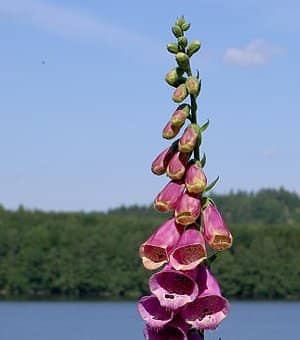
The drug digitalis, derived from purple foxglove (Fig. 1), prevented the death of millions of people. Digitalis is used to treat congestive heart failure (CHF), fluid retention, irregular heartbeat, asthma, epilepsy, tuberculosis, headache, constipation, headache, and spasm. It can also heal wounds and burns. Withering (1785) described the healing properties of the plant as early as the 18th century.
This observation means that if one plant species gets extinct, the potential benefits, such as a source of medicine, will be forfeited.
However, many plants may be nearing extinction without our knowledge. These plants could contain thousands of important compounds that can lengthen the human lifespan.
Plants are not the only sources of medicine. Animals have medicinal properties, too.
Here is a list of animals and their medicinal uses:
- leeches – secretions prevent coagulation and inflammation, microcirculation disorders elimination, restores organs and tissues, removes hypoxia or inadequate oxygen in the tissues, and decreases blood pressure (Shakouri and Wollina, 2021)
- vipers – elements in their venom control blood pressure
- scorpion – brain tumor research uses its venom
- shark – utilized in the study of certain forms of cancer and muscle degeneration
- bees – honeybee products prevent microbes from thriving
- lizards – secrete a toxin that may benefit diabetes sufferers (Ault, 2004)
- frog – produces compounds that prevent infection
2. Agricultural value
Wild species of plants can be a source of essential genes to improve crops that are grown today. Among those genes that scientists splice from plants’ DNAs are pest or disease resistance, salt tolerance, and drought resistance. These properties can help counter the effects of global climate change.
While there are concerns about genetic engineering products such as genetically modified organisms (GMOs), these products helped attain food security. People have had reliable access to a sufficient quantity of affordable and nutritious food.
For example, genetic material from a wild corn species stopped a leaf fungus that previously wiped out 15% of US corn crop. Thus, more crop production ensued by rapid production of corn that can resist diseases. Technological innovations as well as research and development ensure food security.
Animals such as gecko and spiders are also important natural pest control agents. Geckos feed on at least five different kinds of pests, while spiders are known to prey on cockroaches.
3. Ecological value
Have you heard the famous quote: “No man is an island?” No man stands alone? A song was even composed about this truism on human social behavior.

Just like humans, an individual plant or animal could not live by itself. It has to interact with the other organisms as well as its environment to survive.
Removing one animal or plant species from the ecosystem will compromise the life of other organisms that interact with it. Animal or plant extinction can drastically change an ecosystem.
According to the U.S. Fish and Wildlife Service, one lost plant species can lead to the loss of 30 other insects, plant, and other animal species found in the higher levels of the food chain. These individual species of plant or animal are sometimes called the keystone species. If that species is removed, the whole ecosystem will be changed drastically.
Examples to illustrate this importance of endangered species and how they link with other organisms are the following:
- northern spotted owl – health indicator of the ancient forest of the Pacific Northwest
- gray wolf – controls the population of the elk
- killer whale – affects the diet of bald eagles (see Fig. 2)
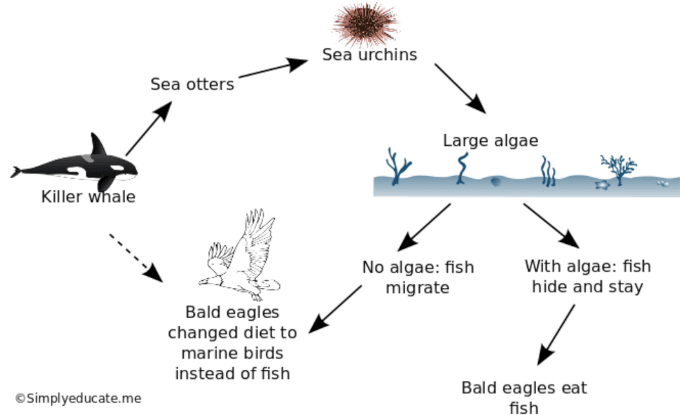
The illustration shows the food chain dynamics in Alaska. If killer whales (Orcinus orca) deplete the population of otters, the population of sea urchins will increase. Overfeeding of large algae by sea urchins will leave no place to hide or breeding places for fish that in turn will migrate to other areas.
Once the fishes migrate, the bald eagle population switches their diet to marine birds. In this case, it appears that the keystone species are the sea otters. Thus, if killer whales deplete the population of sea otters, the bald eagle’s diet will change. The change in the diet of the bald eagle affects other species in the coastal and marine ecosystems.
If killer whales deplete the population of sea otters, the diet of the bald eagle will change. The change in the diet of the bald eagle affects other species in the coastal and marine ecosystems.
4. Bequest value
Leaving out a legacy for the next generation is a desirable value. We want our children to enjoy the benefits that could be gained from wildlife species, not only of their mere existence, but also for the potential benefits they can provide. We call that the bequest value.
Here is a video from Above the Noise for more reasons we should save endangered species.
How to Save Endangered Species
Endangered animals and plants, considering the four reasons why we should save endangered species, must be conserved by all means possible. Doable initiatives include the following strategies:
- reforestation to counter rapid deforestation,
- rehabilitation of degraded lands,
- sustainable harvesting of timber (e.g. sustainable forestry) and other natural products,
- pollution reduction and prevention,
- waste reduction and management, and
- development of innovative strategies to conserve endangered species.
Can you think of other ways to conserve endangered species? There may be other reasons why we should save endangered species that you know. Please share your ideas in the comment section below.
References
Ault, A. (2004). Ventures with venoms: several toxin-based products are in the running as treatments for cancer, stroke, and diabetes. The Scientist, 18(19), 43-45.
WebMD, n.d. Digitalis. Retrieved on May 23, 2014 from http://goo.gl/VvlfYD
Withering, W. (1785). An account of the foxglove, and some of its medical uses: with practical remarks on dropsy and other diseases. Classics of Medicine Library.
Shakouri, A., & Wollina, U. (2021). Time to Change Theory; Medical Leech from a Molecular Medicine Perspective Leech Salivary Proteins Playing a Potential Role in Medicine. Advanced pharmaceutical bulletin, 11(2), 261.
Zoo Granby, 2014. Why protect endangered species… So what? Retrieved on May 23, 2014 from http://goo.gl/6zFiZn
FAQ: Four Reasons Why We Should Save Endangered Species
Q1: Why should we care about saving endangered species?
There are four main reasons: medicinal value (many species contain compounds for treating diseases), agricultural value (wild species provide genes for improving crops), ecological value (species are interconnected and removing one affects entire ecosystems), and bequest value (preserving wildlife for future generations to enjoy and benefit from).
Q2: What are some examples of medicines derived from endangered or rare species?
Digitalis from purple foxglove treats heart conditions, leech secretions prevent blood coagulation, viper venom helps control blood pressure, scorpion venom is used in brain tumor research, and lizard toxins may benefit diabetes sufferers. Frogs produce infection-preventing compounds, and honeybee products have antimicrobial properties.
Q3: How do endangered species help with agriculture?
Wild plant species provide essential genes that can be spliced into crops to improve pest resistance, disease resistance, salt tolerance, and drought resistance.
For example, genetic material from a wild corn species stopped a leaf fungus that previously destroyed 15% of the US corn crop. Animals like geckos and spiders also serve as natural pest control agents.
Q4: What is a keystone species and why does it matter?
A keystone species is one whose removal drastically changes an entire ecosystem. According to the U.S. Fish and Wildlife Service, one lost plant species can lead to the loss of 30 other insects, plants, and animal species in higher levels of the food chain. Examples include the northern spotted owl, gray wolf, and killer whale.
Q5: What practical steps can we take to save endangered species?
Key strategies include reforestation, rehabilitation of degraded lands, sustainable harvesting of natural resources, pollution reduction and prevention, waste reduction and management, and development of innovative conservation strategies.
Q6: How does saving one species affect other animals in the ecosystem?
Species are interconnected through food chains. For example, if killer whales deplete sea otter populations, sea urchin numbers increase, which leads to overfeeding on algae. This destroys fish habitats, causing fish to migrate, which then forces bald eagles to switch their diet to marine birds, affecting multiple other species in coastal and marine ecosystems.
© 2014 May 23 P. A. Regoniel
1. if they have their medical value, we don’t need to protect them. Think about if 1 specie that can kill cancer. People will pay whatever price to make the environment to breed them. do we need to protect them? Do we need to protect chicken even we kill so many a day? For the unknown, they may have value or may not, so, it is gamble with less than 50% chance. How about let them go and free the spot for new species. the new species can provide them same for that purpose. Furthermore, we already have some data of the current species, so, have new specie can provide even more chances. With our technology, we can clone them back later after we collect they cells. So, let more species exist on earth will provide a bigger bank of data.
2. We have less and less species on earth since many years. how about our agriculture? We actually produced more and more. Look at the market. how many new product can you fine? Compare the number with 100 years ago, how many more gain did we produce today? If they have value, human will make it out and keep it. Why do you think human work so hard to develop all kinds of technology? Money talks. Without bees, if that kind of plants can sell a good price, the farmers will touch the flower 1 by 1.
3. Why do we need to care about all species can live. if one out and the whole chain out. it only means 1 thing. that whole chain didn’t fit. With human or not. there are species extinct anyway. So, many years since life exist on earth, we still have life on earth with countless specie appear and disappeared. It is just a cycle or mother nature. As above, we can keep them in zoo or collect their cells and clone later. If 1 species can only eat 1 other species to live, it is clearly that specie needs to change their diet. If they can’t make the change, whose fault?
4. Our children? There are many species extinct even before human exist, so what is the different that our children can’t see some species anymore? How will that change their life? Actually, our children may benefit from not protect them. They can still see some from zoo. how many people actually see animal on wild instead or zoo? Do you want your children to meet a tiger in wild because you want them to see how tiger looks other than from the books? We can already clone some animals now. In the future, we can do even better for sure. Also, keep animal in wild will take so much land. Will you think we will have more human living on earth in the future? with our medication technology, we sure will. that means we need more farm land, more space to build house. Do you want your children live in a bigger house or a cubicle? I am sure most people wants a bigger house. We have no choice but occupy more land. Unless you are animal lover that put animal’s life over human, so you want to kill most human to empty space for animals, this can’t be changed. Let the new animal that can fit into human’s life is one of the limit solution. We already have many of them like dogs, cats, rats…
Human is a part of nature. There is no any species work to protect other species in purpose. Why should we force ourselves to do that? If you love animal and don’t want to hurt them, you don’t have to. However, please let other people choose what they want to do. We are on the top of food chain, it is our right to choose our food. We should not ask everyone to have the same food because it is your favor food.
Do you want there to be no animal diversity? Do you want the eco system to collapse? Are you an idiot, there are so many animals that we can’t survive without. Like frogs, they account for 10% of noble prize awards for human medicine. Do you want your kid to be healthy or be dead? Who the hell cares if you live a cubicle or not. Imagine if you were a animal and your home was being destroyed so humans could “Live in a bigger house”. Everything has a purpose and a role in the food chain. If we destroy that there will be no food chain and oh look that we won’t be at the top of the food chain, we’ll be dead. Nice spelling and puncntuation by the way ignoramus.
But were not one of those species.
please more info.
Even though that is just rude, you are right. For example, if we killed off all animals and humans became extinct, you know what would be left on earth? Only the 10% of plants that don’t rely on creatures for pollination.
I thought it was very cool to see the different medicinal values of all the different animals
sure ! from all corners of the world and from my all observation I came to find that every species depend on each other.
I love animals and I think they should be protected dont you?
im dead on inside help!
save goats from muslims! she succ
thanks for the information
Thanks for the information 🙂
noice, thanks, its very helpful in my speech for this year. =)
Q. What are congresswomen doing about water shortages for US citizens? A. They support more water shortage by failing to fix broken immigration system. “As immigration continues to drive the United States population higher, the demand for water continues to rise, yet the availability continues to decline. For example, a study out of Columbia University found that massive droughts in the Southeastern United States in 2007-2008 were due to the region’s exploding population, which posed “the root of the water supply problem.v
Q. Are congresswomen who want to abolish ICE concerned about endangered animals in USA? A. NO. Overall, there are over 1,300 endangered or threatened species in the United States today and as a growing population demands more and more resources — from farmland to residential real estate to urban sprawl — these species will have fewer places to live.
Q. Are congresswomen concerned about illegal immigrants hurting Americans who drive? A. No. They don’t even know how that cause and effect works. As immigration continues to fuel population growth, more and more cities will feel the strain of overcrowding that New York City is already experiencing, making mass transportation far more arduous.
Q. Is AOC, the big GREEN DEAL darling concerned about the ozone effect from illegal immigration in USA? A. Nope. U.S. immigrants produce an estimated 637 million tons of CO2 annually, which is 482 million tons more than these immigrants would have produced had they remained in their home countries.
Do politicians care about animals? Then they should care that illegal aliens are involved in wildlife trafficking, a $10 billion industry that harms vulnerable animal populations and brings various endangered species closer to extinction. The most commonly trafficked endangered animal seizures into the United States are coral parrots and lizards Of the 4,968 live endangered animal seizures, 257 have been of animal species that face a threat of extinction. What other animals do illegal aliens crossing US border smuggle in? They smuggle in rare breed puppies, kittens, wild jungle cats and kittens torn from the mothers in the wild, sea turtles, baby bobcat kittens torn from mothers in wild, jungle birds, snakes, spider monkeys, praiirie pups, Iguanas, Toucans, baby Anteaters, Margays (small wildcat), etc…But yeah, go ahead and support those intelligent politicans who think there’s nothing wrong with illegal immigration.
In May 2018, for example, three aliens crossed the border into Texas with a black duffel bag, which they abandoned when they realized there were Border Patrol agents nearby. When agents searched the bag, they discovered an UNCONSCIOUS TIGER CUB. Imagine how many other vulnerable animals are smuggled across US borders daily without anyone knowing!! Everyday in the USA, on our borders, it happens. And politicians do nothing about it. Have you ever heard Pelosi give a damn about these animals? She’s so disconnected from cause and effect reality she wouldn’t know. She’s another barricaded elite with her fenced and gated home with bodyguards carrying guns. Living in an ivory tower. Looking down at the dumb Americans who vote for people like her. Does Pelosi, AOC or any of these champions of illegal aliens care about these animals? Nope. That’s why we need an effective border wall, more mass deportations (to discourage further illegal crossing) and more border patrol officers to stop attempts to cross illegally into USA. The animals are depending on us to do something.
Still more, Illegal aliens throw their trash in the cacti among the desert turtles. Desert Turtles have been exposed to batteries, cell phones, clothes, human food, homemade weapons, human waste, jeans, medications, radios, razors, ropes, soap, and water bottles, according to Daily Star reporter Tony Davis. In short, desert animals and plant life have been trampled and harmed by illegal aliens. But CNN won’t show that, right? Fox news doesn’t even show it. Who is speaking up for these defenseless animals!? Politicians don’t care about the animals involved in illegal immigraiton because animals don’t vote.