
Learning how to write a concept paper is one of the most important milestones before jumping into a full thesis or research study. If you’ve ever wondered what a concept paper actually is—or why advisors insist on reading one before you draft a full proposal—this guide breaks down everything you need to know.
Table of Contents
What is a Concept Paper and Why Do You Need It?
Before jumping into how to write a concept paper, it helps to understand its core definition and purpose.
What is a concept paper?

A concept paper is a concise document (typically 1 to 5 pages) that outlines the foundation of a proposed research project, thesis, or program before committing to a full manuscript. It summarizes your core ideas, theoretical grounding, and proposed methodology so advisors or review panels can evaluate the feasibility of your study early on.
Key Reasons to Write a Concept Paper in Research:
- Saves Time & Effort: It prevents you from writing a 50-page proposal only to discover your core topic or methodology needs to be completely redone.
- Clarifies the Thesis Statement: It forces you to define your core research question clearly.
- Provides Early Feedback: Your review committee can give structural guidance while the scope is still flexible.
Whether you are studying computer science, social sciences, or education, knowing how to make a concept paper in research ensures your project starts with clear direction and academic rigor.
What is a Concept Paper? 3 Essential Elements & Step-by-Step Guide
There is no single rigid template for writing a concept paper, as forcing ideas into strict boxes can limit critical thinking. However, every effective research concept paper must include three primary elements:
1. The Rationale
The rationale explains why your proposed study is necessary. When drafting this section, address these core questions:
- What gap in knowledge or real-world problem prompted this study?
- Why is this issue significant to your field?
- What specific outcomes or contributions will your study produce?
2. The Conceptual Framework
A conceptual framework serves as the roadmap for your entire study. An excellent way to map out complex ideas before writing is through a mind-mapping exercise.
A mind map visualizes relationships between variables, terms, and key concepts. Using tools like XMind allows you to structure your research variables visually before translating them into prose.
Visualizing Your Ideas: Creating a clear mind map helps organize your independent and dependent variables seamlessly, making the writing phase significantly easier.
Need a better way to organize your ideas before writing?
Read the Complete Guide: How to Create a Mind Map for Research →3. The Research Hypothesis
Once your conceptual framework is defined, formulate your hypotheses. A hypothesis states the expected relationship between the variables identified in your framework.
Ask yourself:
- How are these variables interconnected?
- Does changing one variable directly impact another?
To ground your hypotheses in existing literature, use academic search engines like Google Scholar and the Directory of Open Access Journals (DOAJ) to verify how similar variables have been tested in prior studies.
Need reliable literature to support your concept paper’s rationale?
Complete Guide: How to Use Google Scholar for Research →Examples of Research Hypotheses:
- There is no significant difference in Wi-Fi signal attenuation when passing through wood versus metal barrier materials.
- There is no significant difference in web browsing load time when using a 10 MB cache setting versus a 100 MB cache setting in Mozilla Firefox.
With these essential elements established, let’s proceed to the 5 key steps on how to make a concept paper, complete with concrete examples from a research project where I led a team focusing on sea level rise.
5 Key Steps on How to Make a Concept Paper
If you are ready to assemble your draft, follow these quick structural steps.
The main research topic for the example given here is ‘coastal community adaptation to sea level rise.’
Step 1. Write the Title: Draft a concise, descriptive title containing your main variables or research topic.
Example Title
Coastal Community Adaptation to Sea Level Rise: Vulnerabilities, Strategies, and Resilience
Example Introduction & Rationale: Define what is the concept paper all about in the context of your specific research problem and justify why the project matters.
This research project matters because escalating global sea levels pose an immediate threat to low-lying coastal populations, critical infrastructure, and local economies.
This study establishes why understanding local adaptive capacities is vital for mitigating displacement, protecting coastal ecosystems, and guiding evidence-based municipal planning before investing time in an extensive thesis or research manuscript.
Step 2. Present the Conceptual Framework of the Study. Write a structured narrative linking your study’s core concepts and present the research paradigm.
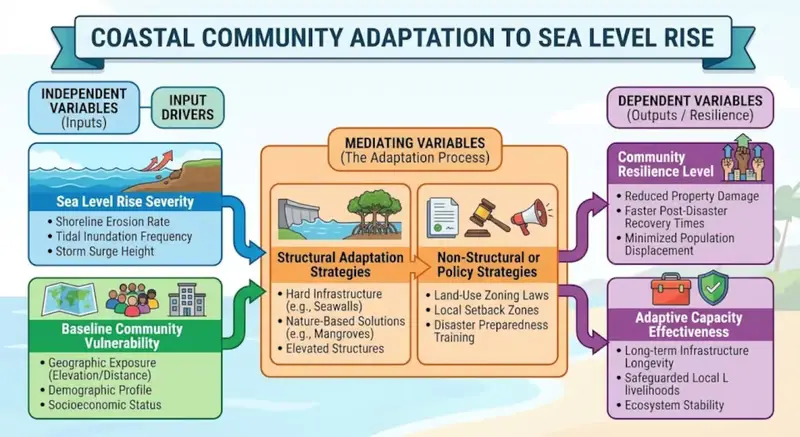
Example Conceptual Framework and Research Paradigm
To study “coastal community adaptation to sea level rise,” the conceptual framework of this study examines the cause-and-effect relationship between environmental stressors, community responses, and ultimate resilience outcomes using an independent-dependent variable structure.
Struggling to map out your study’s variables?
Read the Full Guide: How to Identify Variables for Your Research →1. Independent Variables (The Core Drivers / Inputs)
The independent variables represent the primary conditions and external stressors that act upon the coastal zone, triggering the need for adaptation:
- Environmental Stressor (Sea Level Rise Severity): Measured by indicators such as rate of shoreline erosion, frequency of tidal inundation, and storm surge height.
- Baseline Community Vulnerability: Includes demographic profile, geographic exposure (elevation and distance from the coastline), and socioeconomic status of the residents.
2. Mediating Variables (The Adaptation Process)
These variables represent the active measures undertaken by the community or local government units in response to the independent variables:
- Structural Adaptation Strategies: Implementation of hard infrastructure (e.g., coastal erosion prevention techniques such as seawalls, elevated residential foundations, mangrove afforestation or reforestation).
- Non-Structural/Policy Strategies: Enforcement of local setback zones, land-use zoning laws, and community disaster preparedness training.
3. Dependent Variables (The Intended Outcomes / Resilience)
The dependent variables measure the resulting condition or level of success achieved as a result of the adaptation strategies applied to the independent variables:
- Community Resilience Level: Measured by reduced property damage, shorter post-disaster recovery periods, and decreased long-term population displacement.
- Adaptive Capacity Effectiveness: The degree to which the implemented strategies successfully safeguard local livelihoods, infrastructure longevity, and ecosystem stability against rising sea levels.
The conceptual framework uses an independent-dependent variable structure to examine how coastal communities adapt to sea level rise. It models how environmental stressors (such as shoreline erosion and flooding) and baseline community vulnerabilities directly prompt structural and policy-based adaptation strategies.
Consequently, it evaluates how these combined adaptation actions influence dependent outcomes, specifically measuring community resilience, reduced property damage, and overall adaptive capacity.
Example Research Paradigm on Coastal Community Adaptation to Sea Level Rise
Ready to design your study’s roadmap?
Step-by-Step Guide: How to Make a Conceptual Framework →Step 3. State the hypotheses and Research Objectives. Clearly state your null/alternative hypotheses and primary research goals.
Example Research Hypotheses
Null Hypotheses (H₀):
H₀1: There is no significant relationship between baseline community vulnerability (geographic exposure and socioeconomic status) and the adoption of structural or non-structural adaptation strategies.
H₀2: Structural adaptation strategies (e.g., seawalls, mangrove restoration) have no significant effect on reducing property damage and post-disaster recovery times in coastal communities.
H₀3: Non-structural and policy strategies (e.g., zoning laws, disaster preparedness training) do not significantly contribute to enhancing overall adaptive capacity effectiveness or community resilience against sea level rise.
H₀4: The mediating adaptation strategies do not significantly influence the impact of sea level rise severity on long-term population displacement and community resilience levels.
Alternative Hypotheses (Hₐ):
Hₐ1: Higher levels of sea level rise severity and baseline community vulnerability significantly drive the implementation of structural and policy-based adaptation strategies.
Hₐ2:The combination of structural and non-structural adaptation strategies significantly enhances community resilience, reduces property damage, and improves long-term adaptive capacity effectiveness.
Example Research Objectives
- To assess the environmental stressors and baseline community vulnerabilities associated with sea level rise in coastal communities (including shoreline erosion rates, tidal inundation frequency, geographic exposure, and socioeconomic status).
- To identify and analyze the adaptation strategies implemented by residents and local government units, categorized into:
- Structural Adaptation Strategies: Hard infrastructure (e.g., seawalls, elevated residential foundations) and nature-based solutions (e.g., mangrove restoration).
- Non-Structural or Policy Strategies: Land-use zoning laws, local setback zones, and disaster preparedness training.
- To evaluate the level of community resilience and adaptive capacity effectiveness resulting from the implemented structural and policy-based adaptation strategies.
- To determine the significant relationships or effects between environmental stressors/vulnerabilities (independent variables), adaptation strategies (mediating variables), and resilience outcomes (dependent variables).
Step 4. Present the methodology overview. Provide a brief summary of your intended research design, data collection methods, and analytical tools.
Example Methodology Overview
This study employs a mixed-methods sequential explanatory design to evaluate coastal community adaptation to sea level rise, combining quantitative assessments of vulnerability and resilience with qualitative insights into local adaptation actions.
- Research Design:
- Quantitative Phase: A cross-sectional survey design will measure independent variables (perceived sea level rise severity and baseline community vulnerability) and dependent variables (community resilience levels and adaptive capacity effectiveness).
- Qualitative Phase: Key informant interviews (KIIs) and focus group discussions (FGDs) will provide contextual depth on the mediating variables (structural infrastructure and non-structural policy implementation).
- Target Population and Sampling Strategy:
- Study Site: Selected coastal barangays/municipalities experiencing documented shoreline erosion and frequent tidal inundation.
- Sampling: A stratified random sampling technique will be used to select local residents (N = 300) across varying proximity zones from the shoreline. Purposive sampling will be applied to select local government units (LGUs), disaster risk reduction officers, and community leaders for qualitative interviews.
- Data Collection Instruments:
- Structured Survey Questionnaires: Utilizing Likert-scale items to assess community vulnerability, perceived impact of sea level rise, and levels of household resilience.
- Field Documentation and Institutional Records: Archival data on shoreline erosion rates, historical storm surge events, and municipal land-use zoning maps.
- Semi-Structured Interview Guides: To document LGU policy enforcement, challenges in seawall maintenance, and mangrove restoration initiatives.
- Data Analysis Tools:
- Descriptive Statistics: Frequency distributions, means, and standard deviations to profile baseline vulnerabilities and adaptation strategy adoption.
- Inferential Statistics: Multiple linear regression and structural equation modeling (SEM) to test the null hypotheses regarding the relationships between environmental stressors, mediating adaptation strategies, and community resilience outcomes.
- Thematic Analysis: Used to analyze qualitative transcriptions from interviews and focus group discussions.
Want to organize your variables, objectives, and methods seamlessly?
Step-by-Step Guide: How to Make a Research Matrix for Your Proposal →Step 5. Expected Outcomes and References. State the expected outcomes of the research and include the literature that you have read as references in constructing the concept paper.
Expected Outcomes Example
This study anticipates producing the following key outputs and contributions to the field of climate change adaptation and disaster risk reduction:
- Empirical Baseline on Vulnerability and Stressors:
- A comprehensive profiling of baseline community vulnerabilities (geographic exposure, demographic profile, socioeconomic status) and localized sea level rise severity indicators (shoreline erosion rates, tidal inundation frequency, and storm surge heights) across the studied coastal zone.
- Evaluation of Adaptation Efficacy:
- Empirical evidence detailing the extent to which structural adaptation strategies (hard infrastructure, nature-based mangrove restoration) and non-structural policies (land-use zoning, setback zones, disaster training) are currently implemented and how effectively they mitigate climate risks.
- Resilience and Adaptive Capacity Framework:
- A validated structural equation model (SEM) demonstrating the direct and indirect relationships between environmental stressors, mediating adaptation actions, and dependent resilience outcomes (reduced property damage, faster recovery times, and minimized population displacement).
- Policy Recommendations for Local Governance:
- Actionable, evidence-based recommendations for Local Government Units (LGUs) and disaster risk reduction management offices (DRRMOs) to enhance municipal land-use planning, strengthen community-based preparedness, and prioritize sustainable nature-based coastal defenses.
Example References (APA 7th Edition)
These references cover coastal vulnerability, sea level rise impacts, community adaptation strategies, and resilience frameworks that align with the study:
- Adger, W. N., Hughes, T. P., Folke, C., Carpenter, S. R., & Rockstrom, J. (2005). Social-ecological resilience to coastal disasters. Science, 309(5737), 1036-1039.
- Hinkel, J., Lincke, D., Vafeidis, A. T., Perrette, M., Nicholls, R. J., Tol, R. S., … & Levermann, A. (2014). Coastal flood damage and adaptation costs under 21st century sea-level rise. Proceedings of the National Academy of Sciences, 111(9), 3292-3297.
- Intergovernmental Panel on Climate Change. (2022). Climate change 2022: Impacts, adaptation and vulnerability (Contribution of Working Group II to the Sixth Assessment Report of the Intergovernmental Panel on Climate Change) (H. O. Pörtner et al., Eds.). Cambridge University Press. https://doi.org/10.1017/9781009325844
- Regoniel, P. A., Precillas, F. A., Macasaet, M. T. U., & Mendoza, N. (2020). Climate hazard effects on socio-environmental health and adaptation strategies in two coastal communities in Palawan Island, Philippines. In M. C. P. Alejandria & W. Smith (Eds.), Disaster archipelago: Locating vulnerability and resilience in the Philippines (pp. 235–254). Lexington Books.
- Spalding, M. D., McIvor, A. L., Beck, M. W., Koch, E. W., Möller, I., Reed, D. J., … & Woodroffe, C. D. (2014). Coastal ecosystems: a critical element of risk reduction. Conservation Letters, 7(3), 293-301.
Conclusion
Acquiring proficiency on how to write a concept paper is an indispensable step in the research process. Whether you are defining key research variables, building a robust conceptual framework, or formulating testable hypotheses, a well-prepared concept paper serves as the essential blueprint for your study.
By taking the time to outline your project’s rationale, establish clear research objectives, and map out your methodology, you ensure that your research starts with a strong theoretical foundation and academic clarity.
Before writing a full manuscript or thesis proposal, use the steps and structured examples in this guide to refine your core ideas, get valuable early feedback, and set your research project up for long-term success.
Well, this quick tutorial accidentally turned into a full-blown research proposal… but on the bright side, half your thesis work is already done! Good luck, and happy writing!
Frequently Asked Questions (FAQs)
What is a concept paper in research?
A concept paper in research is a short, concise document (typically 1 to 5 pages) that outlines the fundamental premise, rationale, theoretical foundation, and proposed methodology of a research study before writing a full-blown proposal or manuscript. Its primary purpose is to allow researchers to test the feasibility of their proposed study, clarify their core thesis statement, and receive early feedback from research advisors or review panels without investing time in a lengthier draft.
What is a concept paper for students?
A concept paper for students serves as a preliminary project outline required by academic instructors or thesis committees. It provides students with a structured way to summarize their project ideas, demonstrate their grasp of the subject matter within their field of study, and articulate clear research goals. Writing a concept paper helps students define their variables, construct a solid conceptual framework, and confirm whether their topic is manageable and academically viable before proceeding with the study.
How to write a concept paper?
To write a concept paper effectively, follow these key steps:
Define the Title: Create a concise, descriptive title that reflects your primary research variables or core topic.
Draft the Rationale: Explain the background of the problem, identify the specific knowledge gap, and justify why the study is necessary and significant to your field.
Develop a Conceptual Framework: Build a clear narrative or visual diagram (such as a mind map) mapping out the relationships between your key variables.
Formulate Hypotheses and Objectives: Clearly state your null or alternative research hypotheses along with the specific goals your study aims to achieve.
Summarize the Methodology: Briefly describe your intended research design, data collection methods, target sample, and planned analytical tools.
What is a concept paper sample?
A concept paper sample is a model template or illustrative outline that demonstrates how to structure the key sections of a concept paper. A typical sample includes:
Title Page/Header: Working project title and author details.
Introduction & Problem Statement: Contextualizing the real-world or academic issue.
Research Questions/Hypotheses: Core queries guiding the investigation.
Theoretical/Conceptual Framework: Visual or textual representation of interconnected concepts.
Methodology Overview: Brief summary of research design and data tools.
Expected Outcomes & References: Intended contributions to the field along with preliminary citations.
What is a concept paper in research example?
A concept paper in research example illustrates how theoretical concepts are applied to a specific academic discipline. For instance:
Topic: Wi-Fi Signal Performance Across Physical Barriers
Rationale: Understanding physical signal attenuation helps optimize local area network setups.
Conceptual Framework: Linking independent variables (barrier materials like wood vs. metal) to dependent variables (Wi-Fi signal strength).
Null Hypothesis Example: “There is no significant difference in Wi-Fi signal attenuation when passing through wood versus metal barrier materials.”
Methodology: Testing signal throughput at set distances through standardized material panels using network diagnostic software.
© SimplyEducate.me | P. A. Regoniel
Thank you for visiting my site Daphne. Your remark encourages me to even write more. I’m glad to read such feedback.
thanks alot .your article is of great help to those intending to write a concept paper like me
I attended a workshop on concept paper writing. I found it more confusing because the coach was looking for alot of information. This one is simple and easy to follow. Thanks
Thank for this article it has been helpful to me for improvement of writing concept paper
Dear Dr. Kyejo, thank you for your kind feedback. I’m glad to be of help.
yea this is very useful especially for people like me preparing to do research concept document at post grad level and new in the field of research.
Is a concept paper the same as a research proposal?
I love your article. It has been written systematically to cover all the issues of conceptual writing and literature reviews. I learned a lot from your article. You did a great job, your writings going to help so many people who are not clear where to start. Keep on writing please.
This article has made some fear I had about writing a concept paper disappear. Thank you.
Your article is very helpful.
I LIKE THE WAY YOU TRIED TO GIVE EMPHASIZE ON HOW TO WRITE A CONCEPT PAPER..THANK YOU….I AM LEARNING MANY THINGS FROM YOU.
Welcome Aiwinia. I’m glad you are learning from SimplyEducate.me. I am glad that I have addressed your needs. Your feedback encourages me to write even more. 🙂
let me get more explanation from you as an expert..what are we supposed to consider much especially when writing background of the study?? is it necessary to use both hypotheses and reearch questions in one study?? or only one can be employed? example to use only research questions in quantitative research. thank you
Dear Aiwinia, a study always has research questions and hypothesis as tentative explanation of a phenomenon. You conduct research because you have questions in mind on some unexplained fact or event that you observed. Those questions are your research questions and the tentative answer you give to the cause of that fact or event is your hypothesis.
I hope that addresses your question. Thank you for visiting dev.simplyeducate.me.
Good article!…write a book on the same!
Thank you a mill… for this article. This will not only assist with my concept page for my DBA application but my also with constructing a good topic.
Welcome Gabby. I’m glad this article helped you…
its amazing and very helpful.asy to read,understand and make my own.
I’m glad to be of help tsungai. Thank you for reading this article.
Thanks a great for enlighting me with such gd info.
You’re welcome Omam. It’s great to hear your encouragement.
I had have no any idea about the concept paper but now I can try mine. THANKS
Glad to know that Bibiana.
Thanks a lot for this practical education.
Welcome faezeh.
i realy like it. it was much helper for me. thanks a lot
It’s been 2mos. that am searching on how to write a concept paper for my requirements, it’s hard to start f u dont know what u r going to work for.. thanx for this page..I’l be reading tonight to have knowledge on it..
yeah its very effectable.. thank you
Patrick you are such a blessing,I had no idea on how to write a concept paper and yet I have an assignment over the same,I hope to always get in touch for your guidance
Dear Denis,
Thank you for your feedback. I’m glad that the article I wrote helped you and many others working on a similar assignment.
Take care and God bless…
It’s been of great help for my concept paper.I was just lost not knowing to start but I’m found.Thumbs up Patrick!
Welcome Tee Cee. Glad to know this article helped.
very systematic and well written. Now I have an idea what concept paper is all about.
Thanks for the feedback Peter.
Thanks, you have done commendable work on the guide to writing aconcept paper. Many scholars will agree with me that this guide is comprehensive enough and assure way of starting of. Thanks.
Thanks Patrick, I’m writing a concept paper on implementation of ERP systems in African Puplic universities I hope to learn more from u as I write my thesis , thank
Welcome Bernard and Joackim. I just got too busy the past weeks and have not responded to these comments. Thanks for visiting the site.
Hey Patrick,
Good to know people like you are there willing to share knowledge freely. I was battling on how to start on a concept note on opening up a new branch and got a lot of guidance from this. Thanks and please keep it up. Words can fail many but God reward you. The more you share they more you gain is the principle I too believe in. Lets get on the good direction and continue educating others like me.
God Bless !!!
Welcome Tina. I just shared from experience as I saw the need to write such article. Giving knows no bounds. Thank you for the encouragement.
this is God given, thanks so much for the insight
Thanks for the feedback Anne. I’m glad this article helped.
Thanx its great! It helps me a lot on how can I start writing my concept paper… Blessed you more!
Great to know that mavrix.
This is a good article, keep up the good work. This article really helped me, let me now begin working on my concept paper.
Thanks dear now i can start my concept paper writing after this great ideal have gotten
thank you so much for enlightening me on how to write a concept paper. am preparing a masters concept paper and this information is wonderful.cheers Doctor!
I have been helped with this information for my study purpose.
This is a very good article. Can I use this for my book? Rest assured that there will be proper citation to be done, sir.
great.you have relly helped
Complex made simple. This is very helpful. God bless! Just started my thesis journey!
Thanks very much for your guidance on how to develop concept paper. actually you have being my distant teacher and still you are. God bless you
can you then attach example of the real concept paper, if you wont mind
Thank you for the feedback Loveland. I very much would like to prepare a “real” concept as you requested, maybe in the near future. I have such a busy schedule now because of my administrative work. I have very limited time to write a new article. I do hope to spend more time in this website which is an offshoot of my hobby.
Thank you for consolidating a great idea.
I’m actually making a concept paper about coackroach milk.The time given to me isnt that enough for me to be able to accomplish it.
Dear Airam, you can always write a few notes. You can make your concept paper short.
wonderful work
Hey,
Thanks alot. This really helped me as i had to write a concept note as part of the process of applying for a Masters Degree programme in my institution of choice.
Best Regards
-Raphael
Welcome Raphael. It’s great to know you find this brief article useful in pursuing your degree.
Thanks for the information. It has given me a good idea of to go about writing my research concept paper.
It’s an honor to be of help Hoyelah.
Thanks a lot for your article on how to write a concept paper……………….such a great help for me!
good work.kudos
Thanks a million. I was lost when my boss asked me to write a concept note on Cluster Poultry farming. Now I have an idea. God bless you sir.
Dear Dr. Shase-et, your feedback is very much appreciated. I’m glad to be of help. Best regards. – PAR
Thank u so much,it has been helpful
Your article has been of great help to me as I didn’t know how to get started implementing my ideas. Thank you so much God bless you.
thank you very much… i have an idea now what to do… still preparing a concept paper for my dissertation…
Thanks
very good clue about concept paper, Thank you too.