
In this article, we will explore the nature of qualitative research questions—namely, descriptive, comparative, and relationship-based. To demonstrate how these questions are framed, I provide 10 examples of qualitative research questions to help guide your study.
From open-ended questions to hypothetical scenarios, we will cover it all. By asking effective qualitative research questions, you can gain a deeper understanding of your subject matter and produce valuable insights.
Read on to learn more about the importance of crafting these questions effectively.
Table of Contents
The Nature of Qualitative Research
Qualitative research is a type of research that focuses on understanding human behavior, experiences, and perspectives. Unlike quantitative research, which uses numerical data to draw conclusions, qualitative research relies on non-numerical data such as interviews, observations, and open-ended survey responses.
Open-ended survey responses are free-form text answers where participants write in their own words rather than selecting from pre-defined choices like multiple-choice or Likert scales (e.g., 5-Point Agreement: Strongly Disagree | Disagree | Neither Agree nor Disagree | Agree | Strongly Agree).

To effectively conduct qualitative research, it is important to ask the right questions. Qualitative research questions are designed to explore complex phenomena, understand social interactions, and gain insights into people’s experiences.
In the next section, we will explore the three different types of qualitative research questions with examples for each type.
Types of Qualitative Research Questions
Qualitative research questions are open-ended and exploratory in nature, designed to gain a deep understanding of a particular phenomenon or concept.
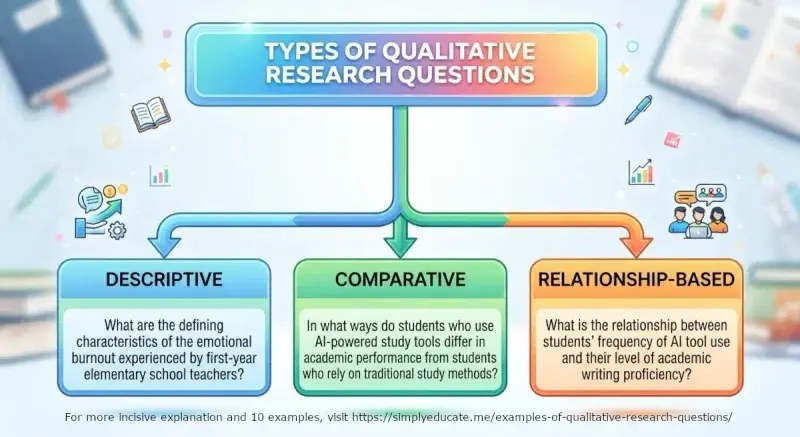
There are three main types of qualitative research questions: descriptive, comparative, and relationship-based.
I discuss these types in more detail in the following sections with corresponding examples of qualitative research questions for each type.
1. Descriptive Research Questions
Descriptive research questions aim to provide a thorough and accurate account of a particular phenomenon, concept, or situation without attempting to explain causal relationships. They typically begin with terms such as “what” or “how,” signaling the researcher’s intent to explore characteristics, patterns, or features of the subject being studied.
When a researcher focuses on characteristics, patterns, or features, they are looking at distinct layers of the subject matter without trying to prove what caused them.
I discuss further what each term means, along with two practical examples of qualitative research questions for each intended feature to highlight. Pause and digest how these features are exemplified so you can accurately frame your qualitative research questions.
Characteristics
Characteristics refer to the inherent qualities, traits, or defining attributes of a specific group, experience, or phenomenon. Researchers look for “what something is like” from the perspective of the participants.
Note: It’s the participant’s perspective, not yours as the researcher. So never make leading questions or lead the participants or interviewees in their answers.
- Example 1: “What are the defining characteristics of the emotional burnout experienced by first-year elementary school teachers?”
- Example 2: “How do remote corporate employees describe the characteristics of a supportive virtual workplace culture?”
Patterns
Patterns refer to recurring behaviors, themes, routines, or sequences of events that emerge across multiple cases or over a period of time. Researchers look for consistency and repetition in how people act or react.
- Example 1: “What patterns of digital communication emerge among teenagers when they are resolving interpersonal conflicts online?”
- Example 2: “How do low-income families navigate their routine food-purchasing patterns during periods of sudden inflation?”
Features
Features refer to the specific components, structural elements, or distinct parts that make up a larger system, program, or environment. While characteristics describe the nature of the experience, features isolate the tangible pieces of it.
The word “tangible” means concrete, specific, and easily identifiable elements that can be clearly pointed out, isolated, or physically observed.
- Example 1: “What features of a hospital’s physical environment do pediatric patients report as being the most comforting?”
- Example 2: “What features of Instagram do users find the most fun?”
While characteristics describe abstract qualities or feelings within an experience (such as a hospital feeling “welcoming” or Instagram feeling “addictive”), features isolate the concrete, specific parts of that experience—such as the actual art on the hospital walls or the Reels tab on the app.
By focusing on participants’ experiences, perspectives, and behaviors, these questions help researchers capture a detailed and contextual understanding of the topic.
Try to identify which feature is highlighted in this example research question (Answer is right after the image).
What are the common experiences of graduate students when using AI tools to assist in writing their research papers?

This question examines characteristics.
Even though the question asks about “experiences,” qualitative research treats personal experiences, perceptions, and feelings as the defining traits or qualities (characteristics) of a phenomenon. It looks at the nature of what it feels like to be a graduate student using AI.
Here is why it fits characteristics rather than patterns or features:
- It seeks characteristics because it explores the subjective qualities and nature of the students’ experiences (e.g., feeling relieved, feeling ethical confusion, or finding it helpful).
- It is not a pattern because it does not track a specific sequence of behavior or a routine over time (e.g., “How often or in what order do students use AI tools?”).
- It is not a feature because it does not isolate a concrete, structural component of the AI software itself (e.g., “What specific buttons or functions of the AI tool do students use?”).
2. Comparative Research Questions
Comparative research questions focus on examining two or more groups, concepts, or phenomena to determine how they are similar and how they differ. These questions generally start with phrases like “in what ways” or “how does,” which signal the intention to compare specific characteristics or conditions.
By investigating these variations, researchers can identify patterns that help explain the influence of different factors on the topic of interest. Such questions are valuable for highlighting contrasts that may guide further analysis or decision-making.
Example Comparative Qualitative Research Question:
In what ways do students who use AI-powered study tools differ in academic performance from students who rely on traditional study methods?
3. Relationship-based Research Questions
Relationship-based research questions focus on identifying and examining how different variables or concepts are linked to one another within a given context. These questions often begin with phrases such as “what is the relationship between” or “how does X affect Y,” indicating the researcher’s intent to investigate potential associations or influences.
By analyzing these connections, researchers can determine whether variables move together, influence each other, or show predictable patterns.
Such questions are essential for understanding the dynamics within a system and for forming the basis of more in-depth explanatory studies. Relationship-based questions are crucial because they reveal how different parts of a system interact and connect, which provides the groundwork needed for future studies to explain why these connections happen.
Example Relationship-Based Qualitative Research Question:
What is the relationship between students’ frequency of AI tool use and their level of academic writing proficiency?
By understanding the different types of qualitative research questions, researchers can design effective studies that address their research objectives and provide valuable insights into the phenomenon or concept under investigation.
In the next section, I provide 10 more examples of qualitative research questions and their corresponding types to enhance your understanding.
10 Examples of Qualitative Research Questions and Their Corresponding Types
Let’s review the purpose of crafting qualitative research questions to keep us on the right track.
Qualitative research questions are designed to explore and understand complex phenomena in depth. They aim to uncover the meaning behind human experiences, behaviors, and interactions.
Bear that in mind as we examine the following additional examples to hone your skills in writing effective qualitative research questions that you can include in your interview guide.
Please note that the instrument is called an interview guide, not a questionnaire (see comparison below).
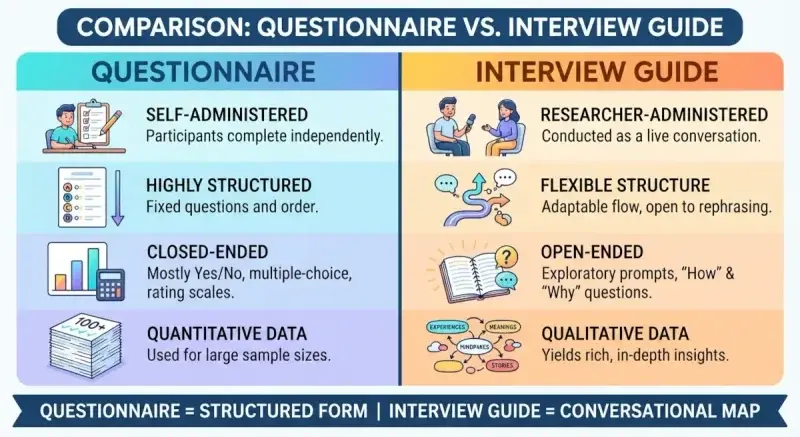
The main difference is that a questionnaire is a structured, written list of questions that participants fill out on their own, while an interview guide is an informal, flexible outline used by a researcher to lead a live conversation.
Examples of Qualitative Research Questions
I provide herewith 10 example research questions for qualitative research and their corresponding types that can help guide effective study design:
- What are the experiences of individuals who have undergone a major life transition, such as divorce or job loss? (Descriptive)
- How do healthcare professionals perceive the challenges of providing care to patients with chronic illnesses? (Descriptive)
- What are the cultural beliefs and values that influence parenting practices in different communities? (Descriptive)
- How do employees perceive the impact of organizational culture on their job satisfaction and performance? (Relationship–based)
- What are the factors that contribute to successful team collaboration in virtual work environments? (Relationship–based)
- How do individuals with disabilities experience social inclusion in their communities? (Descriptive)
- What are the perceptions of students regarding the effectiveness of online learning compared to traditional classroom instruction? (Comparative)
- How do consumers make decisions when purchasing environmentally sustainable products? (Relationship–based)
- What are the experiences of individuals who have undergone psychotherapy for anxiety disorders? (Descriptive)
- How do teachers perceive the role of technology in enhancing student learning outcomes? (Descriptive)
These examples demonstrate the diversity and the importance of tailoring qualitative research questions to fulfill specific research objectives.
By asking open-ended questions, researchers can gain rich insights into complex phenomena and generate new knowledge that can inform practice and policy.
The Importance of Asking Effective Qualitative Research Questions
In conclusion, asking effective qualitative research questions is crucial for designing a successful study. The types of questions you choose to ask will depend on the nature of your research and the goals you hope to achieve.
By using open-ended questions, you can encourage participants to share their experiences and perspectives in greater detail, providing rich data that can be analyzed to uncover themes and patterns.
Next Steps for Your Research
Great research questions deserve flawless data.
Crafting the perfect qualitative question is only half the battle. Once the interviews and open-ended responses start rolling in, organizing that unstructured text is critical. Learn how to prevent bias and ensure your qualitative findings remain methodologically sound.
Read the Data Cleaning Guide: 5 Steps to Safeguard Data Integrity →Additionally, by carefully crafting your questions, you can ensure that your study is focused and targeted, allowing you to draw meaningful conclusions from your findings.
Ultimately, the success of your qualitative research project will depend on your ability to ask thoughtful, relevant, and effective questions that elicit the information you need to answer your research questions.
Frequently Asked Questions (FAQ)
What is qualitative research?
Qualitative research is a type of research that focuses on understanding human behavior, experiences, and perspectives using non-numerical data such as interviews, observations, and open-ended surveys.
What are qualitative research questions?
Qualitative research questions are open-ended questions designed to explore complex phenomena, social interactions, and participants’ experiences to gain in-depth understanding.
What are the types of qualitative research questions?
There are three main types: descriptive, comparative, and relationship-based research questions.
What are descriptive research questions?
Descriptive research questions aim to provide a detailed account of a phenomenon or situation without explaining causal relationships, often starting with “what” or “how.”
What are comparative research questions?
Comparative research questions examine similarities and differences between two or more groups, concepts, or phenomena, often starting with “in what ways” or “how does.”
What are relationship-based research questions?
Relationship-based research questions investigate the links or associations between variables or concepts, often starting with “what is the relationship between” or “how does X affect Y.”
Why are qualitative research questions important?
They help researchers gain deep insights into human experiences, behaviors, and interactions, allowing for rich, contextual data collection and meaningful analysis.
Can you give examples of qualitative research questions?
Yes, for example:
Descriptive: What are the experiences of individuals who have undergone a major life transition?
Comparative: How do students using AI study tools differ from those using traditional methods?
Relationship-based: What is the relationship between students’ frequency of AI tool use and academic writing proficiency?
How should I craft effective qualitative research questions?
Focus on open-ended, clear, and relevant questions that explore experiences, behaviors, and interactions aligned with your research objectives.
How do qualitative research questions benefit my study?
They provide rich, detailed data that help uncover patterns, themes, and insights that inform practice, policy, and further research.
You might want to combine qualitative with quantitative research to come up with a mixed methods research design for your study. Find out how you can do this by visiting our Conceptual Framework Guide.
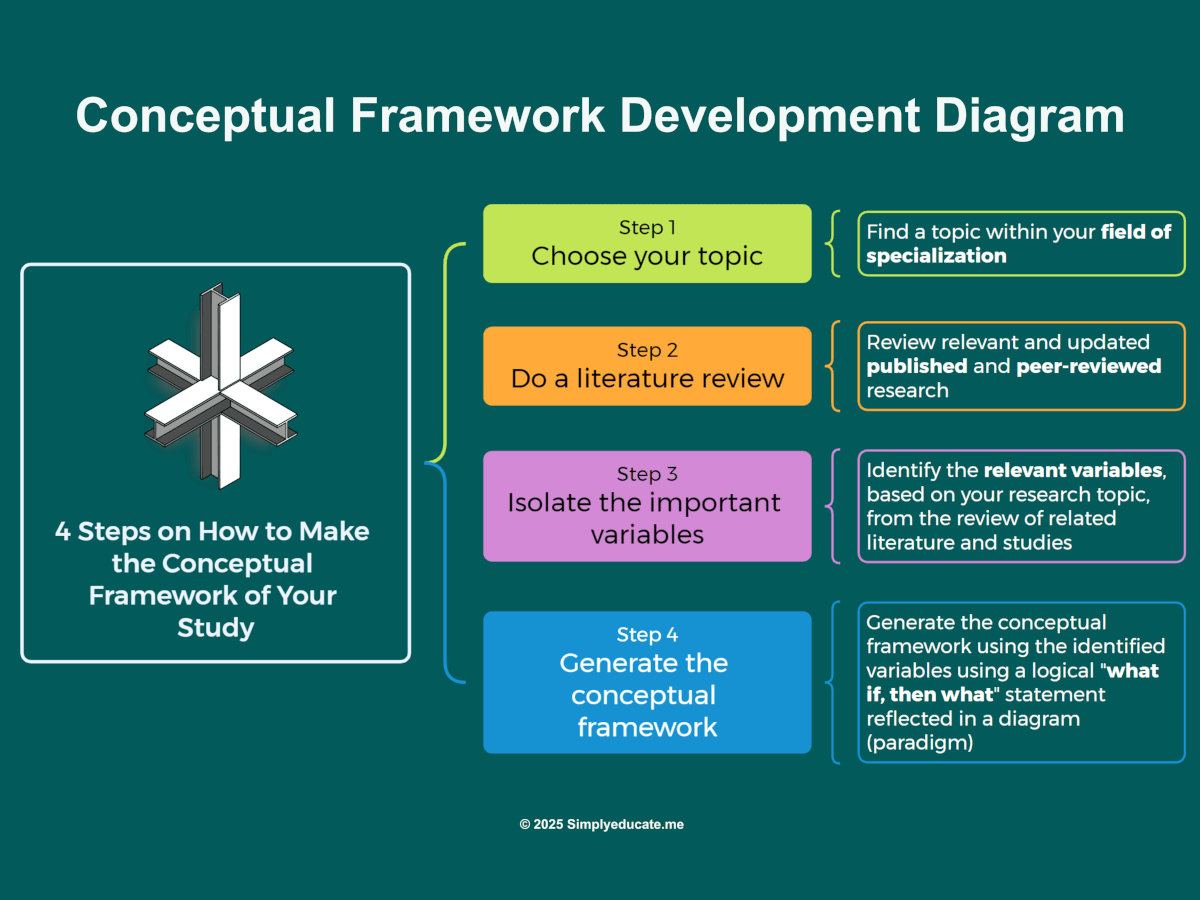
Conceptual Framework: A Step-by-Step Guide on How to Me One
Learn how a conceptual framework is arrived at. by following the step-by-step procedure in this guide. A simplified example is added to illustrate how it is done.
©SimplyEducate.me | Patrick A. Regoniel