
Updated | November 27, 2025
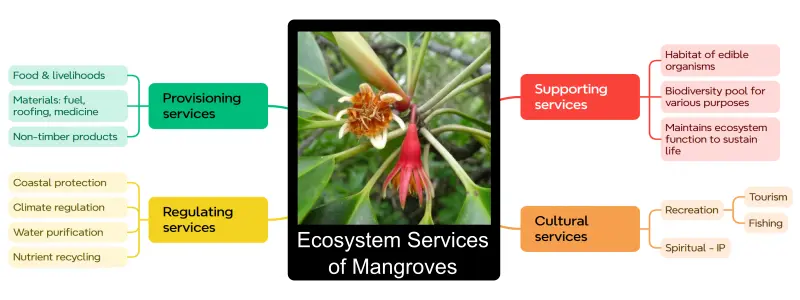
Table of Contents
Introduction
What mangrove benefits can people gain? This article describes the ecosystem services of mangroves that you can’t ignore. Read on to find out.
Many people in the coastal areas do not realize the importance of vegetation around them. Take, for example, the mangroves of the tropical areas. Mangroves are wonderful works of nature that provide ecological services vital to human survival.
Do you hear or remember what happened in Phuket, Thailand, way back in 2004? A tsunami caused an unimaginable disaster. Lots of properties and lives were lost in such a low probability but high-impact hazard of nature.
And did you know that partly the reason for lots of damages was attributed to lack of mangroves to weather the impacts of the surging waters? Had there been mangroves in front of the beaches, these would have blocked the incoming waters that can significantly reduce the tremendous power and force of the tsunami.
But this is just one of the benefits that mangroves provide.
What are Mangroves?
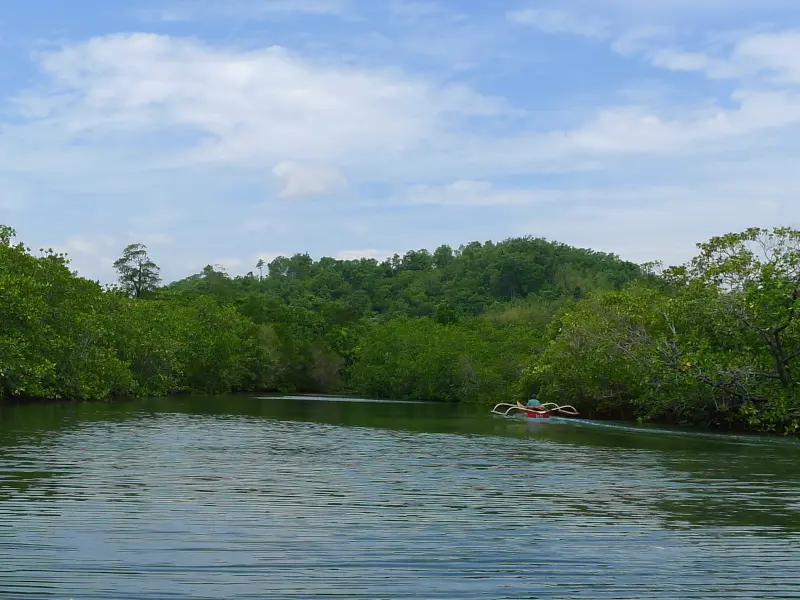
The mangroves are those trees commonly growing along the beaches in the tropical areas. These are of various kinds or species and range in sizes and features.
Common among those mangroves that grow near the beaches and are able to withstand high salt conditions are of the species Rhizophora. These mangroves have sturdy, branching stilt roots that can thrive even in muddy areas.
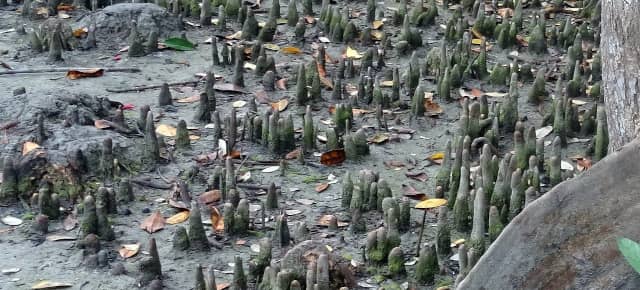
Notable in areas grown with large, mature mangrove trees are their breathing roots or pneumatophores (Figure 2). These are aerial roots that enable mangroves to breathe air in waterlogged habitat along the fringes of the coast.
Ecosystem Services of Mangroves
What are the benefits to be gained from mangroves? I enumerate six of the ecosystem services of mangroves in the following section.
Mangroves provide a wide range of ecosystem services that are crucial for both human well-being and environmental sustainability. These services are categorized into four main types: provisioning, regulating, supporting, and cultural services.
1. Provisioning Services
Provisioning services involve the direct supply of goods. For example, mangroves provide food and livelihoods through fish, shellfish, and shrimp that thrive in their waters. They also supply materials such as fuelwood, roofing materials, and medicinal plants.
Rural folks living in tropical areas make use of mangroves for making charcoal. The product burns much better compared to charcoal from other kinds of trees. This is a direct benefit that people can gain from these amazing trees.
But charcoal making by many rural folks ultimately contributed to the deforestation of the coastal zone. Although beneficial to humans, the practice has threatened the mangrove stands. Cutting those trees take years to replenish (see how a fisherman reforested a 20-hectare mangrove area).
Additionally, they provide non-timber products like honey, beeswax, syrups, and resins, which are used in various industries and traditional practices.
2. Regulating Services
Regulating services refer to the regulation of ecological processes. Mangroves act as natural barriers against coastal erosion and storm surges, offering coastal protection. Planting mangroves as one of the approaches of coastal erosion prevention technologies, is a superb strategy to keep the coasts from eroding thus protect beaches and coastal dwellings. The sturdy mangroves anchored into the muddy substrate in the coasts serve as a strong buffer against waves or strong storm surges (Figure 3).
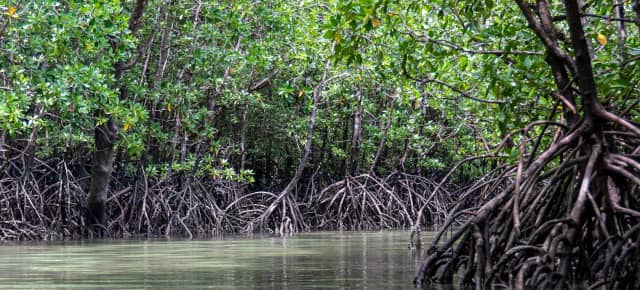
Individual mangrove plants growing together serve as a natural barrier to surging waters or strong winds. This prevents any strong impact that may arise from the sea, such as tidal waves or tsunami. Furthermore, they purify water and recycle nutrients, maintaining the health of coastal ecosystems.
Mangroves also contribute to climate regulation by sequestering carbon dioxide, helping to mitigate climate change. Plants need carbon dioxide to survive. As part of photosynthesis, carbon is removed from the atmosphere and fixed as plant biomass. Mangroves sequester carbon, thus helping to remove excess carbon dioxide from the atmosphere and helping to stabilize the atmospheric balance of gases or achieve a state of atmospheric equilibrium favorable to human life.
3. Supporting Services
Mangroves provide habitats for a wide range of edible organisms, such as crustaceans, shrimps, small fishes. These organisms find refuge among the roots of the mangroves, shells attach themselves on the stems or leaves.
Other organisms that keep the food chain going include two-colored ants that fold the leaves together to house their larvae, mangrove snakes that occupy the thick foliage awaiting prey, and even birds that perch on twigs and branches in the canopy both during the day and at night to roost. These organisms compose the unique food chain of the mangrove forest.
Crocodiles, apex predators that even prey on humans, occasionally inhabit some mangrove lined rivers (Figure 4). They are virtually undetectable at daytime. At night, however, they are easily detected with the characteristic red reflection they bounce back when shone upon by a strong flashlight or portable search light (see how crocodilian populations are studied).
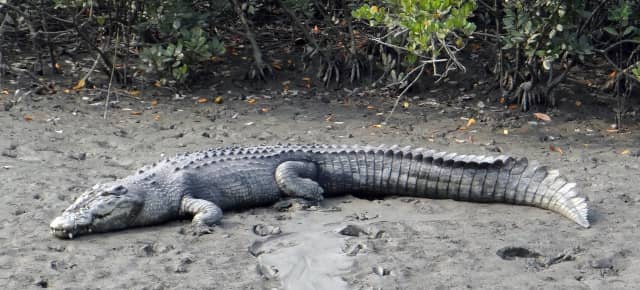
The presence of crocodiles means that the mangrove stand is still a viable ecosystem able to support a large diversity of animal life. Also, crocodiles enrich the ecosystem with its secretions.
A study in the Amazon showed that without the caimans (a relative of crocodiles), the existence of fish appears to be threatened. Fittkau (1970) hypothesized that caimans contributed a significant amount of nutrients that fertilize algae. Thus, with more algae available, more fish production occurred in the river lakes.
Mangroves also serve as a biodiversity pool, supporting a variety of species that have ecological, economic, and scientific value. Lastly, they maintain ecosystem functions that are essential for sustaining life in coastal areas.
4. Cultural Services
Cultural services relate to the non-material benefits people obtain from ecosystems. Mangroves support recreation, such as tourism, fishing, and birdwatching, which contribute to local and national economies. They also hold spiritual and cultural significance for many indigenous and local communities, often playing a role in traditional beliefs and practices.
Mangroves add beauty to the landscape. Anything green soothes the eye. Mangroves just do that as these plants add appeal to an otherwise boring coastal landscape without the greens and the intricate network of awesome stilt or buttress roots of large trees growing in isolated areas.
The many flowers and fruits of mangroves also appeal to the senses and elicit awe. At night, the firefly mangrove (Sonneratia spp.) flowers attract fireflies and adorn the trees with small “flying stars” that twinkle in the dark. It’s as if you’re in a magical land.
There are other things mangroves can do that can be beneficial to man. For this reason, it is just fitting and proper that we help conserve this important resource.
Conclusion
Mangroves provide a wide array of ecosystem services that are essential for both environmental health and human well-being. From provisioning services like food, fuel, and medicine to regulating services such as coastal protection, climate regulation, and water purification, mangroves play a vital role in maintaining ecological balance. They also offer supporting services by sustaining biodiversity and ecosystem functions, and cultural services by supporting recreation, spiritual practices, and traditional knowledge.
Recognizing the ecosystem services of mangroves, there is a need for us, humans, to find ways on how to sustainably use this important coastal resource wherever they exist. Protecting and restoring mangrove ecosystems is crucial for sustaining these benefits and ensuring the resilience of both nature and human communities.
References
Fittkau, E. J. (1970). Role of caimans in the nutrient regime of mouth-lakes of Amazon affluents (an hypothesis). Biotropica, 138-142.
Millennium Ecosystem Assessment, 2005. Ecosystems and Human Well-being. Biodiversity Synthesis. World Resources Institute, Washington, DC.
FAQ: Ecosystem Services of Mangroves: 12 Essential Benefits
Q1. What mangrove benefits can people gain?
Mangroves provide a wide array of ecosystem services that are essential for both human well-being and environmental sustainability. These include provisioning services like food, fuel, and medicine; regulating services such as coastal protection, climate regulation, and water purification; supporting services that sustain biodiversity and ecosystem functions; and cultural services that support recreation, spiritual practices, and traditional knowledge.
Q2. What are mangroves?
Mangroves are trees commonly found in tropical coastal areas that can withstand high salt conditions. They have specialized features such as stilt roots and breathing roots (pneumatophores) that allow them to thrive in muddy, waterlogged environments.
Q3. How do mangroves help in coastal protection?
Mangroves act as natural barriers against coastal erosion, storm surges, and tsunamis. Their sturdy roots help stabilize the shoreline and reduce the impact of strong waves.
Q4. How do mangroves contribute to climate regulation?
Mangroves sequester carbon dioxide through photosynthesis, helping to mitigate climate change by removing excess carbon from the atmosphere and stabilizing the balance of atmospheric gases.
Q5. What are the provisioning services of mangroves?
Mangroves provide food (fish, shellfish, shrimp), fuel (charcoal), medicinal plants, and non-timber products like honey, beeswax, syrups, and resins.
Q6. What are the regulating services of mangroves?
Mangroves regulate ecological processes by protecting coasts, purifying water, recycling nutrients, and sequestering carbon to help regulate the climate.
Q7. What are the supporting services of mangroves?
Mangroves support biodiversity by providing habitats for various organisms, including fish, crustaceans, birds, and even crocodiles. They also maintain ecosystem functions essential for sustaining life in coastal areas.
Q8. What are the cultural services of mangroves?
Mangroves support recreation, tourism, and spiritual practices. They add beauty to the landscape, attract wildlife like fireflies, and are culturally significant to many indigenous communities.
Q9. Why is it important to protect mangroves?
Mangroves are vital for both ecological and human well-being. Protecting them ensures the sustainability of ecosystem services, helps prevent coastal erosion, mitigates climate change, and preserves biodiversity.
©SimplyEducate.me | Patrick A. Regoniel