Updated | November 27, 2025
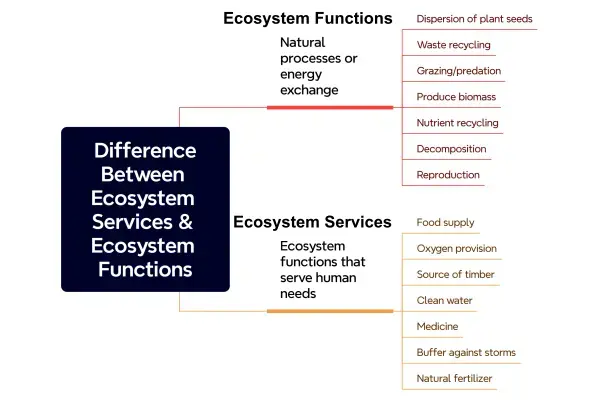
What is the difference between ecosystem functions and ecosystem services? This article describes the difference between these two often confused words in environmental science and management. It aims to integrate and clarify the many definitions and viewpoints of ecosystem functions and ecosystem services currently available online.
Sometimes, students of environmental science and management terms use environmental concepts interchangeably to mean the same thing. Or perhaps misused, misunderstood or used these two phrases inappropriately.
As a professor of environmental science and management, I consciously need to have a second look at what those words I tell my students to mean what I want to convey, given the multiplier effect of what I say. I am apprehensive of the possibility that they may disseminate erroneous information and cause a domino effect that misleads others interested in the subject. When I say something wrong, they may also echo something wrong.
I need to clearly define the concepts that I used, as I expect my students to exercise a certain level of keenness, in line with their graduate school work. We expect graduate students to be meticulous and thorough with their work. This trait separates them from non-graduate students.
Back to the difference between ecosystem functions and ecosystem services.
Ecosystem functions and ecosystem services are two different concepts that students of environmental science need to be familiar with. This article describes each of these concepts and provides examples to facilitate understanding.
Ecosystem Functions Definition
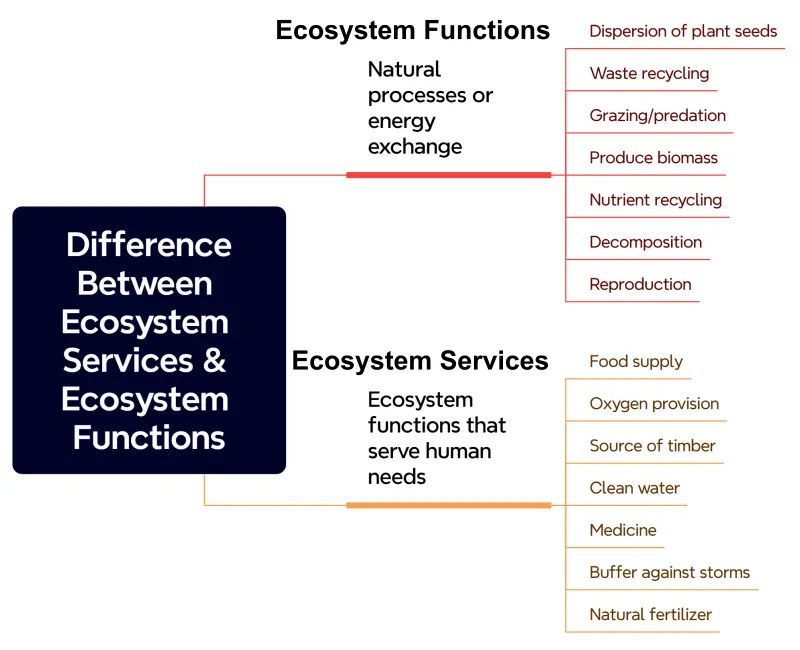
Ecosystem functions are natural processes or characteristic exchanges of energy that take place in the various animal and plant communities of the different ecosystems of the world—from micro-ecosystems to biomes.
Primarily, these are exchanges of energy and nutrients in the food chain which are vital to the sustenance of plant and animal life on the planet and the decomposition of organic matter and production of biomass made possible by photosynthesis. The dynamics in one component affect the dynamics of others that rely on its behavior, state, or productivity.
Ecosystem Functions Examples
Simplified examples of ecosystem functions are:
- Plant seeds disperse in various places through special accessory parts or animals as vectors and germinate in areas where they get deposited
- Grazing and predation take place balancing plant and animal population
- Young plant shoots actively produce biomass to achieve growth
- Waste materials are degraded and recycled back into the soil
- Dead organic matter decomposes into humus
- Animals find their mate and reproduce
To illustrate ecosystem function in more detail, I provide an example below. Figure 1 shows a detailed example of the interaction between plants and animals and how the behavior or function of one component affects the other.
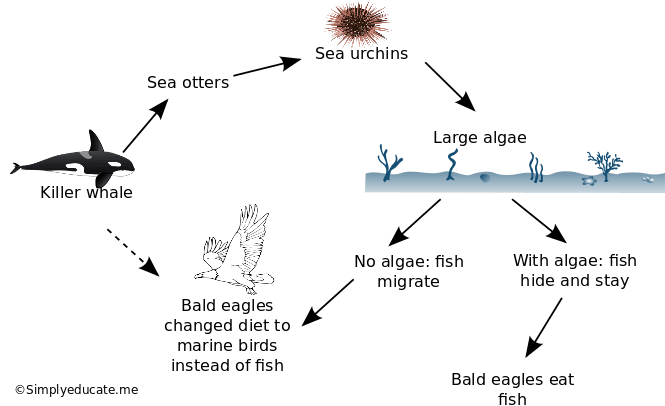
James Estes of the Biological Resources Division of the U.S. Geological Survey and the University of California, Santa Cruz (UCSC)(Kaiser 1998), believes that killer whales depleted the population of sea otters because the population of their main food—the seals and sea lions—has been declining.
This change in the diet of the killer whales indirectly affected the sea urchin population, preyed upon by sea otters. Thus, sea urchins consume more algae, leaving fish with reduced forage material, causing the bald eagles to change their diet from fish to marine birds.
You notice that when one part of the food chain changes as the diagram illustrates, the other components, likewise, get affected. The ecosystem function is affected.
If you have not seen this diagram based on research that links killer whale feeding behavior (at least hypothetically) to the diet of the bald eagle, it is difficult to imagine how the killer whale influences an aerial animal species like the bald eagles. Once changes in the function of one component change, the functioning of the other components also changes.
The quality and quantity of these ecosystem functions largely depend on the development stage of the ecosystem in which these processes occur. Ecosystems that are young will have much more active plant and animal life than one at the climax stage, but the latter is more stable.
Also, the geographic location of ecosystems is a prime determining factor for plant and animal life processes to take place. For example, cooler regions will allow slower decomposition of organic matter than hotter regions.
Now, we shift our attention to the next environmental concept terminology—the ecosystem services. Let’s see how it differs from ecosystem function.
Ecosystem Services Definition
Ecosystem services are ecosystem functions that serve human needs. Humans enjoy the natural functions of the ecosystem.
I name some ecosystem services and italicize the specific services of each description in the next section.
Ecosystem Services Examples
Examples of ecosystem services are:
- Animals supply the protein needs of humans, serve as pets or animal skin for making shoes, bags, and other derivatives
- Humus from decomposition of organic matter serve as natural fertilizer in areas cleared for agriculture
- Trees serve as a buffer against storms preventing destruction of houses by strong winds (see the Ecosystem Services of Mangroves)
- Photosynthesis removes carbon dioxide in the air and supplies oxygen to man
- Trees serve as sources of timber for housing construction, among others
- The watershed provides fresh, clean water for human consumption
- Some species of plants can cure human ailments
Ecosystem services provide life support services crucial to the continued survival of both humans and animals. These ecosystem services are also susceptible to human abuse when actions do not favor or allow natural processes to take place, or if the ecosystem’s function is compromised because of environmental degradation or pollution.
For instance, when humans harvest too many trees, they will compromise the life-sustaining function of oxygen supply and carbon sequestration. Therefore, understanding these ecosystem services and knowing how to sustain them ensures the benefits accrue not only for this generation but also for the future generations.
Summary
To sum it all up, ecosystem function relates to the combination of ecosystem processes and components and how they work together to achieve ecological stability, while ecosystem services are offshoots of ecosystem function that satisfy, directly or indirectly, human needs.
Reference
Kaiser, J. (1998). Sea otter declines blamed on hungry killers.
FAQ: Difference Between Ecosystem Services and Ecosystem Functions
Q1. What is the difference between ecosystem functions and ecosystem services?
Ecosystem functions refer to the natural processes and exchanges of energy and nutrients. Ecosystem services, on the other hand, are the benefits that humans derive from these natural processes.
Q2. What are some examples of ecosystem functions?
Examples of ecosystem functions include:
- Plant seeds dispersing through animals or special accessory parts and germinating in new areas.
- Grazing and predation balancing plant and animal populations.
- Young plant shoots producing biomass for growth.
- Waste materials being degraded and recycled back into the soil.
- Dead organic matter decomposing into humus.
- Animals finding mates and reproducing.
Q3. How does the interaction between killer whales and bald eagles illustrate ecosystem functions?
The interaction between killer whales and bald eagles illustrates how changes in one component of an ecosystem can affect others. Killer whales depleting the population of sea otters (their main food source) indirectly led to an increase in sea urchins, which in turn consumed more algae. This reduced the forage material available for fish, forcing bald eagles to change their diet from fish to marine birds. This example shows how the functioning of one part of the ecosystem can influence the functioning of others.
Q4. What are some examples of ecosystem services?
Examples of ecosystem services include:
- Animals providing protein for humans, serving as pets, or providing materials like leather for shoes and bags.
- Humus from decomposed organic matter acting as a natural fertilizer for agriculture.
- Trees acting as buffers against storms and protecting homes from strong winds.
- Photosynthesis removing carbon dioxide from the air and supplying oxygen to humans.
- Trees providing timber for housing construction.
- Watersheds supplying fresh, clean water for human consumption.
- Some plant species offering medicinal benefits to humans.
© SimplyEducate.me | P. A. Regoniel