
Updated | February 14, 2026
Want a quick summary of the video above? This conceptual framework guide simplifies the conceptual framework into 4 easy steps. Review our step-by-step diagram below and follow the real-world example to map out your own study in minutes.
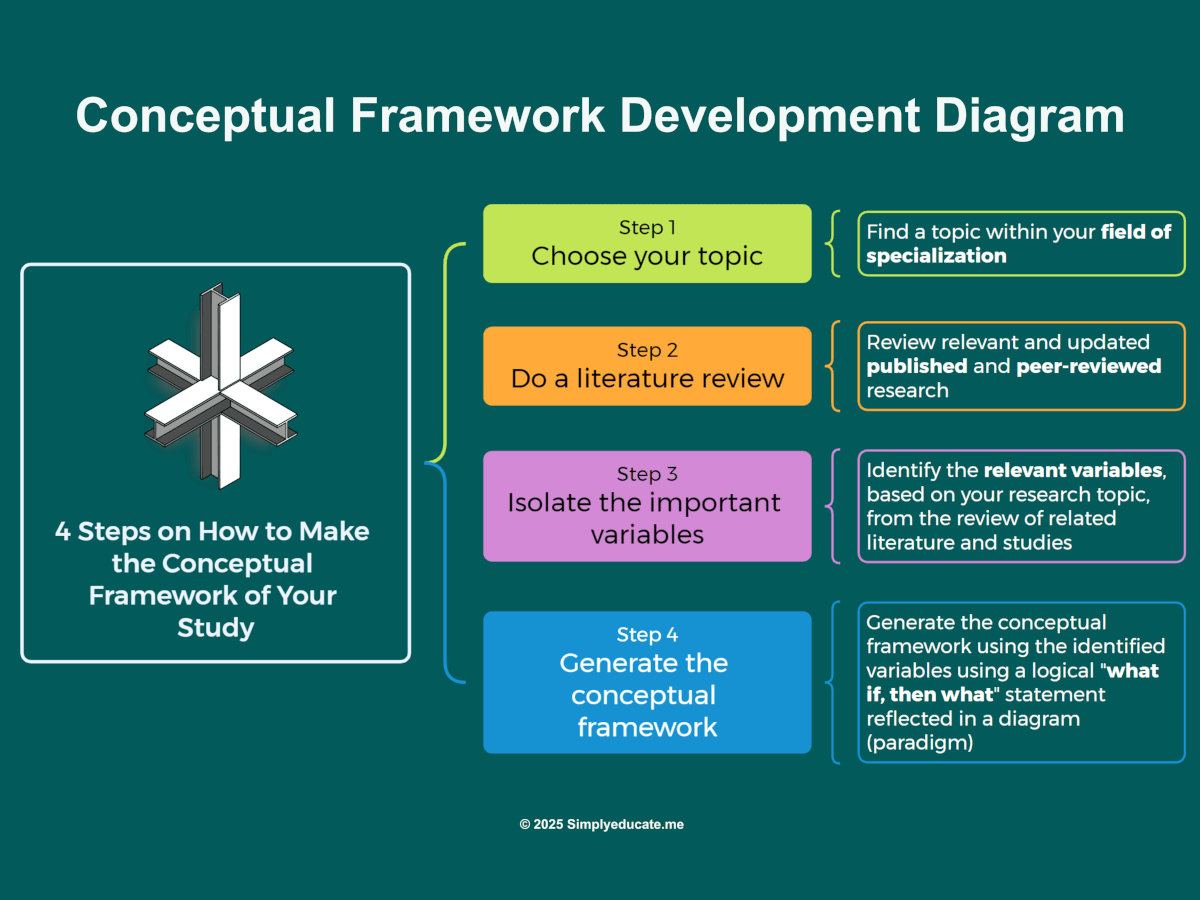
In preparing your research paper as one requirement for your course as an undergraduate or graduate student, you will need to write the conceptual framework of your study. The conceptual framework steers the whole research activity. The conceptual framework serves as a “map” or “rudder” that will guide you towards realizing your study’s objectives or intent.
What, then, is a conceptual framework in empirical research? The next section defines and explains the term.
Table of Contents
What is a Conceptual Framework?
A conceptual framework represents the researcher’s synthesis of the literature on how to explain a phenomenon. It maps out the actions required in the study’s course, given the researcher’s previous knowledge of other researchers’ point of view and his or her observations about the phenomenon studied.
The conceptual framework is the researcher’s understanding of how the particular variables in the study connect. Thus, it identifies the variables required in the research investigation. It is the researcher’s “map” in pursuing the investigation.
As McGaghie et al. (2001) put it: The conceptual framework “sets the stage” to present the particular research question that drives the investigation being reported based on the problem statement. The problem statement of a thesis gives the context and the issues that caused the researcher to conduct the study.
The conceptual framework lies within a much broader framework called a theoretical framework. The latter draws support from time-tested theories that embody many researchers’ findings on why and how a particular phenomenon occurs.
I expounded on this definition, including its purpose, in my post titled “What is a Conceptual Framework? Expounded Definition and Five Purposes.”
🚀 Next Step in Your Research Journey
Before spending your energies into building your conceptual framework or drafting a full-blown proposal, you need to map out your initial ideas. Learn how to outline your research vision, define key goals, and secure early approval with a concept paper.
Read: What is a Concept Paper? →4 Steps on How to Make the Conceptual Framework
Before you prepare your conceptual framework, you need to do the following things:
Step 1: Choose your topic
Decide on what will be your research topic. The topic should be within your field of specialization. (Generate your research topic using brainstorming tips).
Choosing a research topic is one of the most critical steps in conducting any scholarly work because it defines the scope, direction, and relevance of your study. Your topic should fall within your field of specialization so that you can build upon your existing knowledge, skills, and expertise. Working within your discipline ensures that you understand the fundamental concepts, theories, and methodologies needed to examine the subject effectively.
When your research topic aligns with your specialization, you are more likely to:
- Identify meaningful knowledge gaps in existing literature because you are familiar with current trends and debates in your field.
- Apply appropriate methods confidently, since you have already been trained in tools and approaches used in your discipline.
- Gain credibility with your peers, mentors, and potential publishers, as your work will be recognized as grounded in your professional expertise.
Sustain interest and motivation, since the topic aligns with your academic and career goals.
Ultimately, selecting a topic within your specialization not only strengthens the quality of your research but also contributes more directly to the advancement of knowledge in your chosen area.
Step 2: Do a literature review
Review relevant and updated research on the theme that you decide to work on after scrutiny of the issue at hand. Preferably use peer-reviewed, and well-known scientific journals as these are reliable sources of information.
Prefer peer-reviewed and reputable journals in your literature review because they offer the best chance of reliable methods, extremely thorough or accurate results, and useful citations you can build on. A good literature review will show where the gaps, contradictions, and opportunities lie, and it will shape your research questions and methods.
Why peer-reviewed and up-to-date sources?
- Peer review increases the likelihood the methods and conclusions were critically evaluated.
- Recent studies show the current state of knowledge, methods, and debates.
- High-quality journals (and systematic reviews) help you identify accepted standards, commonly used instruments, and typical sample sizes.
- Using strong sources strengthens your credibility and the defensibility of your study.
Practical steps to do this effectively
- Define the scope and keywords. Convert your topic into 4–8 search terms (include synonyms and related concepts). Example: (“coastal erosion” OR “shoreline retreat”) AND (“community adaptation” OR “household resilience”).
- Search major databases. Start with discipline-specific and multidisciplinary databases: e.g., Web of Science, Scopus, PubMed (health), ERIC (education), IEEE Xplore (engineering), and Google Scholar for breadth. Your university library resources and indexes matter a lot. So, your library is still not obsolete. Visit them. You can browse both the digital and card catalog if they still exist. In the US, these are now replaced by modern online public access catalogs (OPACs) for over two decades.
- Prioritize recent and high-quality sources. Filter by date (last 3-5 years for most fast-moving fields), look for review articles and meta-analyses first to get the big picture. A review article synthesizes existing research to summarize a topic, while a meta-analysis is a statistical method within a systematic review that pools data from multiple studies to produce a single, more precise estimate of an effect. That saves you time for other more important process in developing your research proposal.
- Use well-known journals and citation metrics thoughtfully. Journal reputation helps, but always read the paper — a small, well-designed study in a newer journal can still be valuable. Using your judgment as to the relevance of a research article will be worthwhile. This approach particularly works in situations where your proposed study belongs to a relatively new field.
- Read critically, not passively. For each important paper note the research question, sample and context, methods, main findings, limitations, and how it relates to your topic. Keep a short annotated bibliography. Being keen is the mark of a true researcher.
- Look for methodological patterns and gaps. Ask: which methods are used most? What populations or contexts are under-studied? Are there conflicting findings? A rubric which can help you decide can help (see Table 1).
- Track citations forward and backward. Use cited-by tools in databases to find newer papers that cite a key article (forward citation). Check the reference lists of good papers (backward citation). A lot of citations of a paper indicates that the research is foundational or a solid reading to help advance knowledge on the particular subject matter.
- Manage references. Use a reference manager (Zotero, Mendeley, EndNote) to save articles, PDFs, and notes — it saves huge time later.
- Assess quality and bias. Check sample size, controls, statistical methods, conflicts of interest, and whether conclusions overreach the data. Many researchers tend to conclude more than their study has covered. In doing your own research, avoid being too general in your conclusions. Always stick to your findings.
- Synthesize, don’t summarize. Organize the literature into themes (e.g., theories, methods, findings, gaps) and write a narrative that leads naturally to your research question and justification. You can use a mind map to guide you on this activity.
- Cite responsibly and ethically. Give credit always, and be transparent about uncertainties and limits in the literature.
Table 1. Rubric for Evaluating Literature Review Findings
| Criteria | Excellent (4) | Good (3) | Fair (2) | Poor (1) |
|---|---|---|---|---|
| Identification of Common Methods | Clearly identifies multiple methods used in the majority of studies; explains why these methods are common and their strengths/limitations. | Identifies main methods used; provides some explanation of their relevance. | Mentions some methods but without clear linkage to their frequency or purpose. | Methods used are unclear, incomplete, or inaccurate. |
| Recognition of Under-studied Populations/Contexts | Accurately identifies specific populations or contexts with limited research; supports with evidence from reviewed studies. | Identifies some under-studied areas with minimal evidence or examples. | Mentions under-studied areas vaguely without clear evidence. | No mention or incorrect identification of under-studied areas. |
| Analysis of Conflicting Findings | Clearly describes areas where findings disagree; compares studies and discusses possible reasons for conflicts. | Notes some conflicting findings but with limited comparison or explanation. | Briefly mentions conflicts without analysis or context. | No identification or misunderstanding of conflicting findings. |
Scoring Guide
- 10–12 points = Excellent synthesis and critical thinking
- 7–9 points = Good understanding with some gaps
- 4–6 points = Limited analysis; mostly descriptive
- 1–3 points = Minimal or inaccurate evaluation
Step 3: Isolate the important variables
Identify the specific variables described in the literature and figure out how these are related. Some research abstracts contain the variables, and the salient findings thus may serve the purpose. If these are not available, find the research paper’s summary.
If the variables are not explicit in summary, get back to the methodology or the results and discussion section and quickly identify the study variables and the significant findings. Read the TSPU Technique to skim articles efficiently and get to the essential points with little fuss.
When identifying variables, it is important to distinguish between independent variables (factors the researcher manipulates or categorizes to observe their effect), dependent variables (the outcomes measured), and control variables (factors kept constant to reduce bias). Some studies also include moderating or mediating variables, which help explain or influence the relationship between the independent and dependent variables. Mapping these out — even in a simple diagram — helps clarify the research logic and the cause–effect pathways tested in prior studies.
Once the variables are clear, pay attention to the relationships reported.
- Are they positive, negative, or non-significant?
- Are they consistent across different studies or do results vary depending on context, sample, or methodology?
This process not only sharpens your understanding of how concepts interact in the existing literature but also reveals potential research gaps — such as variables that have been studied separately but not yet linked, or relationships tested only in limited populations or settings. These insights can guide the refinement of your own research framework.
Step 4: Generate the conceptual framework
Build your conceptual framework using your mix of the variables from the scientific articles you have read. Your problem statement or research objective serves as a reference for constructing it. In effect, your study will attempt to answer the question that other researchers have not explained yet. Your research should address a knowledge gap.
When constructing your conceptual framework, start by mapping out the relationships among the variables you have identified from the literature. This can be done visually (e.g., boxes and arrows showing causal links, correlations, or interactions) or narratively (explaining the logical connections in words). The framework should clearly indicate how the independent, dependent, and, if applicable, mediating or moderating variables are expected to relate to one another. Use evidence from prior studies to justify each link, but also highlight areas where evidence is weak or inconsistent — these are where your study can make its strongest contribution.
Your problem statement or research objective acts as the anchor for the framework, ensuring that every variable and relationship you include serves the central purpose of your study. Avoid adding variables just because they appear frequently in the literature; include only those that are directly relevant to answering your research question. Remember, the conceptual framework is not just a diagram — it is your study’s roadmap. It should demonstrate how your research builds upon existing knowledge while targeting a specific gap, making your work both original and necessary.
Example of a Conceptual Framework
Research Topic
Statement number 5 introduced in an earlier post titled How to Write a Thesis Statement will serve as the basis of the illustrated conceptual framework in the following examples. Here’s the thesis statement:
Chronic exposure to blue light from LED screens (of computer monitors and television) depletes melatonin levels thus reducing the number of sleeping hours among middle-aged adults.
The youth, particularly students who need to devote a lot of time using their mobile phones to access their course modules, laptops, or desktops, are most affected. Also, they spend time interacting with their mobile phones as they communicate with their friends on social media channels like Facebook, Messenger, and the like.
When free from schoolwork, many students spend their time viewing films on Netflix, YouTube, or similar sites. These activities can affect their sleeping patterns and cause health problems in the long run because light-emitting diode (LED) exposure reduces the number of hours spent sleeping.
Thesis Statement
Related to the students’ activity, we can write the thesis statement thus:
Thesis statement: Chronic exposure to blue light from LED screens (of computer monitors, mobile phones, tablets, and television) deplete melatonin levels, thus reducing the number of sleeping hours among the youth, particularly students who need to work on their academic requirements.
Review of Literature
The literature review supports the thesis statement as among those that catch one’s attention is a paper that warns against the use of LED devices at night. Although we can save a lot of electrical energy by using the efficient LED where the inventors Isamu Akasaki, Hiroshi Amano and Shuji Nakamura received a Nobel prize in physics in 2014, there is growing evidence that it can cause human health problems, particularly cancer.
Haim & Zubidat (2015) of the Israeli Center for Interdisciplinary Research in Chronobiology synthesized the literature about LEDs. They found out that blue light from the light-emitting diodes (LED) inhibits melatonin production, particularly during active secretion at night. Melatonin is a neuro-hormone that regulates sleep and wake cycles. Also, it can slow down aging and prevent cancer (Srinivasan et al., 2011).
Thus, looking directly at your laptop, mobile phone, or television at night not only can severely damage your eyes but also prevent the achievement of sound sleeping patterns. As a countermeasure, sleep experts recommend limiting the use of digital devices until 8 o’clock in the evening.
Those affected, especially those with virtually uncontrollable digital addiction, experience insomnia (see 10 Creative Ways on How to Get Rid of Insomnia); they sleep less than required (usually less than six hours), and this happens when they spend too much time working on their laptops doing some machine learning stuff, monitoring conversations or posts on social media sites using their mobile phones, or viewing the television at night.
💡 Insight
Can’t put your phone down before bed? Explore the psychological triggers and behavioral patterns behind late-night scrolling and how to address this issue in our comprehensive guide: 8 Effective Strategies to Combat Digital Addiction (Digital Detox).
Read the Full Article →Meanwhile, a related study on reducing bluelight from smartphone screen at night improved the sleep quality of students. Hence, this strengthens the previous findings that exposure to blue light from smart phone screens indeed need to be reduced if not eliminated to get a restful sleep.
Variables Isolated from the Literature
Using the background information backed by evidence in the literature review, we can now develop the study’s paradigm on the effect of LED exposure to sleep. We will not include all the variables mentioned and select or isolate only those factors that we are interested in.
Figure 1 presents a visual representation, the paradigm, of what we want to correlate in this study. It shows measurable variables that can produce data we can analyze using a statistical test such as either the parametric test Pearson’s Product-Moment Correlation or the nonparametric test Spearman Rho (please refresh if you cannot see the figure).
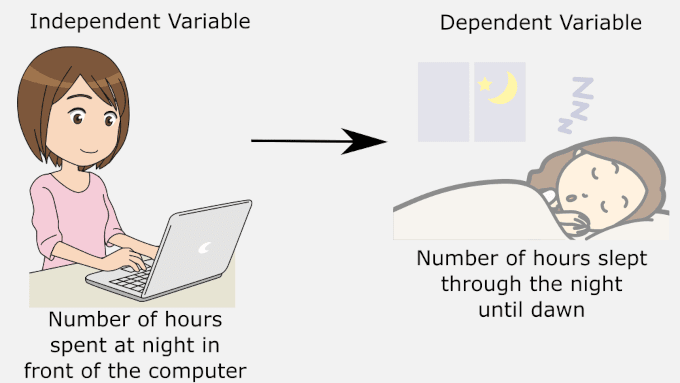
Notice that the variables of the study are explicit in the paradigm presented in Figure 1. In the illustration, the two variables are:
1) the number of hours devoted in front of the computer, and
2) the number of hours slept through the night until dawn.
The former is the independent variable, while the latter is the dependent variable. Both variables are easy to measure. It is just counting the number of hours spent in front of the computer and the number of hours slept through the night in the study subjects.
Assuming that other things are constant during the study’s performance, it will be possible to relate these two variables and confirm that, indeed, blue light emanated from computer screens can affect one’s sleeping patterns. (Please read the article titled “Do you know that the computer can disturb your sleeping patterns?” to find out more about this phenomenon). A correlation analysis will show if the relationship is significant.
💡 Wondering How to Quantify the Intangible?
Abstract concepts like “love” often feel impossible to capture in a research paradigm. But what if you could map human connection into concrete variables? Discover how to turn complex emotions into measurable data by exploring our guide on How to Measure Love: The 6 Levels of Human Connection and find out how to bring new dimensions for your conceptual framework.
Read the Full Article →Evolution of a Social Theory as Basis of Conceptual Framework Development
Related to the development of the conceptual framework, I wrote a comprehensive article on how a social theory develops by incisively looking at current events that the world is facing now — the COVID-19 pandemic. It shows how society responds to a threat to its very survival.
Specifically, this article focuses on the COVID-19 vaccine, how it develops and gets integrated into the complex fabric of human society. It shows how the development of the vaccine is only part of the story. A major consideration in its development resides in the supporters of the vaccine’s development, the government, and the recipients’ trust, thus the final acceptance of the vaccine.
Social theory serves as the backdrop or theoretical framework of the more focused or variable level conceptual framework. Hence, the paradigm that I develop at the end of that article can serve as a lens to examine how the three players of vaccine development interact more closely at the variable level. It shows the dynamics of power and social structure and how it unfolds in response to a pandemic that affects everyone.
Check out the article titled “Pfizer COVID-19 Vaccine: More Than 90% Effective Against the Coronavirus.” This article shall enrich your knowledge of how an abstract concept narrows down into blocks of researchable topics.
References
Haim, A., & Zubidat, A. E. (2015). LED light between Nobel Prize and cancer risk factor. Chronobiology International, 32(5), 725-727.
McGaghie, W. C.; Bordage, G.; and J. A. Shea (2001). Problem Statement, Conceptual Framework, and Research Question. Retrieved on January 5, 2015 from http://goo.gl/qLIUFg
Randjelović, P., Stojanović, N., Ilić, I., & Vučković, D. (2023). The effect of reducing blue light from smartphone screen on subjective quality of sleep among students. Chronobiology international, 40(3), 335-342.
Srinivasan, V., R Pandi-Perumal, S., Brzezinski, A., P Bhatnagar, K., & P Cardinali, D. (2011). Melatonin, immune function and cancer. Recent patents on endocrine, metabolic & immune drug discovery, 5(2), 109-123.
Cite as: Regoniel, P. A. (2015, January 5). Conceptual framework: a step-by-step guide on how to make one. Research-based Articles. https://dev.simplyeducate.me/conceptual-framework-guide/
FAQ: Conceptual Framework: A Step-by-Step Guide
1. What is a conceptual framework?
A conceptual framework is the researcher’s synthesis of literature on how to explain a phenomenon. It maps out the actions required in the study’s course and identifies the variables needed in the research investigation, serving as a “map” or “rudder” that guides the entire research activity.
2. How is a conceptual framework different from a theoretical framework?
The conceptual framework lies within a much broader framework called a theoretical framework. The theoretical framework draws support from time-tested theories that embody many researchers’ findings on why and how a particular phenomenon occurs, while the conceptual framework is more specific to your particular study.
3. What are the 4 steps to create a conceptual framework?
The four steps are: (1) Choose your research topic within your field of specialization, (2) Do a literature review using peer-reviewed and updated research, (3) Isolate the important variables from the literature and figure out how they’re related, and (4) Generate the conceptual framework by building relationships among the variables based on your problem statement or research objective.
4. Why should I use peer-reviewed journals for my literature review?
Peer-reviewed journals offer reliable methods, accurate results, and useful citations you can build on. Peer review increases the likelihood that methods and conclusions were critically evaluated, and recent studies show the current state of knowledge, methods, and debates in your field.
5. What types of variables should I identify in my conceptual framework?
You should identify independent variables (factors the researcher manipulates or categorizes), dependent variables (the outcomes measured), and control variables (factors kept constant to reduce bias). Some studies also include moderating or mediating variables, which help explain or influence the relationship between the independent and dependent variables.
6. How do I know which variables to include in my framework?
Include only variables that are directly relevant to answering your research question. Avoid adding variables just because they appear frequently in the literature. Your problem statement or research objective acts as the anchor, ensuring that every variable and relationship serves the central purpose of your study.
7. Should my conceptual framework be visual or written?
Your conceptual framework can be presented visually (using boxes and arrows showing causal links, correlations, or interactions) or narratively (explaining the logical connections in words). Most researchers use a combination of both, with a visual diagram accompanied by written explanation.
8. How does the conceptual framework relate to my research gap?
Your conceptual framework should address a knowledge gap by attempting to answer questions that other researchers have not explained yet. It should demonstrate how your research builds upon existing knowledge while targeting a specific gap, making your work both original and necessary.
©Simplyeducate.me | P. A. Regoniel
i want to use this book because it is very useful book. for developing thesis
its really interesting………………….
good stuff for postgraduate students
I heard about conceptual framework recently and I’m supposed to include it in my paper. I am doing determinants of vegetables. Could you please offer some assistance on how to go by it?
I really need an extra hand on how to go by mine, even if a sample is available, I would really appreciate.
Dear Gideon,
What do you mean by determinants of vegetable? Are you growing vegetables? What do you intend to do?
I am to include it in my term paper, the topic is historical development of American art
I heard about a conceptual framework from a friend and I want to use it in my study titled conceptual framework in teaching and learning in electrical technology. Infact I am confused in drawing the objectives because ideas from others. when I accidentally login your website I found that you can be a solution to my problem. please I will appreciate if given attention. thank you
Dear Satumari, please just clarify what you intend to do in your study. Be clear on what is the purpose or objective of your study.
My research top is : Roles of negotiate in conflict resolution, a case of Gulu Uganda.
Question, does this research top fit in well for Governance and international relations student?
How best can I come up with the conceptual framework? Considering the IV and DV.
Any help?
I meant roles of negotiation in conflict resolution. Sorry for the typo in the previous submission
I really need help on how to design a framework of impact assessment of reuse of electronic waste in a company I am doing an internship with. Can you help me with the step by step guide on what to do
Dear sir regoniel, i am having a hard time about how to make conceptual framework of my thesis, please help me. My study title is ‘determinants of speacialty preferences among radiologic technologist and its impact to job satisfaction. Please sir i need your help. Thank you in advance.
please I need conceptual framework on accessment of agricultural support services on yam production
Kindly help me in designing a conceptual framework. My resesrch topic is on RRFERRAL PROCESS AND FACTORS INFLUENCING ITS UTILIZATION IN SELECTED HEALTHCARE INSTITUTIONS
please I need you to help me develope the theoritcal and conceptual framework my topic is the impact of exchange rate on construction project delivery in the construction industry
So how would you learn it if he has to develop it for you? Please, I don’t mean to be mean but academics does not work that way. You read through and then ask for questions for guide. That way, you would learn for future. You get what I mean?
kindly help me making conceptual framework about implementing monthly coastal clean up. Please <3
Dear Patrick,
I thank you immensely for the blog posts. I am super grateful! You wouldn’t really understand how helpful this is to me.
Thank you!
Welcome Chisom… And thank you for helping me advocate for self-learning. That is the intention of this site.
My study is about investigating the uterotonic activity of herbal medicines that induce labour. I need to produce a conceptual framework. Please help.
The topic of my technical study is titled I quote, ‘ The impacts of informal land subdivision in peri-urban areas’ case study of XYZ municipality , please kindly advise on how to formulate a conceptual framework of my study.
@Phiri and John, please read the article and see which of the things I explained are not clear. Thank you.
How to make theoritical framework and conceptual framework in eat all you can business?
Dear Irene, what do you want to know?
Am supposed to develop a conceptual framework based on three variables; abusive supervision, organization justice and CWBs… But its challenging. Any help please
Dear Christine, you need to read the literature about your keywords. Just be clear about what you want to do. What is the issue that you want to understand, or a problem that you want to solve. Start from there.
Please I need help on using conceptual and theoretical framework for decongestion of a city
Sir, i am having a hard time about how to make conceptual framework of my thesis, please assist. My study title is Incidence, characterization and management of onion purple blotch disease . Please sir I need your usual cooperation. Thank you.
Dear Iliya, please read literature about purple blotch disease. Find out what are the causes of this disease and see if there are unaddressed issues or gaps in knowledge that you would like to study.
Help me to create a conceptual framework of my study: Bullying and Performance among Students”
Dear Cicelle, you need to identify the indicators of bullying and relate this to academic performance if that’s what you mean.
hello Mister:
If my study is descriptive quantitative research, do I have to make a conceptual framework like in a paradigm? or should I just write a descriptive paragraph?
I hope you could help me with this.
Thank you.
I have the same question, my study is a descriptive-survey, how to make a conceptual framework for this? Thank you very much
Dear Raz, please read the expanded version of my explanation of the need for a conceptual framework in this more recent post: https://dev.simplyeducate.me//2020/11/05/what-is-a-conceptual-framework/
Hello Mary Rose, in working out a conceptual framework, you are showing things which have been done and what you intend to do. It serves as a guide in understanding what the study is all about. Since your work is quantitative, I assume you will be relating some variables with something else. Hence, you need a conceptual framework to guide you along the way.
What do you intend to do by the way? What are the objectives of your study?
Hi Patrick!
Thank you very much for responding to the question from Mary Rose as it was also clicking on my mind too after reading your notes and my little knowledge on research,
Welcome Mathias. Your research objective becomes clear as you read the literature. The key is identifying the focus of your study, i.e., what can you add to the present body of knowledge.
How i write a conceptual frame work in APA format?
Would you please tell me?
Help me with a conceptual framework on The relationship between health literacy and water, sanitation and hygiene practices in cholera affected communities.
Dear Winnie, your independent variable is health literacy and the dependent variable is water, sanitation and hygiene practices as measured by your indicators. For example, the frequency of hand washing in a day may be your measure.
I need the book it seems it can help me to complete my research on Incidents/accident in the fuel Industry
Hi
Thank you for sharing this guide with us.
The title for my study is- the lived experiences of stigma related to hearing aid usage. I have been struggling to make a conceptual framework for my study. I do have objectives and a research question. My problem is, I do not know how to structure the Conceptual Framework. Please help.
thank you
Dear Gcinile, what you want to do is a qualitative study if you will just describe people’s accounts. However, from what I could surmise from your study you would like to associate the use of hearing aid and stigma. That could qualify as a quantitative study. The independent variable may be a visible or not visible hearing aid and the dependent variable will be stigma which can measured by the level of confidence a person has if wearing a hearing aid. If you will just associate them, then your framework will be just the concepts hearing aid use and stigma: hearing aid use –> stigma and expound on them in your paper. You should define as well these terms.
My topic is”The influence of headmasters leadership behavior on teachers job commitment. Any help to construct the conceptual framework?
Dear Lincoln, find literature on leadership style and job-related concerns. Try to find a way to measure job commitment. What is its indicator?
How to write conceptual framework on “how can overcrowded classroom affect academic performance of the primary school students”?
Thanks so much for this explanation.
Dear Prof
How can I write a conceptual framework on ” an exploration on the challenges facing the teaching and learning of calculation of elapsed time in Grade 3″
Dear Bulelwa, please make your statement of the problem clear first. What do you want to do? Why do you want to do such study? To make that clear, you need to review the literature to find out what others have done along your research concern.
Dear Prof
How can I write a conceptual framework on ” A Conceptual Framework for Mobile Augmented Reality Environment for Young Children using Assistive Button Interaction” ? I hope you can help me to give idea . Thank you
Dear Amira, review the literature to see how mobile augmented reality affects young children. You need to read to find out.
Dear Prof
Help me with a conceptual framework on an Online fleet Management system . Thank you
Dear John, you need to make clear first what you intend to do. You have such a broad topic.
My only question is: is it necessary to use both theoretical and conceptual frameworks or one may substitute the other depending on the nature of the study? I have come across studies that use both and others that opt for either of the two. Seriously need a help.
Dear Mahega,
Depending on your university and course. Usually conceptual framework is mandatory as it shows the relationship between the outcome variable and independent variables. However, a theoretical framework is used to ground mainly by those in humanities. In science based courses, you only need a conceptual framework. Social sciences and humanities, you need both
Dear Prof
Help me with a conceptual framework, my topic is on challenges of debt management in a hyperinflation economy
Dear Charles, that’s too broad a topic. What do you want to look into about debt management? Are you talking about an individual or an organization? Narrow your topic further.
i am carrying a study on debt management of a specific local authority
Dear Charles, so what do you intend to do with the challenges of debt management of that specific local authority? You should clearly state the purpose of your research. So what if you know the challenges?
Besides, I’m investigating how personality traits are related to language learning strategies among EFL learners. I have hardly found a single theoretical framework that could account for the two. Accordingly, I have opted for only a conceptual framework with personality traits being my predictor variables and language learning strategies the criterion variables. Any assistance please.
Regards,
Renatha
Dear Renatha, as I’ve mentioned, the conceptual framework is your own construction based on the theories you have reviewed. It is just fine to have a combination of theories to come up with your own idea on how things are related. That’s how science works. We synthesize previous findings.
Dear Patrick,
I wrote a paper on how the COVID-19 has affected the labor market and now I have to write the conceptual framework.
I would like to know if the conceptual framework has to be a different chapter in the paper or I have to write only 2-3 sentences about what I intend to do with my study?
In the case I have to write only 2-3 ideas, in which chapter(Introduction, methodology, conclusion, etc) should I introduce the conceptual framework?
Thanks a lot!
Dear Cristina, considering that the conceptual framework provides the “map” of your study, it should be placed after introducing your topic and reviewing the literature. It’s your construct of how things are related after seeing others’ viewpoints where you saw a “gap” on what has already been done. If you are using the IMRAD format, that means you have to integrate it in your Introduction.
VERY GOOD MATERIAL FOR STUDENTS LIKE ME . THAN
im asking your advice guys, because our research topic is learning challenges in new normal and im having a hard time citing authors ugh help me
Dear Dowell, please read this article to guide you on how to go about your review of literature: https://dev.simplyeducate.me//2018/02/16/review-of-literature/
Hi, my research topic is Demographics of unemployed residents in barangay indulang what are the variables here?
Dear Twinky, you are the one who should define your variables in your demographics. Demographics is the study of a population so the variables you will consider will be factors like age, educational attainment, sex, years unemployed, etc. The variables you include will depend on the objectives of your study.
Hi … I have finished designing the conceptual framework for my study. I want to ask what I should do with the variables in the framework. Am I supposed to define the variables or to explain them?. If an explanation is needed, then how should I go about it?
Please do assist, I am greatly in need of some assistance.
Dear Lizy, if it is a thesis, you will need to include the variables in the Definition of Terms section of your study. Define the words in your study using a reference (conceptual definition), or define them as you intend them to mean (operational definition).
Good day! Thank you so much for this very informative post about the conceptual framework. I was able to understand it now. It’s very organized and well-explained.
Dear Cindy, good day, too. I am glad that you find this article very informative. I’m happy that my writing has served you well just like the others. Keep safe…
Dear Patrick,
Good day. A question please, must the variables that are used in the conceptual framework appear on the literature review? Or can one use other variables of a concept that are not mentioned in the literature review or in the research proposal?
Dear Atabongwoung,
You can always add a variable that you find relevant in your study. Relevance means that you have a sound basis for adding that variable. It may be something that you yourself observed to influence the dependent variable but found no reference material to cite. You must, however, watch out for spurious variables, meaning, variables that may have an effect but which may be just coincidental.
Do descriptive studies require a conceptual framework?
Yes. You may develop a conceptual framework for a qualitative study but it all boils down to the study’s objectives. Qualitative studies may not always require a conceptual framework. I discussed this concern in my ebook on conceptual framework.
I am doing a lived experience qualitative study, How do I decide on a conceptual framework
Good day! I would like to seek help because. I am struggling with my conceptual framework of on my quantitative research. my title is Factors of Cigarette Smoking Among Student
Hello Gemma, first things first. Make sure you have written your research objectives. It should be clear in your mind. What do you want to do?
Hello, I am interested in learning more about the conceptual framework and wanted to buy the second edition of your eBook. However, the Paypal link doesn’t seem to work, despite multiple trials. Would you mind looking into this issue? Thanks!
Hello Shijia, it should work now. Just try clicking on it and follow the instructions.
This article is very helpful, especially for a young researcher like me. Thanks a lot.
Incredible indeed! I have learned a l0t while reading this article. It’s crucial and helpful.
Good day, I am working in a thesis on the effect of communication and information as a tool for information at the workplace and I am wondering what my conceptual framework should be like.
Dear Ruth, perhaps what you intend to do is to find out if the communication tool (whatever it is) affects the work productivity of the employees. You have to be clear with the objectives of your study. Just type “research objectives” in the search box of this website and it will show you the articles related to writing the research objectives.
My research topic is ‘identification of difficult concepts in teaching basic science and technology in junior secondary schools’
Pls give me the theoretical/conceptual frame work. Thank you.
Dear Moses, what do you mean by difficult concepts? It’s too broad. What may be difficult to one person may not be difficult to another.
Very interesting and educative information. Please guide me with Conceptual Framework of my study on Performance Management System in an organization: Exploratory Case Study
Doc please I am working on informal settlements and pollution Behaviour in the Adentan Municipality
My Objectives are
1 To map out and identify informal settlements in the Adentan Municipality
2. Identify sources of pollution in informal settlements
3.evaluate the influence of indiscriminate waste Disposal on the health of informal dwellers and their environment
4. Establish populations behavior towards the environment.
5. Identify Behavior Change Techniques which can reduce indiscriminate waste Disposal in informal settlements
How best can I link my variables I am very confused in building my conceptual Framework.
Dear Eugenia, upon reading your objectives, I can see that you need to harmonize them as some of the objectives appear to be redundant. You need to focus your research on a particular issue. From what I can discern, you would like to know if there is a relationship between the waste disposal behavior of communities and the amount or volume of waste produced. You can make a comparison between informal and formal settler waste disposal behavior in terms of the waste they generate.
Please, I need assistance with a theoretical or conceptual framework on the topic:
The expectations and experiences of nursing students on the use of the online medium of education during the Covid-19 pandemic
Dear Captain, your intended study sound like a qualitative one. You can create constructs for the items you would want to study.
Assessing the use of Geographic Information Systems (GIS) as a storage information tool in estate management:
How do i come up with a conceptual framework. What would be variables??
Dear Mbuso,
Why will you assess the GIS use in estate management? What is it for?
My topic is; Mitigating against Childmaltreatment in earlychildhood through positive parenting: Chronicles of first time parents in XYZ City”
How do I come up with a conceptual framework? What would be variables?
Hello Phathi,
Apparently, you are trying to relate parenting and child behavior?
My topic: E-commerce Platform for Agricultural and Construction Supplies with e-KYC Identification, Feed Page, and Products Bidding
Will you please help me to make Conceptual Framework written with visual representation. thank you so much in advance.
Good day Jomar, I am not so clear about what you want to do. Can you write the objectives of your study? You can read about framing the research objectives here: https://dev.simplyeducate.me/2020/03/15/research-objective/
our topic is Neutrophil and Lymphocyte Ratio as a Diagnostic Biomarker for Kidney Stones (experimental)
How do I come up with a conceptual framework? What would be the variables?
My name is Jobson, my research topic is: The scope of Ugandan nurses and midwives in using the nursing process in the care of patients
hi Doc
I read the article how still struggling to come up with a conceptual framework, may you please assist, how should I go about as a new researcher
my topic; INVESTIGATE THE DECISION TO TRANSFER NINE (9) FUNCTIONS OF ENVIRONMENTAL HEALTH TO LOCAL GOVERNMENT .
Purpose: The purpose of this research is to review the delivery of EHS at the local government with a view to understanding the variation in performance and their causes.
questions are:
1.2.1 What factors explain the performance variation in the delivery of EHS across municipalities?
1.2.2 How has devolution of the EH function aided or harmed the delivery of EHS?
Hello Mr. Siyabonga. I think what you want to find out is how environmental health services (EHS) performed at the local government level. In doing so, you need to have a set of indicators of successful transition. How is performance assessed? Once you already have a measure of success, then you need to define which variables in the local government have significantly influenced performance. After you have done so, then you can try to correlate local government characteristics and their performance.
I hope that helps.
Hello Jesse, there are many free alternatives online if you are diligent enough in finding them. The reason I wrote this article is that in 2015, when I originally wrote it, I could not find an easy-to-understand explanation of the conceptual framework which will help my students. I also have a vague knowledge of the concept at that time, even with the available literature. Hence, I painstakingly gathered all materials I could from online and offline literature, synthesized them, and wrote about the concept in the simplest way I could without losing the essence. Now, I have seen many articles and even videos using the ideas I have rigorously prepared. If you find the tedious work I did irrelevant, then perhaps the ebook is expensive notwithstanding the many expenses on hosting, domain name, time and effort in maintaining the site that I incur in keeping this website online and make this ebook available to everyone.
hallo! I would like to study “the socio-economic and environmental Impact of urban forests on livelihood: The perception of urban residents” how can my conceptual framework be like?