
This article defines what is a curriculum and explains the four major foundations of curriculum and their importance in education. We provide infographics to illustrate how these psychological theories influence the learner.
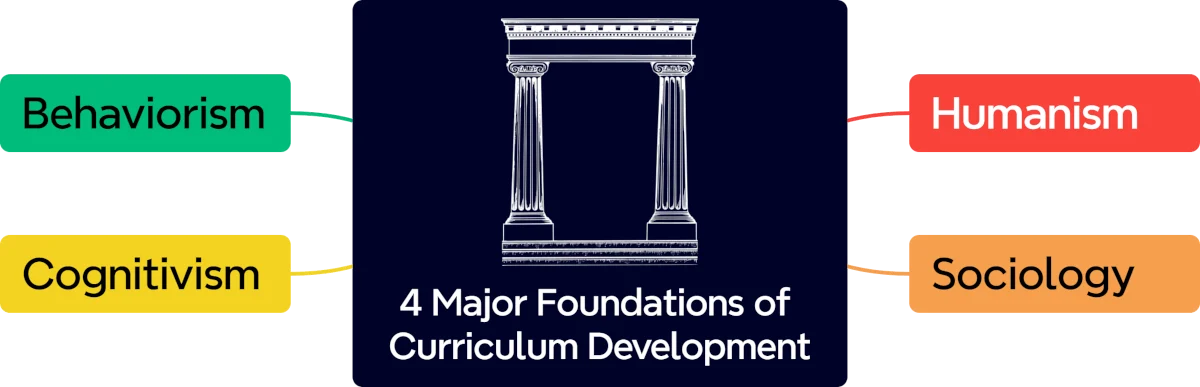
Read on and reflect on some experiences you have had in school. Match it with how philosophy, history, psychology, and sociology influence those experiences of yours.
📄 Prefer reading offline? Get an ad-free, print-ready PDF version with a clickable table of contents.
Download PDF Directly From This Page ↓Table of Contents
What is a Curriculum in Education?
Before looking at how a curriculum is built, we must understand what it actually is.
A curriculum is the structured blueprint of lessons, assessments, and learning experiences designed to guide students through an educational program. In other words, it is not just a list of textbook chapters; it is the ultimate roadmap that connects what a teacher says, what a student experiences, and how that growth is measured.
A curriculum is the structured blueprint of lessons, assessments, and learning experiences designed to guide students through an educational program.
Basis of Curriculum: The Influence of Philosophy
Educators, curriculum makers, and teachers must have espoused a philosophy or philosophies deemed necessary for planning, implementing, and evaluating a school curriculum. The philosophy they have embraced will help them achieve the following:
- define the school’s purpose,
- identify the essential subjects to be taught,
- design the learning students must have,
- develop approaches or methodologies on how students can gain the knowledge, skills, and attitude,
- produce the instructional materials,
- identify the methods and strategies to be used, and
- determine how teachers will evaluate students.
Likewise, philosophy offers solutions to problems by helping the administrators, curriculum planners, and teachers make sound decisions. A person’s philosophy reflects his/her life experiences, social and economic background, shared beliefs, and education.
When John Dewey proposed that “education is a way of life,” his philosophy is realized when put into practice. He means that learning is an ongoing, experiential process integrated into daily living, which demonstrates its true value when actively applied to real-world experiences.
Now, particularly in the Philippines, Dewey’s philosophy served as an anchor for the country’s educational system. That is because Dewey’s pragmatic philosophy—emphasizing practical, hands-on learning, critical thinking, and civic engagement—was adopted during the American colonial period to replace rote learning and build a public school system tailored to democratic nation-building.
History and Its Influence to Curriculum
The history of one’s country can affect its educational system and the curriculum.
If we trace the curriculum’s formal beginning, we get back in time to Franklin Bobbit’s book entitled “The Curriculum,” published in 1918.
From Bobbit’s time to Tyler, many developments in the purposes, principles, and contents of the curriculum took place.
Please read the Six Famous Curriculum Theorists and their Contributions to Education for more information on how the philosophies shaped curriculum development.
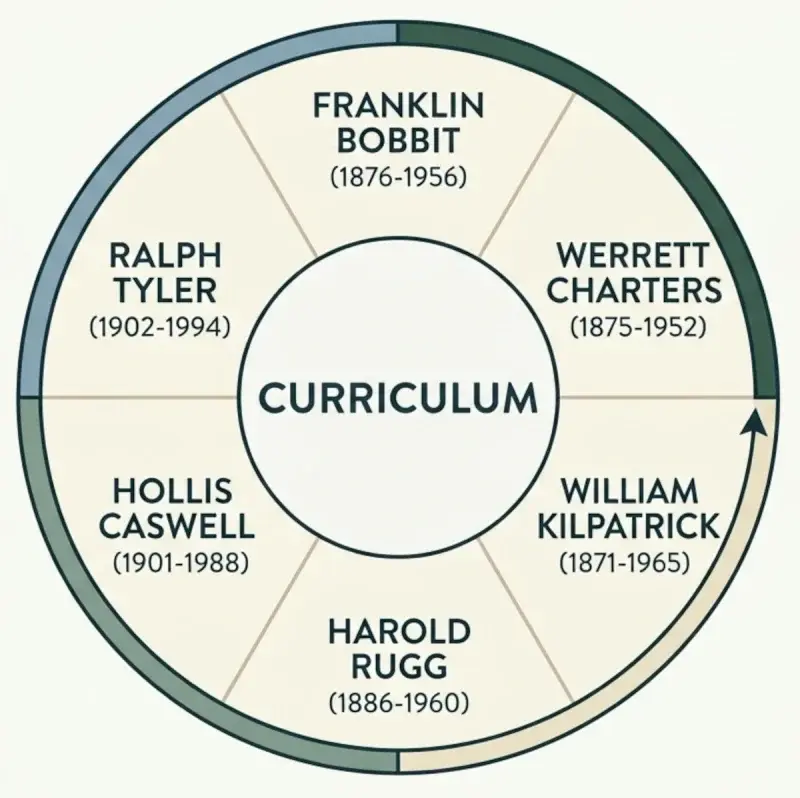
Six Famous Curriculum Theorists and their Contributions to Education
The six famous curriculum theorists and their specific contributions to the development of the curriculum that we know today.
Four Major Foundations of Curriculum and the Influence of Psychology
The curriculum is influenced by psychology. Psychology provides information about the teaching and learning process. It also seeks answers how a curriculum will be organized to achieve students’ learning at the optimum level and what amount of information they can absorb in learning the various contents of the curriculum.
The following are four psychological theories in learning that served as major curriculum foundations in curriculum development:
1. Behaviorism
Education in the 20th century was dominated by behaviorism. The mastery of the subject is given more emphasis. So, learning is organized in a step-by-step process. Using drills and repetition are common.
Behaviorism focuses exclusively on observable actions—specifically, how an external stimulus triggers a specific response, reinforced by rewards or punishments. To educational psychologists who criticized this view, this approach reduces the profound art of learning to a series of predictable, automated habits.
Though many are skeptical about this theory, we can’t deny the influences it had on our educational system.
2. Cognitivism
Cognitive theorists focus on how individuals process information, monitor and manage their thinking.
The basic questions cognitive psychologists zero in on are:
- How do learners process and store information?
- How do they retrieve data and generate conclusions?
- How much information can they absorb?
With their beliefs, they promote the development of problem-solving and thinking skills and popularize critical thinking, reflective thinking, creative thinking, intuitive thinking, discovery learning, and others.
Learning is an active, internal process of structuring meaning, rather than a passive reaction to external rewards or rote memorization.

By shifting the focus from external behaviors to internal mental processing, cognitive psychology emphasizes that the brain functions much like a dynamic processor—organizing, connecting, and manipulating information to navigate complex tasks.
This thinking process resembles a computer’s processing, but there is a major difference: while a computer is a static processor that rigidly manipulates meaningless data using pre-written code, the human brain is a dynamic, living processor that actively transforms its own interconnected networks to construct meaning, feel emotion, and make intuitive leaps.
3. Humanism
Humanism is taken from Gestalt’s theory, Abraham Maslow’s theory, and Carl Rogers’ theory. This group of psychologists is concerned with the development of human potential.
Humanism integrates the holistic perspective of Gestalt psychology—which views an individual as a complete, unified whole rather than just a collection of behaviors—with the pioneering theories of Abraham Maslow and Carl Rogers. By focusing on the unique inner experience of the individual, Maslow’s concept of self-actualization and Rogers’ emphasis on a supportive, person-centered environment provided the framework for understanding human growth.
Furthermore, humanism is a philosophical and ethical stance that emphasizes the value, agency, and potential of human beings. Rather than relying on religious dogma, superstition, or divine intervention to understand the world and solve problems, humanism focuses on human reason, science, empathy, and the enrichment of life in the here and now.
Ultimately, this collective school of thought shifts the educational focus away from rigid testing or mechanical conditioning, aiming instead to nurture creative, self-directed individuals and maximize their inherent human potential.
In this theory, the curriculum is after the process, not the product; focuses on the learners’ personal needs, not on the subject; and clarifies psychological meanings and environmental situations.
In short, curriculum views founded on humanism posit that learners are human beings who are affected by their biology, culture, and environment. They are neither machines nor animals.
Curriculum views founded on humanism posit that learners are human beings who are affected by their biology, culture, and environment.
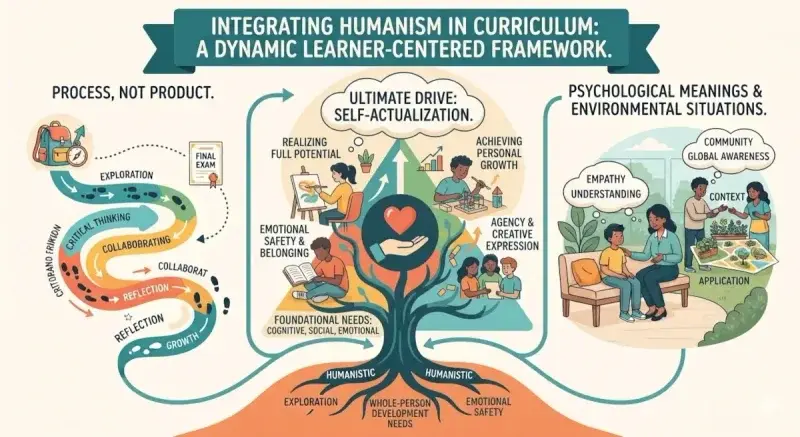
Along this line, curriculum developers must craft a more advanced, more comprehensive curriculum that promotes human potential. Teachers educate not only the minds, but the hearts as well.
4. Sociology and Curriculum
Among the major foundations of curriculum development, the sociological foundation emphasizes the influence of society on education. It is founded on the belief that there is a mutual and encompassing relationship between society and curriculum because it exists within the societal context.
To fully understand this dynamic, curriculum designers rely on several key sociological theories:
- Structural Functionalism (Emile Durkheim): This perspective views schools as vital organs of society that maintain social order and stability. Under this lens, the curriculum is designed to transmit core cultural values, language, and norms to the next generation, effectively preparing students to function smoothly within existing social roles.
- Conflict Theory (Karl Marx): In stark contrast to functionalism, conflict theory posits that curriculum is not neutral; instead, it can inadvertently perpetuate social inequalities, economic gaps, and class divisions. It focuses on the “hidden curriculum“—the unwritten, informal lessons about power and status that schools teach—and advocates for a curriculum that empowers marginalized groups to challenge systemic injustices.
- Social Constructivism (Lev Vygotsky): This theory bridges sociology and learning by asserting that knowledge is not absorbed in isolation, but co-constructed through social interaction, language, and cultural tools. In curriculum development, this justifies collaborative learning, community-based projects, and contextualized lessons that reflect the learner’s immediate environment.
- Symbolic Interactionism (George Herbert Mead): This micro-sociological theory examines how daily face-to-face interactions, labels, and classroom rituals shape a learner’s self-concept and worldview. It reminds curriculum developers that the written syllabus is heavily influenced by how teachers and students dynamically interpret meanings in the classroom.
Though schools are formal institutions that educate the people, other units of society educate or influence the way people think, such as families and friends, and communities. Primary social circles like families, friends, and the broader community serve as informal educators that deeply shape a person’s core values, behavioral habits, and daily worldview.
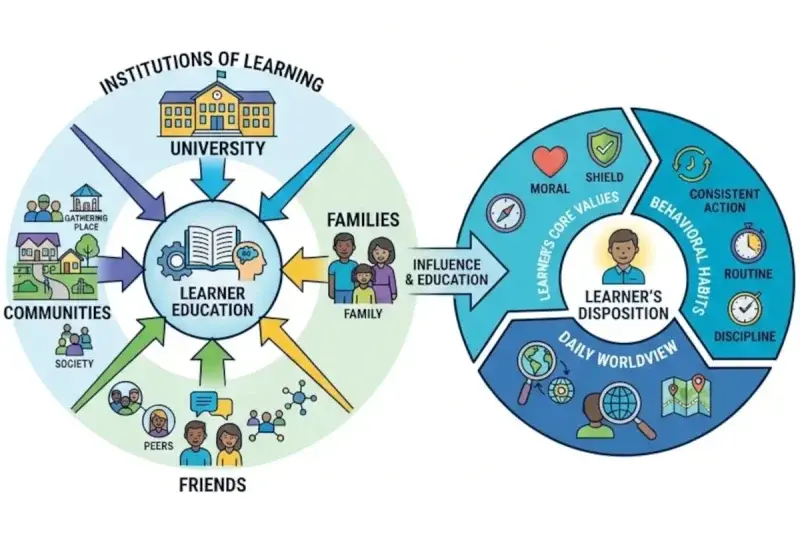
Since society is dynamic, many developments are difficult to cope with and adjust to. But the schools are made to address and understand the changes not only in one’s country but in the world as well.
Summary and Conclusion
Now, I summarize these four major theories of learning that served as foundations of curriculum development in one matrix below comparing the focus, key idea, how learning occurs, the role of teacher and the role of learner.
| Theory | Focus | Key Idea | How Learning Occurs | Role of Teacher | Role of Learner |
|---|---|---|---|---|---|
| Behaviorism (Pavlov, Skinner, Watson) |
Observable behavior | Conditioning through stimulus and response | Reinforcement and punishment shape behavior | Trainer, provider of reinforcement and feedback | Reactor to external stimuli |
| Cognitivism (Piaget, Bruner, Ausubel) |
Mental processes | Mind works like a computer; schema building | Information processing, organization, memory use | Organizer, explainer, scaffold of knowledge | Active processor of information |
| Humanism (Maslow, Rogers) |
Personal growth and emotions | Learning is self-directed and student-centered | Motivation, self-actualization, and choice drive learning | Facilitator, guide, supportive mentor | Self-motivated, responsible for own learning |
| Sociocultural (Vygotsky) |
Social interaction and culture | Learning occurs in social context | Collaboration, language, Zone of Proximal Development | Scaffolder, encourages collaboration | Co-creator of knowledge within a community |
Therefore, schools must be relevant by making their curriculum more innovative and interdisciplinary. A curriculum that can address global learners’ diversities, the explosion of knowledge through the internet, and the educational reforms and policies recommended or mandated by the United Nations.
However, it is also imperative that a country must have maintained a curriculum that reflects and preserves its culture and aspirations for national identity. No matter how far people go, it is the country’s responsibility to ensure that the school serves its purpose of educating the citizenry.
Now, it is your time to reflect. Can you think of your experiences in which the major foundations of the curriculum can explain it?
Try to ask yourself the following questions:
- Why should I take history, philosophy, psychology or even PE subjects in college?
- Why is it that the Department of Education is implementing K to 12 and the mother tongue-based curriculum?
- Why is there institutional amalgamation?
- Why is there “One UP” (One University of the Philippines) now in the Philippines?
- Why is there a need for a globalized higher education?
These questions imply that change will take place soon. So, brace yourself for the many changes that will take place in education!
What are the different types of curriculum that arose based on these major foundations of the curriculum?
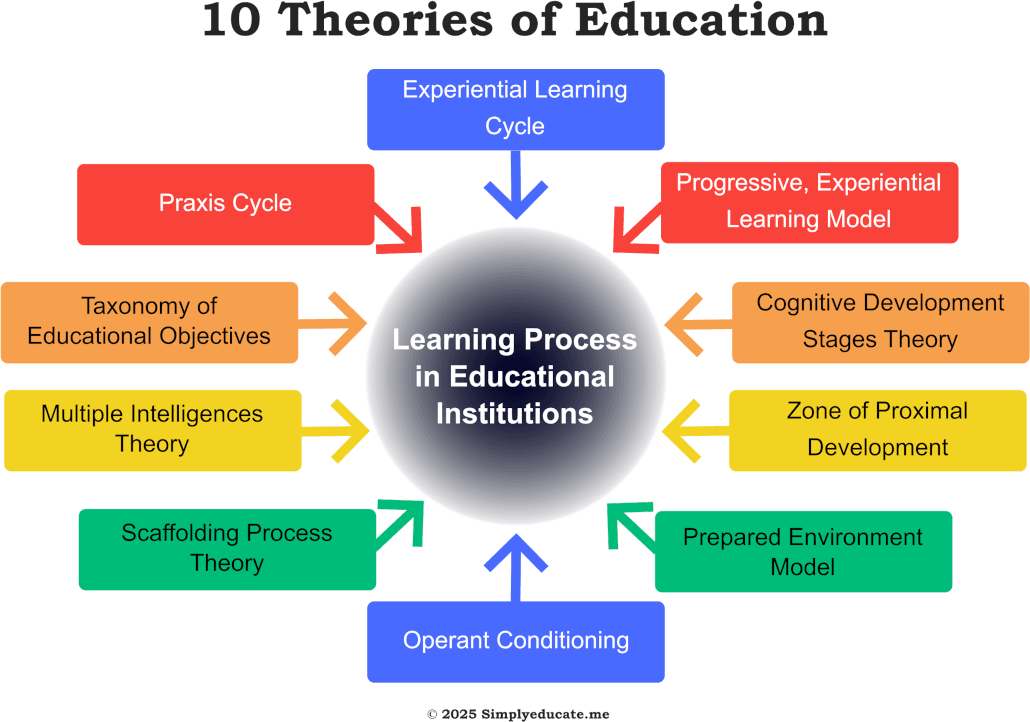
Find out in our engaging discussion focused on the 7 School Curriculum Types and Their Classroom Implications. Also, check out the 10 theories of education that shaped education as we know today.
Related Post
This article presents 10 of the major theories of education including a description of the theory with diagrams and contributions to the development of education as we know today.
Frequently Asked Questions (FAQ)
Why is philosophy important in curriculum development?
Philosophy provides the foundation for curriculum planning, implementation, and evaluation. It helps define the school’s purpose, choose subjects, design learning activities, and guide teaching methods. Without philosophy, curriculum decisions would lack direction and coherence.
How does philosophy influence what subjects are taught?
The philosophy embraced by a school determines which knowledge and skills are considered essential. For example, a progressivist philosophy influenced by John Dewey emphasizes problem-solving, critical thinking, and real-life learning experiences.
What is the relationship between history and curriculum?
History shapes curriculum by showing how educational purposes and content evolved over time. For instance, Franklin Bobbit’s The Curriculum (1918) and Ralph Tyler’s principles influenced how schools structured learning objectives, content, and assessments.
How does psychology affect curriculum design?
Psychology explains how students learn, which guides curriculum structure and teaching strategies. Behaviorism emphasizes drills and reinforcement, Cognitivism stresses information processing, Humanism highlights personal growth, and Sociocultural theory values social interaction and collaboration.
What role does sociology play in curriculum development?
Sociology examines the relationship between society and education. A curriculum must respond to cultural values, community needs, and social changes. It ensures that schools prepare students not just for personal success but also for active participation in society.
Who are the major theorists behind the foundations of curriculum?
Key contributors include John Dewey (philosophy and progressivism), Franklin Bobbit and Ralph Tyler (history of curriculum), Pavlov, Skinner, and Watson (behaviorism), Piaget, Bruner, and Ausubel (cognitivism), Maslow and Rogers (humanism), and Vygotsky (sociocultural theory).
How is the Philippine curriculum influenced by these foundations?
The Philippine K to 12 program and mother tongue-based curriculum are influenced by philosophy, psychology, and sociology. Dewey’s progressivism guided experiential learning, while sociocultural principles shaped community-based and culturally responsive education policies.
Why must the curriculum be continuously updated?
Society and knowledge are dynamic. The internet, globalization, and United Nations educational reforms require schools to make their curriculum innovative, interdisciplinary, and globally competitive, while still preserving national identity and culture.
Reference
Bilbao, P. P., Lucido, P. I., Iringan, T. C., and R. B. Javier (2008). Curriculum development. Quezon City: Lorimar Publishing, Inc.
Cite as:
Alvior, M. (2026, October 3). Four major foundations of curriculum and their importance in education. SimplyeducateMe. https://dev.simplyeducate.me/foundations-of-curriculum/
© Simplyeducate.me | M. G. Alvior
Four Major Foundations of Curriculum
Elevate your research and classroom instructional design. Download your personal copy of this essential e-article, meticulously formatted for quick reference and seamless academic reading.
What’s Included in This Premium Edition:
- ✓ Clickable Table of Contents: Jump directly to key sections, theories, and comparative matrices instantly.
- ✓ Distraction-Free Reading: Completely zero ads, pop-ups, or banners for uninterrupted learning.
- ✓ Print & Note-Ready Format: Beautifully prepared in standard 8.5 x 11 in dimensions—perfect for printing or desktop annotation.
beneficial to all classes of people in the education & many more.
Hi, Heng Srien! Thank you so much for a wonderful comment. I wish that you will also share this site to your family and friends. God bless.
can i ask if you can give some examples of situation where those foundation of curriculum can be use? each foundtion
thanks a lot
thank you for your good views.welcome Arusha Tanzania
Hi,purchased your ebook awhile ago. But i think i missed some links to download it. I have the email xonfirmation with me for the payment. I really need your help.thank you
Thank u so mch mary. The info is helpful
How can i contact you ?
Hi. I am a student of department of education 5th semester and, I ask that how philosophy contribute curriculum
hi mam can i ask, how are these foundations interrelated to one another in crafting a curriculum?
Hi, Mary thank you for many information but can I ask you this? Why is there “One UP” (One University of the Philippines) now in the Philippines?
Hi, Tom! I don’t exactly get what you mean. But if you don’t clearly understand something , please ask me and I am willing to help you. Thank you so much.
Regards,
Mary
Can you please give or cite a situations or samples of each foundations of curriculum? I need it for the completion of my Field Study subject…ASAP please..
HI! It would be easier for me to answer you if I know your field of specialization or degree, so that I can explain it well. Anyway, I will give you examples as to how a curriculum can be developed using the four foundations. Let’s simplify it. If you are doing it for a degree program (macro level), It means that the subjects to be offered be related to the four foundations. For example, students should have at least one subject under philosophy, history, psychology and sociology as part of the basic subjects. However, it depends on your Curriculum Development Committee guidelines, procedures, and policies. In some universities, the subjects are arranged as: basic, major, cognates, and electives. So, in the basic subjects, you can think or choose a particular subject under philosophy, and so on. Here are the specific examples (Philippine setting):
Philosophy – Introduction to Philosophy/ Philosophy and Logic
History – History of the Philippines
Psychology – Introduction to Psychology
Sociology – Physical Education
You may also think of other subjects that are related to the program and to the need of the students. In the Philippines, there is a Commission on Higher Education that set the minimum standards. It prescribes what subjects to take and how many units be given per subject, per semester, and the total units for the program. My only suggestion is to have at least one subject as a representative of each major foundation. However, there are already reforms in the educational system. The basic subjects are now placed in Grades 11 and 12, in the Philippines. I hope I am able to answer your questions. God bless to your endeavour.
How does child psychology influence curriculum design? (Using psycho social theory)
Hi Ma’am Mary help me on this please… tnx
what are the philosophical thoughts which serves as the foundation of k-12 curriculum? elaborate their implication to quality delivery of instructional?
no he is just encouraging people to read much
Foundations of curriculum are also referred to as the bases of curriculum, which
determine the quality of curriculum decisions. They are defined as the values, traditions,
factors, and forces which influence the kind, quantity and quality of the experiences
students are offered in schools. Discuss the four major foundations of curriculum.
Madam kindly help.
Mary, I wish know the courses you offered during your Msc. Programme, Please.
Dear Michael,
Hi! Thanks for reading, but can you be specific what information you need? Are you asking for my courses during my MSc, or are you asking the courses that we offer for MSc Program? Since this site is not owned by a university, Dr. Patrick Regoniel currently works in Palawan State University in the Philippines. He is a professor in the Graduate School. His specializations are Environmental Science and Public Administration. You may write or contact him in this site if you are interested in our Graduate School Programs. If you still have other questions, I am willing to help you.Again, thank you so much.
Regards,
Mary
Dear Michael,
Hi! Thanks for reading, but can you be specific what information you need? Are you asking for my courses during my MSc, or are you asking the courses that we offer for MSc Program? Since this site is not owned by a university, Dr. Patrick Regoniel currently works in Palawan State University in the Philippines. He is a professor in the Graduate School. His specializations are Environmental Science and Public Administration. You may write or contact him in this site if you are interested in our Graduate School Programs. If you still have other questions, I am willing to help you. Again, thank you so much.
Regards,
Mary
So i am asian man so i hardly to understand the contexts, so can u answer what’s the most important of studying Foundation of education?
Hi, Mathsary. The most important reason for studying the foundation of education is that it contains all the essential concepts. If you know them well, you will be a qualified, efficient and compassionate teacher someday.
Good after noon kindly explain how those foundation reflect the development of foundation in the 21st century classroom
Then,describe the different foundation of curriculum
Hi, Obadiah! Thank you so much. You may also read other articles in that site. Just take a look at the contents. Enjoy reading!
Thanks, Obadiah.
good morning maam. What is best example of each foundations of curriculum for elamantary?
Hi! Thanks for reading my article. The foundations of curriculum can be seen or manifested in too many ways. It can be the subjects, strategies, and activities inside and outside the school. As to your question, I think I could not give you the best example because that would be quite debatable. But here are specific examples for each:
Philosophy – the emphasis 3Rs (reading, writing, and arithmetic), as basic subjects.
History – lessons like our national heroes, national plants and animals.
Sociology – field trips like visiting the zoo.
Psychology – the use of audio-lingual approach or reading dialogues (from behaviourism).
I hope that I am able to answer your question.
Thanks a lot.
Please Mary help me out on this .
1.the importance of psychogical foundations to curriculum developers
2.importance of sociological foundations to curriculum developers
Dear Kirui Haroon,
We, curriculum developers, recognize the importance of psychology and sociology in designing a curriculum. Psychology is important because it gives us ideas about the teaching and learning process. A curriculum that is written may seem perfect, but once we implement it in the classroom, some problems may arise because we are handling different individuals. So, we have to think and analyse (or shall I say, psychologize) our students in order for them to learn and understand what we teach or facilitate.
Likewise, sociology is important particularly now that our education is getting global. We need to know how students will react in a multi-cultural setting and we need to avoid or lessen the problems in our society. Sociology can help us solve problems in life.
I hope that I have answered your question. Thanks a lot.
Good afternoon kindly explain how those foundation reflect the development of curriculum in th 21st century classroom
Describe the different foundation of curriculum
wooow!!!!!!!!!!! what a succes…..good work.
Hi, Francis! Thanks for reading.
well documented, i hope you will be able to able in curriculum development. My question is these :philosophy,psychology,sociology and history are the major foundations of curriculum.may u shed some more light on the above wth specific reference to how they can be linked.
Mary, thanks for your wonderful efforts to present this information . I will be more glad if you add something on professional foundation and educational foundations. be blessed
Dear Kibet,
Thanks for your suggestion. Yeah, those topics are also essential. If I have time, I will write again. God bless!
Good day maam,can you give the meaning of legal bases of curriculum,.
Thank you maam
Hi Mary,I really love the way you are handling this field of curriculum.I would like to pursue a masters program in curriculum.Could you please guide me…thanks in advance
Hi, Steven. Thanks so much. Yes, it is my pleasure to help you. Just let me know. 🙂
Hi Mary, thanks for the good research you have done in the field of curriculum.
Kindly give me some information about Historical foundations of curriculum design
Hi, Andrew! Kindly click this link, https://dev.simplyeducate.me/2014/12/03/six-famous-curriculum-theorists-and-their-contributions-to-education/
That’s also my article about historical foundation of curriculum. If you cant open that link, just google or bing, 6 famous curriculum theorists and their contributions to education. I hope that I can help you with this. God bless.
kindly tell me how socialogical foundation has influenced development in education with relevant exampes
Hi, Betty! That’s also a good topic to write about. If I have time, I will write about it. Thanks so much and God bless.
That’s great,now how does the psychological aspect in curriculum foundation contribute to curriculum development in Kenya?
Please, kindly highlight these psychologica theories:cognitivism , behaviorism and humanism and it’s influence on education for me.
Hi, Gloria. The article answers your questions in an indirect manner. But don’t you worry, I will give you specific examples and their influence to education..
1. BEHAVIORISM – promotes drills, repetition and memory recall – – – the use of audio lingual approach in teaching language (English & Filipino). Another influence is asking students to memorize rules, lessons, facts or events. Asking and answering questions with who, what, when and where.
2. COGNITIVISM – promotes critical thinking, etc. – – – use of problem solving, experiments, field trips.
3. HUMANISM – promotes human potential, educates the minds and hearts – – – use of value-laden lessons, or after discussing the lesson, the teacher must introduce some values (virtues) that can be deduced from the topic.
You may also read the article below, and other articles in this website. Just look at the left side corner of your desktop, click EDUCATION, and go to CURRICULUM AND INSTRUCTION.
https://dev.simplyeducate.me/2014/12/03/six-famous-curriculum-theorists-and-their-contributions-to-education/
I wish that I am able to help you. I suggest that you read other articles or books about your questions. Thanks a lot.
Helo miss Mary
Please help with following theories..mental discipline theory,natural unfoldment theory,behavouirism and cognitivism.I can define them but could you please explain their philosophical outlooks for eachof these theories in relation of curriculum design and development in schools especially primary schools
Is there anything common that binds the philosophical, sociological, paychology, historical, and legal bases of the curriculum?
Hi, Aileen. Thanks for reading my article. As to your question, I think it is the purpose that binds all. If the purpose of putting up a school, institute, or a university is clear, then the owners, the school administrators or the governing body can choose what kind of philosophical, psychological, sociological, historical bases they must adopt including the legal bases and the emerging foundation which is based on economy. Remember, a school cannot exist without espousing these major foundations.
Hi Ms. Mary, thank you for your informative answers. It helps me a lot.
would you send me any cuuriculum material whchi help me for my PhD program please?
Hi! Ms. Mary, here’s my another question. What will you do to make sure that you will be able to effectively implement the curriculum at the classroom level?
Hi! Sorry for a late reply. I will monitor and evaluate it. Thanks.
..we’re on the same page Aileen.. 🙂
Thanks for dropping by, Askyme.
Hello! thank for ur contribution i fed with ur post in my accademic carrier becouse i offer one course that correspond ur post .
You are welcome.
Thank you so much, Sir! I appreciate it. If you don’t mind how did you do it? I would be glad if you could show or give me a proof that indeed you used my post in this site. Please email me at simplyeducateme1mga@gmail.com.
Sincerely,
Dr. Mary
As a student of educational management, I have really benefited from the presentation. This will help me in understanding the module/course in curriculum studies.
Thank you so much, Sir Donald.
Hi ma’am mary can u pls help me? Will u pls give me an example of graphic organizer based on existing philosophies of education?pls.put even a short explanation thank you and godbless…
Hi, April. Actually, I don’t really get what you mean. There are many graphic organizers, such as charts, diagrams, flowchart, KWL, venn diagram, among others. Probably, you are asked by your teacher to explain the existing educational philosophies through graphic organizers. Because as far as I know, graphic organizers are used as a way of explaining ideas in a systematic and logical manner. They are used particularly for visual learners. No particular graphic organizer is based on a particular educational philosophy. Please clarify to your teacher what he/she really meant. Thanks a lot.
I think she’s trying to say that evolve your own philosophy based on the existing philosophies of education and illustrate it through a graphic organizer. then, explain it.
Can I ask a help?
In my fs 4, im going to evolve my own philosophy based on the exesting philosophies of education and illustrate through a graphic organizer.
Can you give me an example?
Hi, Vanz. Please try to read my two articles:
1. https://dev.simplyeducate.me/2014/06/09/edecolepmentalism-a-personal-philosophy-in-higher-education/
2. https://dev.simplyeducate.me/2014/10/26/translating-the-edecolepmentalism-philosophy-into-a-universitys-vision-goals-and-program-objectives/
About graphic organizer, you can explain that using graphs, concept mapping, flowchart, etc. Thanks.
To someone who wrote me anonymously on February 8, 2016 at 9:58AM. Here are my answers:
As to specific examples of Philosophical, Historical, Psychological, and Social Foundations, please read the thread of conversations or comments in this article. You can find the answers there.
Then, for the example of philosophy based on the existing philosophies of education through graphic organizers, please read my two articles from this site. Go to contents and look for, Edecolepmentalism and then. read this link, https://dev.simplyeducate.me/2014/10/26/translating-the-edecolepmentalism-philosophy-into-a-universitys-vision-goals-and-program-objectives/.
Under philosophical foundations of curriculum,what is the difference between subject matter theories and subject philosophies?
Dear Sir Ken,
Hi! As to your question, I would admit that I’m not familiar with the subject matter theories and subject philosophies. Are there subject matter theories and subject philosophies? What are the examples of those? As far as I know, there are educational philosophies and theories, in general. Now, it depends on the educators/administrators or teachers what they would like to apply in choosing or organizing their subjects or subject-matter. I would highly appreciate if you could give me the links or references regarding the subject matter theories and subject philosophies. Thank you.
hi there ms. Mary
I am a 3rd student from Laguna State Polytechnic University Taking up Bachelor of Elementary Education major in Early Childhood Education.
Regarding to my specialization can you give me a specific example or situation of the four foundation of curriculum. thank you.
hi ma’am Mary!
kindly please answer this.
“what will you do in an effort to share the knowledge you gained about the curriculum to your peers?
I need this for my FS.
Hi, Kenjoe. About your specialization, here are the examples:
Philosophy – talk about common beliefs or about the names of philosophers
History – talk about our national heroes or any cultural or national identities like our national flower, national animal, etc.
Sociology – play, games or field trips
Psychology – ask them questions with WHAT, and try to encourage them to ask questions with WHY. If they could already explain things, you may start asking them with WHY questions.
Please help me popularize this site to Laguna State Polytechnic University.
Regards,
Dr. Mary
philosphy does not really limit on the belief and the naming of the philosophers because it covers the whole aspects of knowledge and even the understanding from the query of human being guided by reason.
Hi, kenjoe. Sorry for a delayed reply. Since your major is Early Childhood, here are the answers:
1. psychology – use of objects with different colors, what they want or not. Another is exposing them to sounds.
2. history – pictures of historical sites or maybe pictures of your countries identity.
3. philosophy – maybe give them situations where they can identify what is good from bad. For example, giving them things which they do not own or possess.
4. sociology – let them play or communicate with others.
hi ma’am Mary!
kindly please answer this.
“what will you do in an effort to share the knowledge you gained about the curriculum to your peers?
I need this for my FS.
Hi, Quena. Once you learned something or discovered something about curriculum, particularly on the current trends, I think , it is your responsibility to share it with others. Curriculum is the heart of the school. That’s why it is important to be shared with others. On my part, I share it through this site for free. Thus, I am asking favour from you to help me share this site with others.
THANK YOU SO MUCH MA’AM MARY
You are welcome, Quena.
mary Give Me specific examples or situation of Philosophical , historical , psychological and social foundations . Plsss .
Thanks for that good research of foundations of curriculum
Hi, Carla! Please read the thread of the comments because I already gave a lot of examples. Thanks.
Hi, Carla. Please read my previous answers.
Nice and thanks Mary for those good and nice foundations of curriculum thanks
Hi Enock. You are welcome.
Hi Ma’am Mary
Mam can you please help me in my take home exam in curriculum development. 1. If you are the head of the institution what will you do to improve the curriculum? What do you expect that the students, teachers and the stakeholders will do? What are the foundation and legal basis of your curriculum?
I am an AB graduate mam batch 2009, Now in 2. I am going to propose revision on my curriculum base on the K to 12 Curriculum in process. What are the foundation and legal basis of your propose curriculum?
Any help you can extend ma’am is greatly appreciated. God Speed!
Hi, Rosalin. The questions are very practical and personal. Since that is the exam, it must be you who should answer it. But to help you, I will give you my personal answer. One, the head can improve the curriculum by obeying/complying the requirements of CHED/DEPED or other institutions that make policies and regulations for the offering of programs. The head should make it sure that it is well implemented by monitoring and evaluating it. For the 2nd question, students, teachers, and other stakeholders only follow/obey, and cooperate with the schools, particularly if they see that what you are doing is meaningful to them. For the last question, I can’t answer that because I don’t know what you have proposed. It is better to ask your teacher. He/she is teaching that subject, therefore, he/she must be an expert in that field. You must be aware of the foundations, and once you know them, you should relate or connect them to your proposed curriculum. Thank you.
Hi Ma’am Mary
What are trends and issues in our education? How did the government address the issues in our education?
Hi, again. Aren’t you aware that K12 in the Philippines is one of the issues and trends? The government instructed DEPED and CHED to answer the issues. There are trainings, seminars, public fora to address the problems.
There are many issues, Ma’am Rosalin. Perhaps the following articles can help you but you should be the one to answer as to how the government addressed/addresses the issues.
https://dev.simplyeducate.me/2015/09/10/innovations/
https://dev.simplyeducate.me/2016/05/24/obe-what-why/
https://dev.simplyeducate.me/2015/09/06/tips-on-how-to-develop-a-unified-curriculum-for-institutional-amalgamation/
I wish these articles can help you.
identification of philosophical foundation in secondary schools curriculum?
ma’am help me for knowing the perfect answer..
Hi, Niki Bharatdwaz. Honestly, your question is hard to answer because the it depends on your school and your country. As to your name, it seems you are not from the Philippines. So, better if you ask or interview the adminsitrators in your school particularly in secondary schools. But in my own point of view, read the educational philosophies so that you have a background, and then try to observe a secondary school if the philosophies were applied or implemented. Thank you.
TO,
Mary Alvior, PhD in Curriculum Development
I am writing a research paper on “historical development of psychology and its impact on educational curriculum”. Kindly help me how should I frame my research outline.
Thank You
Lampu
Hi, Lampu! I think you must have a list of educational psychologies from a historical viewpoint then, study the effect of each in the curriculum. Thank you so much.
Thank you Mary,
your suggestion has open my mind. When we talk educational psychologies from historical point, it reminds us those school of thoughts, like, structuralism, functionalism, behaviorism, psychoanalysis etc. But as far as my knowledge is concern among these psychological thoughts behaviorism, cognitive, gestalt theory (Humanism) and psychoanalysis has more impact on curriculum.
Thanking you very much
You are welcome, Rev. Lampu.
Hi Dr. Mary
I have a questions what are approaches to curriculum design?
Thank you..
From :Mardz
Hi, Mardz. The common are child/learner, subject, problem, and human relation centered approaches.
wonderful presentation … it will help me alot. . thank you so much ma’am
Thanks a lot, Shanayal.
Hi Mary, I’m a curriculum student HONS doing research but struggling to come up with a topic!
Hi, Will! It’s nice to hear that. May I know what HONS mean? As to your topic, just explore anything that you are interested in and it must have many review of related literature and studies.
thank alot for ur contribution,it helps me alot.
You are welcome. Please help us share this site to others.
hi,please can you explain the influence of psychology to curriculum.
Psychology can influence curriculum in so many ways. It focuses more on how to understand the learners acquire knowledge and process the information and store it in their long term memory. In short, if the teacher has background in psychology, he/she can easily teach the students learn and become successful someday.
good evening ma’am can you help me how to explaine what is the use of curriculum foundation and the three curriculum foundation which is 1.psychology 2. sociology 3. philosophy .and give me a concrete example each foundation. hope you can help me ma’am I need it for my report.thank you.
Hi Ellen Mae. If I am not mistaken, i have so many answers regarding your question. Please read the previous comments. But I can still answer your question. Curriculum foundation is the basis in making curriculum design. You must include the subjects under each foundation when you make a program. For example, most programs have the four foundations as subjects. Nest, there are actually four major foundation, and not three. For psychology, we have to determine how students learn and study. sociology is more on the interaction, and philosophy will make teachers solve the problems.
It is also important that each degree program must have subjects from each foundation. For example, there are subjects like PE for sociology; Introduction to Psychology, and Logic for Philosophy.
this so nice mary but i have a question
how does curriculum developers being influenced by the psychological foundation in developing the curriculum
Hi, Sarongoh! You have a very good question. Curriculum developers are influenced by the psychological foundation because whatever strategies and/or methodologies they suggest, or even the scheduling and the time of classes are dependent upon the psychological theories they advocate in. For example, if the time scheduling is to help students rest and eat their breakfast before going to school, what psychological theory is that? If you want to have a lot of group works and field trips, you are influenced by the constructivism.
What are Philosophical and Sociological of foundation and give examples where those foundation is present- in the classroom, school and community ?
Please read my article again and my previous answers.
Good day to Mrs Mary and the poster. i appriciate your effort and how you spelt out what curriculum foundation is all about. you have used simple language in a summary form. Indeed this is the work of Vetran in Curriculum development. keep it up. It has helped me alot in understanding the concept, and in writing my test also. Sincerely speaking I may say that: “This post was meant for me”
Thumbs up.
Thanks so much for your kind words. God bless! You may also contribute an article here particularly the educational system or best practices in your country.
Sarongoh:
Psychology study human as independent entity, how he perceive information, how he transform from unknown to known, how he develop from neonite to adulhood, how a child acquire skills knowledge, ideas, values, norms etc. Psychology study how human develop cognitively; Piaget theory, attitudinally, emotionally, socially,etc. with that in mind we can say that Psychology serves as one of the curriculum foundations since what is to be planned in curriculum must reflect the needs, aspirations, age and maturation, abilities and characteristics of the learners. so without psychology learner will not be adequately known. then if such happened then curriculum will not be suitable to the learner, and at the end educational objectives can not be achieved.
I hope my scanty answer will help.
Thank you.
Ubaida Adamu, Education/Biology Undergraduate student from Gombe State University Nigeria.
Dear Ubaida, Thanks so much for helping me answer the questions. I really appreciate it.
Good after noon kindly explain how those foundation reflect the development of foundation in the 21st century classroom
Then,describe the different foundation of curriculum
Good day!! Can you please help me provide an output about the Technological Foundations of Education?
It would be highly appreciate if you could give me also references or links/ website. Thank you so much!! and God bless!
Hi, GTS. I’m so sorry but I don’t have.
Hi, can i ask if how important that four Major foundations of curriculum in education, or in the curriculum development process?
we’ve been discussing that in our class during our PEC course i still don’t get the point. and we will be having an activity, we will make a graphic organizers for that four major foundations..can u give me some ideas?
i am hoping you can answer or give me an insights bout my question.
Hi, Jaybee. I think I already answered this kind of questions earlier. Please explore this site regarding education/ curriculum. Read my articles one by one and the comments.
Dr Mary i have lack of words for important contrbution from the above essistal article . i wish for you a long life forever. God bless !!!!!
Thank you so much, Ayalew Molla. Please pray for me because I’m getting sick lately.
I enjoy your contributions to support the establishment of sound foundations for educators, teachers, administrators etc. I am also interested in education and working in the fields of education. Wish you continuing success!
Thanks for your kind words, Thura. God bless.
please help me..
please show me the example of curriculum design that reflects your own philosipy ..
thank you
God Bless You Dr.
Hi, Lechell. I think I already answered this question. Please read all my articles in this site and the comments I had given. Look for the EDUCATION corner at the left side of this site.
maam, can you help me?
what are the best features of curriculum design models?
Hi, Elvera. I wish I have time to write an article about the curriculum design models. I’m getting sick lately and I have so many work to do so.
Realy It Is funtastic!
Thanks so much, Mohammed.
Welcome, Mohammed.
hi maam how would you evolve phylosophy based on the existing philosophies in education. Can you illustrate it in a graphic organizer and explain how it will applied if you are going to put up your own school?
Hi, Seth. I think you should read all my articles in this site. Many of my readers have the same question. Just read the comments and the answers at the end of the article.
Thank you so much for a brief explanation about foundations of curriculum, it helps me a lot on my fs 4 workbook…God Bless…
You are welcome, Joy Ruth.
Hi can i ask a question?is there anything common that binds the philosophical ,sociological?psychological bases of the curriculum?
Hi, Yuni. Yes and that is the purpose of the school. If the purpose or existence of the school is clear to the stakeholders, then they know what should be the subject matters/topics for each foundation.
When i become teacher,what will i do to make sure that i will be able to effectively implemet the curriculum at the classroom level???
Thank you
Hi, again. Make it sure that you monitor and evaluate it. Be reflective.
Maam do you teach in Palawan Stat University, College of Arts and Humanities?
Hello, Rhizza. Yes, I used to be the Asst. Prof. 2 and the Director of the Curriculum & Instructional Materials Development Office. I was in the College of Arts & Humanities from 1995 to 1999, if I am not mistaken.
hi ma’am. can i ask a question?
How can we possibly address the problem of continuously deteriorating phil. education using psychological, sociological and philosophical theories and principles?
you will be of great help to me mam in answering this.. thanks much and god bless
Hi, Cel. Pease read the article and from there you can reflect and answer the question. But here is my answer:
1. philosophy – use your concept of philosophy, particularly in social reconstructionism to change the way people think and how to help others.
2. psychology – use psychological theories that can help students how to learn more or how to increase their academic performance.
3. sociology – use this in solving societal problems that are detrimental to our education.
if you use these three principles and theories, the educational system will be uplifted.
I’ve been reading all the comments and I must say it’s been a great enlightenment. Thank you Mary and all who also commented. My question is, is there a difference in Curriculum development and Curriculum content. And if there is a difference, what are the psychological factors that underpin curriculum content?
Dear Edward, Curriculum content refers to topics or subjects to be studied while the curriculum development is a process on how to develop the curriculum particularly the contents (topics or subject matters). As to your last question, that is too long to answer. Perhaps, I will write a book about it.
Hi. Can I ask you what are the common features of the different bases or foundations od curriculum?
Hi, Kaye. I’m so sorry because I can’t answer it. I think I must write a book about it.
Can I ask if there anything common that binds the philosophical, sociological, psychological, historical ang legal bases of the curriculum.?
Hi, Celjan16. I think I already answered this question in one of my articles.
Hi Maam Alvior, i can’t access your article about Seven School Curriculum Types it says “Parse error: syntax error,”.
Hi, Mhel. Thank you for the feedback. Yeah, you are right. So, I told the admin and he said that you simply refresh it or go directly to the site and look for “search icon” at the right corner above. Then type the complete title of the article and press enter. If you can’t find it, please do it manually by going to the bar on the left side. Click education, then Curriculum and instruction then scroll down and look for the article and then click the title. It is a long process but be patient. Thanks so much,
Hi what are the implications of psychological and social foundation of secondary education curriculum
Hi, Haggai. I’m so sorry but your question is too broad. You better answer it by yourself.
Hi doc. Pls can u explain what curriculum and education in the environment is about? Thanks
Hi, Lucy. Your question is vague or not specific. It is hard to answer and it must be very long if I answer it.
Hi Mary!Please help me to explain the sociological and cultural foundation of curriculum.Can you please cite me an example how does it influence in school or what are the possible changes if we know about this curriculum.
Hi, Cherry. Please read the article and my answers to the comments. The question must be personally answered by yourself.
What is psychologization? Is happening in the philippine context? how extensive is its permeation now into the educational system?
Hi, Regie. I’m so sorry because I’m not familiar with the issues you raised. Thanks.
hi mam, your article is really interesting …one of our class requirements to construct an english curriculum in primary grade.i don’t have ideas on how to do that…
Hi, Fau. Please be guided accordingly by what you read and what you learned from your professors. Your professor can help you. God bless.
plz mam tell me how can i explain phychological foundation in class;because my presentation is very near.can u help me plz?
mam ap jldi reply nhi krti
Hello, Ayesha. Where are you from? i don’t understand you.
madm where u live plz help me kl meri presentation ha
I’m a Filipina but I currently work in Thailand. Please speak in English. Thanks.
gud ni8 mam ap reply ne kr ri mai kb sy w8 kr re hu.apka articl very intrsting ha wesy
Hello, Chmaato. Where are you from? i don’t understand what are you telling me. I’m a Filipina.
mam pragmatism ki philosphy meri smj mei ne i plz tell me
Hello, Mano. I’m so sorry but I don’t understand you.
hi ma’am mary, gud morning hope you will read this message for so that i will be able to understand more about this matter. i have something to ask and clarify.
state the values and beliefs about the nature of learning?
how History and society influenced curriculum?
can you give me some idea about this matter.reply asap.
arvin ceblano.
plz. reply ma’am mary. i need the answer now.
Hello, Arvin. Sorry for a much delayed reply. If you read the article above and the comments, I’m sure you were able to answer. But the values and beliefs about the nature of learning is off-topic. It is not covered in my article.
Good Eve Mam i’d like to as why it is important to know the sociological and psychological foundation of education? how does each component [rovide importance?
Hi Mam Mary, kindly answer my question articulate your understanding of the sociological and psychological foundations of education that is grounded in the knowledge gained from class readings and discussions. Thank you very much Mam and More Power
Hello, Jane. Sorry for a late reply but the questions can be answered by yourself. Please read and understand the article and the comments and try to relate them in your experience or classroom situation.
Christine, please read the thread of the comments. Thanks.
Abdur Raheem, you are welcome.
Hello Sir George. Please extend my regards to Arusha, Tanzania. Thanks a lot.
Winnie, the influence of child psychology/psycho-social theory to curriculum development is so huge that I didn’t have time to write.
How are education stakeholders(teachers, learner,private sector,civil society) involved developing the curriculum policies?
is there evidence of thier involment having made a difference?
Victor Chimbamu, I’m so sorry but I have no time to answer your question.
hello maam kindly answer my question
Francis, I’m sorry but the curriculum development in Kenya is not within my range of expertise.
Hi, Zelalem. You may check this book, https://dev.simplyeducate.me/curriculum-development-overview/ Thanks and God bless your studies.
Hi
Can you please help me with the foundations of education an their componentsn
Hello, Matilde. I’m so sorry but I don’t understand your question.
hi.. can you give me sample situations on how these axioms are realized in the school setting. ?? 10 axioms for curriculum designers
Im so sorry, Liezel but I don’t understand your question. I don’t know your context.
Hi!sorry,I didn’t understand what exactly are those four ways of foundation of curriculum
Hi, Ruby. I suggest that you read a lot and ask your teacher in that subject. Thanks.
nice, its clear and understandable.
Thanks so much, Rashidi.
Hello Mary G. There are some area uncaptured in History and curriculum,, what are the Historical Landmarks which influence curriculum and Again do we have the importance of curriculum foundations?
Hi, Mutinda. Your questions need elaborate answers and I don’t have time to write. Thanks.
Thank you ma’am for the write up, but I will still want you to butress on the point, why is it necessary to have history as a content in curriculum. thanks
Hi, Ifeoluwa. Just try to read this and reflect if this can help you. Please read, https://dev.simplyeducate.me/2014/12/03/six-famous-curriculum-theorists-and-their-contributions-to-education/
Your answers are really helpful. Thank you Dr. Alvior. 🙂
Thanks a lot Ayelah.
Hello Maam How can i explain the philosophy Foundation in my Class..
Thank you so much hope you will help me tomorrowis my Reportday.
Hi, Chriszy. That’s a long answer. Please search for it or ask your teacher. Thanks.
Good work Dr Mrs Mary. do more
Hi, Irash. I’m still single. Thanks but I don’t have time.
Hello Dr. Mary
Thank you very much for the great ideas n information in your publication, it helps me lot in my preparation for the report on Curriculum.
I’m glad to hear that, Ms. Adin. Keep it up.
A blessed day Dr. Alvior.. I am a 3rd year college student & taking up BEED.. I was given by my professor a report about “Historical Foundation of Curriculum”.. Honestly, i really don’t know how & where to start.. It is very conflict to understand..
Hope u can give me even just an ideas or the content of what should i must discuss regarding my reports.. I’m very much thankful if u can.. Please..
Hi, John. Please try this, https://dev.simplyeducate.me/2014/12/03/six-famous-curriculum-theorists-and-their-contributions-to-education/
Uhhm. Hello. I’ve read you article. I am an education student. Major in Social Studies. May I ask if this 4 foundations of curriculum is somehow related and can be seen in the curriculum of social studies, if it is, then it what way? Thanks. Ill be expecting juicy answers. 🙂 God bless.
Hello, Marchael. Yes the four foundations are basic in all subjects; and thus, these can be seen in Social Studies. Here are the samples:
1. History – History itself is a part of Social Studies. If you give lessons about heroes or heroines or how a particular place was discovered, that belongs to HISTORY as a major foundation.
2. Philosophy – there are situations in which you can apply philosophy in social studies. For example, how can you solve the gap between the poor and the rich? How can you solve corruption and what philosophical theories will you apply in solving it?
3. Psychology – if for example you study the behavior of a poor community or a particular group, that is PSYCHOLOGY.
4. Sociology – if you analyze how the millennials behave or work.
The activities and the learning outcomes will help you understand how you can apply the four major foundations of curriculum.
What are the common features of the different basis of the curriculum?
Sorry, Rose. I don’t understand your question.
Hi Mary, what are the four group of philosophical foundation of education? Example is realism. With its characteristics. Thankyou very much in advance Mary G. Alvior
Hello, Kimberly. Your question is not related to the article I wrote. Probably, you are referring to the educational philosophies such as realism, existentialism, progressivism, reconstructionism
among others. Please surf the internet or check this link for more, https://oregonstate.edu/instruct/ed416/PP3.html. Thanks.
hello.. kindly tell me how psychology has influenced the process of curriculum development in Kenya…
Hello, Pamela. It is hard to answer because I am a Filipina. Perhaps, our audience can help you. Thanks.
pls help me is there anything common that binds the philosophical, sociological, psychological, historical, and legal bases of the curriculum? tnx
Hello, Julie. I think the one that binds all of them is the purpose of the school. What are the aims of the school? Everything will depend upon them.
Hi Joseph a student from Makerere university . Kindly help me with this question which states that”with reference to curriculum dimensions, discuss how a country can establish a holistic education for her citizen.
Hello, Lukusa. If we say curriculum dimensions, are you referring to BRASSIC? Balance, relevance, articulation, scope, sequence, integration and continuity? If these are the ones you are referring to, the country can have a holistic education if they will consider the well being of the citizens – that they are humans and therefore must be taught not only of the knowledge/competencies but the soft skills as well. Developing the mind, body and heart makes the curriculum holistic. Then you can craft that curriculum by applying the dimensions mentioned above.
hi everyone help me with this question ” explain three sources of curriculum foundation. How do they influence curriculum developers”
Hello, Isaac. I don’t know those three sources you are referring to. I am so sorry.
What is the impact of the four foundations of the curriculum on planning
A curriculum that is not informed by philosophy of education is incomplete. Discuss
how do I attempt such a question
it’s well detailed but I have a question,what are some of the culturally induced biases that exist in the community that may influence the curriculum?
Thank you so much madam mary
Good day Ma’am, I would like to us if How to relate the philosophical, psychological and sociological foundation of curriculum to your work as a teacher? thanks hope you can help me..
hello maam gud day…may i ask for your help regarding this questions…
What are the relevance of philosophy to education in terms of;
a. Curriculum planning and design
b. Strategies and practice of teaching
c. Its direct and indirect bearings on curriculum or learning content
thanks maam…hoping for your response…u
Hi Dr. Mary can ask something? In the four majors curriculum foundations who do you think the most outstanding personalities in the cluster of curriculum foundations who contributed to curriculum development.
Good day ma’am can you pls help me to explain the different curriculum school of thought and his relationship to the philosophical, psychological and social dimension of education? How can we relate this in classroom situation
thank you ma’am for your effort to published this blog. its helps a lot.
more power & godblessU !
Thank you ma’am for posting this substantial infos. More power and God Bless!
It was helpful. Thanks
As a future implementor of curriculum, this post really help me. Thank you ma’am for a meaningful article. Best regards!
As a distributor of knowledge, it was very helpful for us. Thank you Ma’am.
May the GOD bless you
thank u very much, its a great help… God bless.. more power…
Thanks to this article that gives us an additional info. about the Four Foundation of Curriculum. Thank you Ma’am. More Strength ❤ God bless
Hehehe.
Thank you Ma’am for your educational article.
This will help me a lot for my future purposes as a student. 🙂
Hi, I found the material very important. Could any please add particular examples how each philosophy, psychology, history, and sociology contributed for curriculum? Thank you in advance!
Hi, I found the material very important for me. Could any please add particular examples how each philosophy, psychology, history, and sociology contributed for curriculum? Thank you in advance!
good day maam. pls kindly elaborate this statement…
analyze the rationale and objectives of the curriculum.
tnx.
Hi Mary.
Please kindly help me with ds: what are d significances of each foundations of curriculum.
Thank you so Alvior,i would like you to help me with this question.Why different communtiy should have a different curriculum
how those foundation reflects the development of the curriculum in the 20th century in the classroom?
This article is of great importance,, thank you.
awesome
Very good article
It really help beginners who are in the process of curriculum studies to understand the basics of curriculum development
Thanks so much. Really useful.
1. Identify which among the foundations of curriculum has influenced what you have learned in school as a college student?
could you please sent some historical information on reconstructionism educational philosophy
What are the importance of including in the structure the different thought of philosophy, sociology and history and how these affect and how these affect in the attainment of k to 12 curriculum goal and its relationship to the national and global decelopnent.?
What are the importance of including the structure of the different thought of philosophy, psychology, sociology and history and how these affect in the attainment of k to 12 curriculum goal and it’s relationship to the national and global development?
Hello Meh. Sorry for late reply. These 4 foundations are badly needed to be taught to our students in order to develop our country and the world. One of the goals is nation building. How can we develop our country if we don’t know our history, social structures, philosophies and psychological perspectives. For global development, we need to carefully interact with them. If we don’t know these four foundations in the international level, we can no longer achieve the goals in MDP and SGD, to name a few.
Question:
Why do psychology, sociology and anthropology, and philosophy serve as the CURRICULUM FOUNDATIONS?
Can I ask what is the influence of these curriculum foundation to the students?
Hello! I think it is more on the subjects being taught to the students. Unconsciously, they are influenced by the way history is being taught to them; the way they should interact with others as perceived by their communities; the way they view things as influenced by the philosophical views that are introduced to them; and the way psychology is presented – it will lead to the kind of life they would take in the future.
Hai i’m Merry Ann and Bsed student can I have your ideas regarding on How you will examine closely how language-in-education policies are made?
Thank you for helping me access this information. This is timely and very important.
Thank you for making this information accessible. This help me in my journey of developing a curriculum.
Thank you Doc for your productive and important research on the four major curriculum foundations and their importance on learning and teaching processes. Please, let us continue building and researching more and adding more flesh to these important Theories such as Abraham Maslow’s theory, and many more so that education becomes more meaningful our citizens. Thanks.
Dr. MARSHAL Mayuniyuni, from ZAMBIA.