
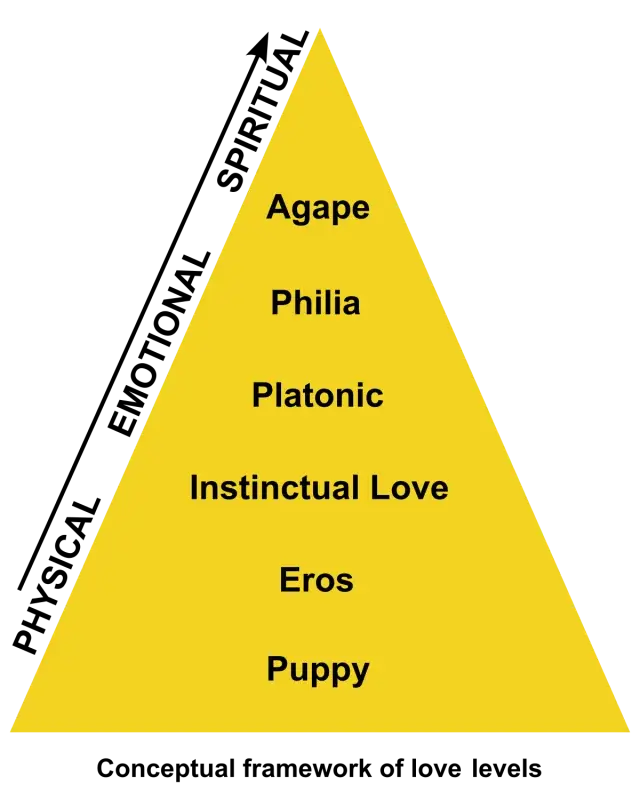
Textbooks claim that abstract emotions are completely unmeasurable variables. However, understanding how to measure love doesn’t require a calculator—it requires shifting your perspective to a psychological scale that maps out exactly how affection evolves from a fleeting adolescent crush into a profound spiritual reality.
Can love be measured? Read on to see how an ordinal scale makes it possible.
Table of Contents
In my statistics classes, a fascinating debate always sparks when we discuss measurement scales. Students naturally understand how to measure variables like height, income, or temperature.
But when we shift our discussion to what cannot be quantified, the textbook examples always point to abstract human emotions like love. The ultimate consensus is usually simple: you cannot measure love.
But as a data educator, I like to challenge that assumption.
While you certainly cannot use a ratio or interval scale to claim that you love someone “exactly 42% more today than yesterday,” love isn’t completely unmeasurable. If we step away from hard numbers and look at the concept through the lens of an ordinal scale—where data is categorized by rank, progression, and depth—a beautiful framework begins to take shape.
By mapping the different levels of human connection, much like Maslow’s Hierarchy of Needs, we can actually track how love evolves from a basic survival instinct into a profound spiritual reality.
When designing a study, abstract variables like human emotion must be clearly operationalized. Before you can map these metrics into a structured framework, learn how to build the foundation properly.
📖 Conceptual Framework: A Step-by-Step Guide on How to Make One →How to Measure Love: The 6 Levels of Human Love (An Ordinal Scale)
How do you measure love?
While humans can experience multiple types of affection simultaneously, these distinct phases represent a clear progression in depth, commitment, and emotional maturity.
1. Puppy Love: The Short-Term Infatuation

On the baseline of our ordinal scale on the measurement of love sits puppy love. Typically experienced during childhood or the adolescent years, this level is defined by a sudden, intense surge of emotion toward another person.
In statistics, we look at the duration and stability of a variable; puppy love is characterized by its fleeting nature. Because it is built on a temporary “crush” rather than a deep mutual understanding, this phase is classified as a short-term infatuation.
It is a beautiful introduction to romance, but it lacks the structural stability to climb higher up the emotional ladder. While it perfectly captures the excitement of a new beginning, the connection is too fragile to survive the weight of deep emotional commitment.
2. Eros: The Physical Plane of Passion

Taking a step upward, we reach Eros, or romantic passion.
Drawing a parallel to the foundational layers of Maslow’s pyramid, Eros operates primarily on the physical and biological plane.
According to classic psychoanalytic theory, this type of love serves a fundamental, evolutionary purpose: self-preservation, pleasure, and the continuation of the human species.
While Eros is incredibly powerful and essential for romantic chemistry, a relationship built solely on this metric remains bound to physical desire. To truly mature, love must transcend this biological layer and move toward the emotional and spiritual realms.
3. Instinctual Love or Storge: The Nurturing Force of Survival

Further up the scale sits instinctual love, most clearly seen in the fierce, protective bond between a mother and her child.
While biology drives animals to defend their offspring, human love runs much deeper. It transforms a basic defense mechanism into a lifetime of affectionate nurture, manifesting not just between parents and children, but also when one sibling steps up to protect another.
Within our measurement framework, this layer is crucial because it introduces selflessness. It is a biological drive aimed at ensuring species survival, yet it lays the emotional groundwork for unconditional care.
4. Platonic Love: Transcendence of the Physical

Platonic love represents a major shift on our ordinal scale.
At this level, love leaves the physical plane behind and enters the emotional realm. It is defined as a deep, intimate companionship—frequently between people where romance is a possibility—that intentionally operates without sexual involvement.
By removing physical desire from the equation, platonic love proves that human connection can be sustained entirely by intellectual, emotional, and mutual respect. It acts as the bridge leading toward the highest forms of connection.
5. Philia: The Spiritual Bond of Brotherhood

Philia climbs out of individual relationships and enters the spiritual realm.
This is the love for our fellow human beings, often described as brotherly or sisterly love. Philia is fueled by deep compassion rather than emotion.
When you experience Philia, you are willing to step outside your own physical comfort zone to extend a helping hand to someone in need.
In our statistical hierarchy, this ranks remarkably high because it does not depend on proximity, blood relations, or personal gain. It is a broad, community-centered goodwill.
While defining emotional tiers helps quantify the abstract, the ultimate goal in research is structuring these variables into a comprehensive model to guide your methodology.
🚀 Conceptual Framework: A Step-by-Step Guide on How to Make One →6. Agape: The Highest Metric of Love

At the absolute peak of our ordinal scale sits Agape. This is the ultimate, unconditional love that transcends all human limitations.
Historically and philosophically, the greatest benchmark for Agape is the love demonstrated by Christ for humanity, beautifully captured in John 15:13: “Greater love has no one than this, that one lay down his life for his friends.”
A medic sacrificing his life for wounded soldiers is another example of the ultimate acts of love one can show to another.
Notably, history highlights Desmond Doss, who refused to take human life and instead served as an unarmed combat medic during the 1945 Battle of Okinawa. Under relentless enemy fire, he single-handedly rescued an estimated 75 soldiers.
Agape requires complete self-sacrifice. It is a love that expects nothing in return and remains steady regardless of circumstances.
On our measurement scale, Agape stands as the highest possible metric of human and spiritual capability.
The Fluidity of the Scale on How to Measure Love
As a statistician, it is important to note that these categories are not mutually exclusive. A single relationship can experience shifts, progress through these levels, or occupy multiple tiers at the exact same time.
The fact that love can change and expand simply shows that it has no rigid boundaries. While words and data scales can help us map out its structure, the true depth of the highest forms of love remains wonderfully limitless.
At the very least, we have something we can use to determine how to measure love.
From Heartstrings to Hard Data: How to Quantify the Abstract World
Now that you understand the 6 levels of human connection, how do you actually turn those emotional variables into clean, actionable research? Discover how statisticians categorize and quantify the abstract world around us.
Read Next: Explore the 4 Scales of Measurement →© Simplyeducate.me | P. A. Regoniel