
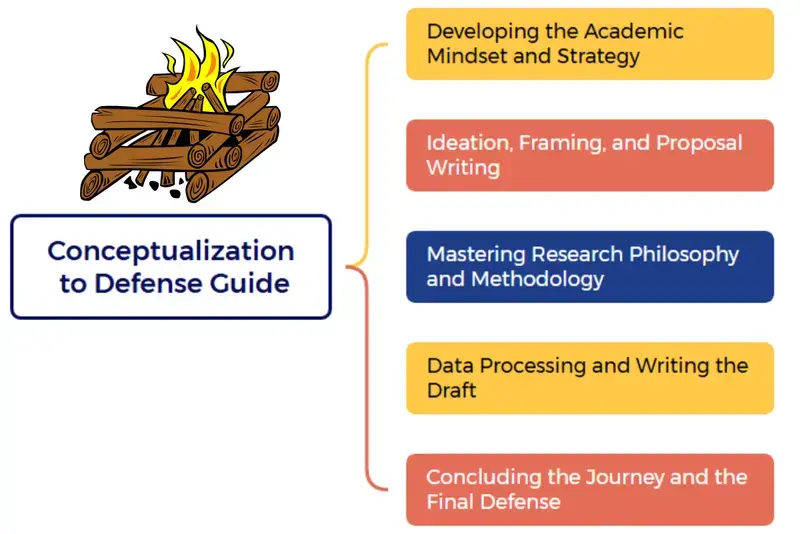
This graduate research guide consolidates all the specialized articles, frameworks, and academic insights published across this website into a single, structured repository.
Curated specifically to support advanced scholars, this centralized master resource simplifies complex methodologies and streamlines the writing process to help graduate students successfully advance their careers.
Contents of this Graduate Research Guide
Earning an advanced degree is a test of endurance, not just intelligence. Many graduate students get stuck—not from a lack of effort, but from a lack of a clear, sequential roadmap.
This comprehensive guide synthesizes complex academic frameworks into five actionable phases. Bookmark this page as your permanent reference manual as you advance from initial ideation to your final presentation.
Phase 1: Developing the Academic Mindset and Strategy
Before going into software or statistics, you must build a sustainable workflow. Succeeding in graduate school requires balancing intense intellectual labor with everyday life demands.
- The Blueprint for Success: Thriving in an advanced degree program requires specific scholarly habits. Discover the foundational traits needed to cross the finish line in our guide on the How to Complete Graduate School While Working Full time.
- Beating the Clock: Prevent timeline creep and protect your graduation date by mastering the time-management tactics in How to Finish Graduate School on Time.
Phase 2: Ideation, Framing, and Proposal Writing
Every great study begins with a well-defined question. If your initial topic is too broad, your data collection will become unmanageable.
- Visualizing Your Study: Mapping out variables and literature relationships early prevents structural flaws later. Streamline your outline by watching How to Use a Mind Map to Develop Your Research Proposal.
- Overcoming Writer’s Block: If you are struggling to narrow down an academic problem or choose a direction, use the brainstorming frameworks detailed in 5 Ways to Generate Ideas When Uninspired.
- Clarifying your Research Direction: The core ideas that represent your research direction are found in the conceptual framework. Get your thoughts organized after reviewing the literature by reading Conceptual Framework: A Step-by-Step Guide
Phase 3: Mastering Research Philosophy and Methodology
Your chosen methodology dictates how you collect data, establish validity, and answer your core questions.
- Choosing Your Lens: You must explicitly define your philosophical worldview before touching data. Master the core differences between objectivist and constructivist lenses in our exhaustive breakdown of the Research Paradigm in Quantitative and Qualitative Studies.
- Qualitative Frameworks: If your research evaluates power structures, media, or socio-political communication, you need a rigorous qualitative toolset. Learn how to break down textual data using the principles in Critical Discourse Analysis: Definition & Principles.
Phase 4: Data Processing and Writing the Draft
With your methodology set, you enter the execution phase. This involves managing statistical software and maintaining deep focus during long writing sessions.
- Open-Source Data Analysis: You do not need expensive proprietary software to run powerful statistical tests. Use Gnumeric, an open source alternative to proprietary software that will help you understand data.
- Distraction-Free Drafting: Writing thousands of words requires an environment free from notifications and digital clutter. Minimalist tools like FocusWriter can help you focus on your topic and not get distracted.
Phase 5: Concluding the Journey & The Final Defense
The defense panel is not an interrogation; it is a scholarly conversation where you demonstrate mastery over your chosen domain.
- Defending with Confidence: Presenting your findings requires clear data visualization, precise speaking, and emotional composure under questioning. Prepare for your panel review using the actionable strategies in Thesis Defense: 10 Tips That Are Proven to Work.
Good luck to your graduate school venture using this graduate research guide. Keep the fire burning!
©Simplyeducate.me | P. A. Regoniel