
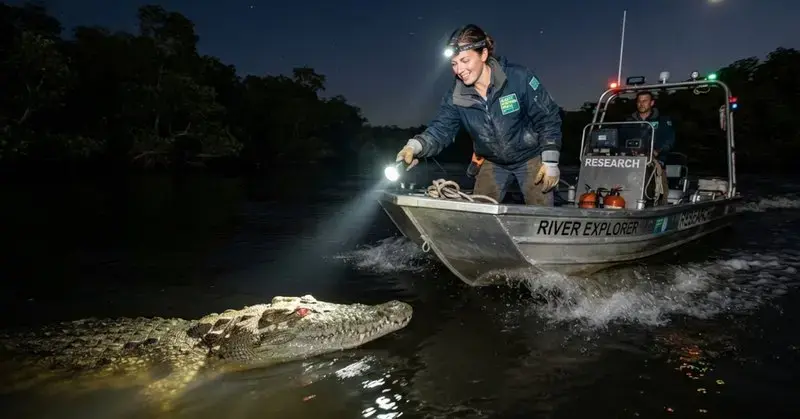
What does a wildlife biologist do in spotlight surveys?
This article explains the methodologies for crocodilian population assessment as one of the activities related to conservation of wildlife populations.
Read on to find out.
Table of Contents
Introduction
Crocodilians are apex predators and essential components of aquatic ecosystems. To effectively monitor and manage wild populations, wildlife biologists employ specific field techniques, most notably spotlighting surveys.
This article details the operational protocols employed by the wildlife biologist to assess population density, evaluate risks, and inform conservation strategies.
The standard procedure involves nocturnal surveys along river systems, often within dense mangrove stands, to maximize detection rates of these nocturnal animals.
This article explains in the following sections why crocodilian populations are best surveyed at night.
Operational Protocols and Equipment
The wildlife biologist is responsible for deploying specialized equipment designed to ensure safety and data accuracy during field assessments.
The standard toolkit for a crocodilian survey includes:
- A fiberglass boat equipped with an outboard motor for navigational stability.
- A high-intensity spotlight powered by a 12-volt battery system.
- Dark, non-reflective clothing to minimize the visual profile of the survey team.
- A 3-meter pole (approx. 1.5-inch diameter) serving as a defensive deterrent.
Risk Assessment and Behavioral Analysis
From the perspective of the wildlife biologist, understanding the behavioral ecology of the saltwater crocodile (Crocodylus porosus) is critical for risk mitigation. While surveys of dangerous species inherently involve risk, a wildlife biologist armed with behavioral knowledge can effectively manage these hazards.
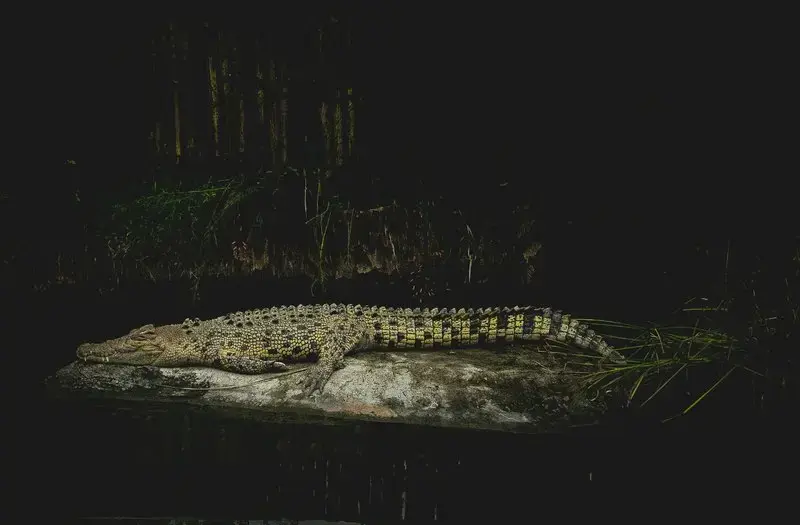
Crocodiles generally exhibit shyness toward boats illuminated by bright spotlights, as the light source is perceived as an intrusion rather than prey.
However, territorial males may display aggression.
Historically, the technique of spotlighting was misused by commercial hunters, leading to population decimation in various regions where crocodiles could be found. Hunters can effectively spot crocodiles at a distance and aim their spears or guns to hit a vulnerable spot in the reptile’s body.
Today, the wildlife biologist utilizes the “eye shine” phenomenon—where the crocodile’s eyes reflect red light—to locate animals floating in rivers or basking on banks without causing stress. Smaller individuals can be approached closely and caught by hand.
Defensive Mechanisms and Safety Protocols
The effectiveness of the spotlighting technique relies on the visual confusion induced in the target. When light is focused directly into the eyes, the crocodile experiences temporary “blindness,” unable to clearly discern the observer.
The wildlife biologist must wear dark clothing to eliminate silhouettes that could trigger a predatory response.
In the event of an attack, the 3-meter pole serves as a critical non-lethal defense tool. A wildlife biologist trained in this protocol can use the pole to strike the crocodile’s body, leveraging the animal’s tendency to tire under sustained physical pressure.
Furthermore, the wildlife biologist must exercise extreme caution in freshwater upstream regions where nests or mounds of leaves and mud are located. Maternal instinct in female crocodilians can lead to aggressive defense of eggs; thus, avoiding these specific zones is a primary directive in the wildlife biologist’s field safety manual.
Survey Methodology and Data Analysis
The core procedure of the spotlighting survey is executed under the supervision of the wildlife biologist. The spotter, positioned at the bow of the boat, scans the horizon with the spotlight while simultaneously guiding the boatman. By maintaining eye level with the light source, the observer maximizes the detection of the characteristic red eye reflection.
Data collection involves a rigorous counting process:
- Observation: Crocodiles are identified and counted based on visual confirmation.
- Calculation: Population density is derived by dividing the total number of sightings by the river kilometers covered.
This quantitative data allows the wildlife biologist to compare population densities across different river systems. Such comparative analysis is vital for management purposes, particularly in identifying “problem crocodiles” that pose a threat to human populations.
Management strategies, such as the removal of aggressive individuals, are implemented based on the wildlife biologist’s assessment of population levels relative to human safety.
Ecological Significance and Conservation Imperatives
The primary objective of the wildlife biologist is not merely population counting, but the preservation of ecosystem integrity. Crocodiles play a pivotal role in nutrient cycling; their excretions and secretions enhance algal growth, which in turn supports herbivorous fish populations, thereby strengthening the entire river food web.
Historical data underscores the ecological importance of this role. Research indicates that overhunting of crocodiles in the Amazon led to a significant decline in fish populations within nutrient-poor rivers. Similarly, studies in Africa demonstrated that the removal of crocodilians caused a surge in hippopotamus populations, which disrupted the balance of aquatic and grassland ecosystems.
As the wildlife biologist continues to study these resilient reptiles—remnants of a lineage dating back 200 million years—the focus remains on conservation. The data generated by wildlife biologists provides the empirical foundation required to protect these species and maintain the delicate equilibrium of the aquatic ecosystems they inhabit.
© Simplyeducate.me | P. A. Regoniel