

From exploiting nature to protecting it, human perception shapes our relationship with the environment. Explore the five key environmental perspectives that have defined how we interact with the natural world—and how these views determine the future of our ecosystems.
Table of Contents
Introduction
Environmental theories attempt to explain how humans view the environment. The prevailing perception of the environment determines the outcome of human-environment interactions—the outcome of which is either favorable or unfavorable for its continued existence or sustainability in its functions.
This article presents five of the dominant human-environment interactions or views on the environment that have transpired through time in human civilization. It shows how human perception shapes attitudes towards its management: exploitation in the early stages, extreme protectionism, wise use for present as well as future generations, and planned outcomes to ensure the health of ecosystems.
Let’s examine these environmental theories to help us understand the ecosystem dynamics through time.
Evolution of Environmental Perspectives
Man’s treatment of the environment defines its integrity. Find out how perception can enhance, destroy or sustain use of the environment to meet human needs.
The way humans treat the environment depends on how they perceive it. What does this statement mean in the context of environmental management?
To explain how this works, the following diagram in Figure 1 showing the evolution of environmental perspectives is presented. It summarizes the five evolutionary paradigms of human-environment interactions[1].
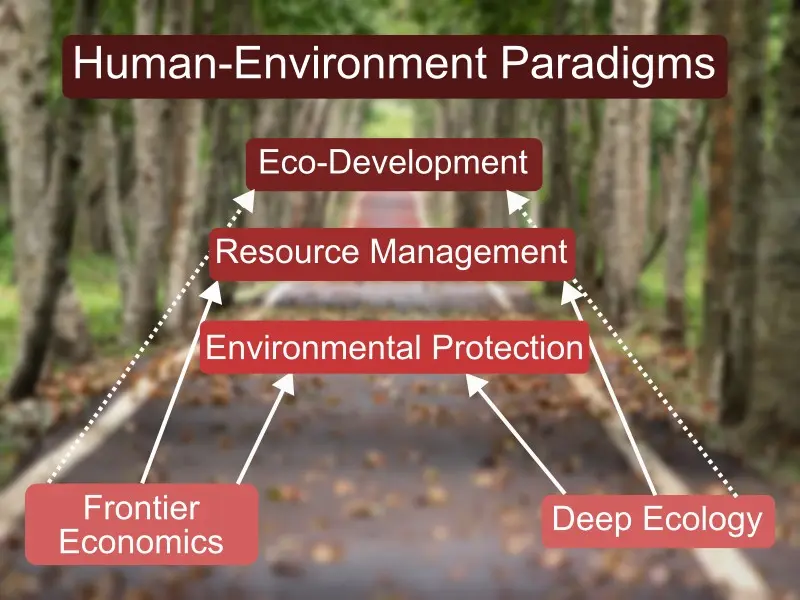
Five Environmental Theories on Human-Environment Interaction
At the bottom of the diagram lies two opposing ideologies on how man should treat the environment. These are frontier economics and deep ecology thinking.
Let me discuss the key differences between these two worldviews.
1. Frontier Economics
Frontier economics thinking is an environmental perspective that prevailed in industrial economies of developed countries until the rise of environmentalism around the 1960s.
This environmental perspective is founded on the belief that nature is an infinite supply of physical resources including raw materials, energy, water, soil, and air. These resources are present mainly for human benefit.
Nature is treated as an infinite sink (!) of resource consumption by-products in the form of pollution and ecological degradation. Adherents of this environmental perspective do not recognize a biophysical “environment” to be managed because it is considered irrelevant to the economy.
2. Deep Ecology
Deep ecology thinking, on the other hand, promotes symbiosis or mutually beneficial relationship between nature and man.
Nature, in this instance, is given more emphasis in this environmental perspective. Nature takes precence over human needs.
Deep ecologists expect the world to return to pre-industrial, rural lifestyles and simple standards of living to meet human physical needs. This environmental perspective recognizes that the earth’s “supplies” is limited, so it must be protected at all costs. Return to traditional ways that advocate preservation of nature is given prime importance [2].

In the hope of integrating human needs or harmonizing these needs with the environment which serves as resource supplier, three other dominant paradigms arose through the years. These are environmental protection, resource management, and eco-development.
These paradigms are discussed more fully in the next sections.
3. Environmental Protection
The environmental protection perspective came into focus with Rachel Carson’s (1962) Silent Spring book that revolutionized the environmental movement. The book was instrumental in the creation of the now well-known US Environmental Protection Agency (EPA).
Rachel Louise Carson was an American marine biologist and conservationist whose book Silent Spring and other writings are credited with advancing the global environmental movement[3]. Her work along with other scientists linked synthetic pesticides like dichlorodiphenyltrichloroethane (DDT) with near extinction of bird species. Shell thinning of bird eggs due to DDT caused death of birds through bioaccumulation; thus, silent spring ensued as there are no birds to sing their melodious songs.

Disclosure: As an Amazon Associate, I earn from qualifying purchases. This means I may earn a small commission if you make a purchase through this link at no additional cost to you.
To address problems of environmental pollution, the environment must be protected. The perspective focuses on repairing and setting limits to harmful economic activities and uses the “end of pipe” or “business-as-usual”, plus a treatment plant” approach.
4. Resource Management
The resource management environmental perspective appears to be the ideal approach to environmental management nowadays. It promotes wise use of resources through regulation of human behavior and activities.
Natural resources, both tangible and intangible, are used in an organized and efficient manner. Resources referred to here include land, water, labor, capital, organization, skills, as well as people’s belief systems.
It is believed that traditional ways are compatible uses of the environment because these practices have evolved through time and are desirable for continued survival. Greater emphasis is given on long-term sustainability of resource use and development activity.
This environmental perspective encourages energy efficiency, resource conservation, pollution prevention, ecological restoration, ecosystem and social health monitoring, and “polluter pays” principle. The economy is embedded within the ecosystem.
5. Eco-Development
Lastly, the eco-development environmental perspective champions restructuring of the relationship between society and nature into a “positive sum game” through sophisticated symbiosis.
Economic restructuring incorporates ecological principles. It integrates all the concerns of other perspectives. Man and nature should co-evolve.
Eco-development advocates “green development “where land use planning includes consideration of community-wide or regional environmental implications of development, as well as site-specific concerns.
References
[1] Colby, Michael E. 1989. The evolution of paradigms of environmental management in development. Strategic Planning Division, Strategic Planning and Review Department, The World Bank. 34 pp.
[2] Lear, Linda (1997). Rachel Carson: Witness for Nature. New York: Henry Holt. ISBN 0-8050-3428-5.
FAQ: Environmental Theories: Human Perception of the Environment
Q1. What are the five environmental perspectives discussed in the article?
The article outlines five dominant human-environment interactions: exploitation, extreme protectionism, wise use, planned outcomes, and sustainability.
Q2. What does the exploitation perspective entail?
This perspective views nature as a resource to be used for human benefit, often leading to environmental degradation and short-term gains.
Q3. What is the extreme protectionism perspective?
This view advocates for strict preservation of nature, often opposing human use and intervention to maintain ecological integrity.
Q4. What is the wise use perspective?
This approach balances human needs with environmental protection, promoting sustainable use of natural resources for present and future generations.
Q5. What does the planned outcomes perspective focus on?
This perspective emphasizes intentional management of ecosystems to achieve specific ecological and human benefits, often through conservation planning.
Q6. What is the sustainability perspective?
This approach seeks to maintain ecological balance while meeting human needs, ensuring long-term environmental health and resource availability.
Q7. How do these perspectives impact human-environment interactions?
Each perspective shapes how humans interact with the environment, influencing policies, behaviors, and the outcomes of environmental management.
Q8. Why is understanding these perspectives important?
Recognizing these different viewpoints helps in developing effective environmental policies and fostering sustainable practices.
Q9. Which perspective is considered the most balanced?
The wise use and sustainability perspectives are often seen as the most balanced, as they aim to meet human needs while preserving ecological health.
Q10. How can these perspectives be applied in real-world scenarios?
These perspectives can guide land use planning, conservation efforts, and environmental policy-making to achieve desired ecological and social outcomes.
© Simplyeducate.me | P. A. Regoniel