

To ensure you finish graduate school on time, completing your Master of Science (MS) or Doctor of Philosophy (PhD) within the prescribed period requires systematic planning and rigorous execution. Here are four tips to keep you on track.
Table of Contents
As a graduate student, you may be quite concerned, especially if you have a fixed number of years to finish your degree as part of the requirements of a grant or scholarship. This target is possible, as long as you are determined to finish graduate studies as a desirable goal in your life.
If others were able to do it, why can’t you?
Remember that the main reason many people pursue an advanced degree is to be able to do independent research. Aside from the personal satisfaction of maximizing your potential as a student, you are actually preparing yourself for a life of research, of discovering things, and ultimately contributing to the improvement of human life on this planet.
However, many MS and PhD degree holders get their degree just for the sake of getting it—for promotion purposes, to secure a permanent teaching position in a college or university, or out of plain vanity. These degrees are not designed to be taken for such purposes. Learning the art and skills of research requires the responsible application of what has been learned.
So, if you are inclined and ready to take on the challenge of finishing an MS or a PhD in your chosen field, here are four tips that will help you finish your course in due time and dispel your worries. These are products of experience topped with a little imagination.
1. Have a research topic ready early in your schooling
During the early part of my advanced schooling to finish my PhD, my professor noted that, ideally, graduate students should already have their research topic ready upon entering graduate school. This is important so that the student is able to select the appropriate subjects required to effectively conduct research on the topic envisioned to be explored.
Find a good advisor and refer to your university’s or scholarship-granting institution’s research agenda on topics to be pursued, if there are prescribed directions for the preparation of the thesis or dissertation. It is better to be aligned with such priorities, especially if you expect funding assistance from these institutions.
2. Procrastinate up to a certain point
Many people say that procrastination is bad. But procrastination can be productive too—at a certain point.
The point is, if you postpone doing things to a later date, there may be better options along the way that you could consider or integrate into your decision.
So, it’s better to take action within a set timeframe because you gain more information as more time is allowed to pass. More information means better decisions. You can write your manuscript better with intensive editing, and there will be fewer time-consuming repetitions or revisions of your manuscript. You are then able to save time.
Haphazard work, even if quickly submitted, is never acceptable.
If you are given a week to work on a project, maximize it. Chances are, you can do your best if you make use of all that time.
But of course, there are exceptions. If your scholarship provider gives a monetary incentive for being able to finish early, then go for it.
Hack away…
3. Use a fishbone planning guide
There are many free tools available now to facilitate planning activities within a timeframe.
One of my favorites is XMind, a mind mapping software with free version to help your ideas take form. It is freely downloadable, while extended features can be enjoyed using the Pro version. Plan your timeframe to finish your advanced degree using this tool.
I prepared a simple sample of a fishbone planning guide for graduate students below showing the critical points of graduate school work (see below).
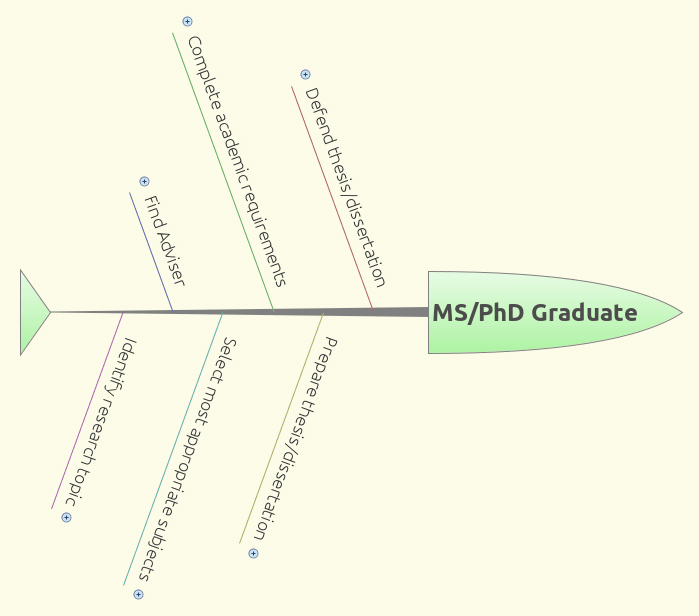
A simplified plan to finish graduate school work.
You can add more detail, such as adding the schedule of when you will do the things required to finish your course and including details on what you will do under those major milestones in your study.
You may print this figure and stick it on a wall to remind you always.
4. Play
You also need to de-stress once in a while. All work and no play can make Johnny a dull boy.
Take time out with friends and relax. After all, what are you studying for? Is it not that you want to have a good life to enjoy? Little joys can compensate for a hectic work schedule.
Taking on too much stress can be bad for your health because chronic stress forces the body’s “fight-or-flight” system to remain permanently active, flooding your system with hormones like cortisol and adrenaline that disrupt almost every bodily process.
While stress is necessary to get things done, too much stress can have negative effects. Too much production of the stress hormone cortisol, according to Scott (2013), includes the following negative effects:
- An inability to think well or understand things
- Problems in the thyroid, which is responsible for calcium secretion (related to bone maintenance)
- Higher than normal blood pressure that could lead to a stroke
- A weakened immune system that will allow cancer cells to proliferate
- More fat in your abdomen (!)
Over time, this constant physiological strain elevates blood pressure and damages blood vessels, significantly increasing your risk for heart attacks and strokes. It simultaneously suppresses the immune system, leaving you more vulnerable to infections and slower recovery times, while triggering digestive issues like acid reflux and irritable bowel syndrome.
If you gain too much fat, you will have a host of other problems associated with it. That will be another source of stress.
Apply these tips and you will be well on your way to the path of academic success.
If you are working full-time as most graduate students are, how can you successfully complete graduate school? Check out the article on How to Finish Graduate School While Working Full-Time.
For a comprehensive guide that consolidates all the specialized articles, frameworks, and academic insights published across this website into a single, structured repository, visit our page:The Ultimate Graduate Research Guide.
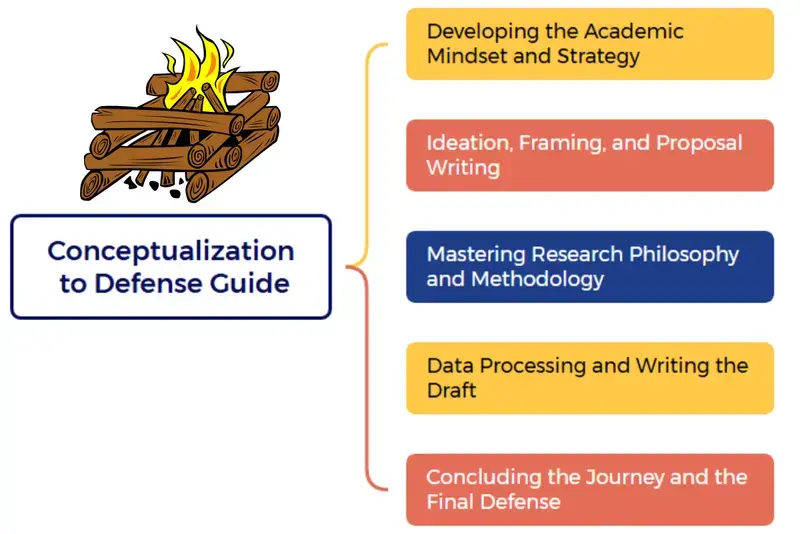
The Ultimate Graduate Research Guide
Specialized articles, framework, and academic insights for your graduate research activities.
© Simplyeducate.me | P. A. Regoniel