
Updated: October 28, 2026
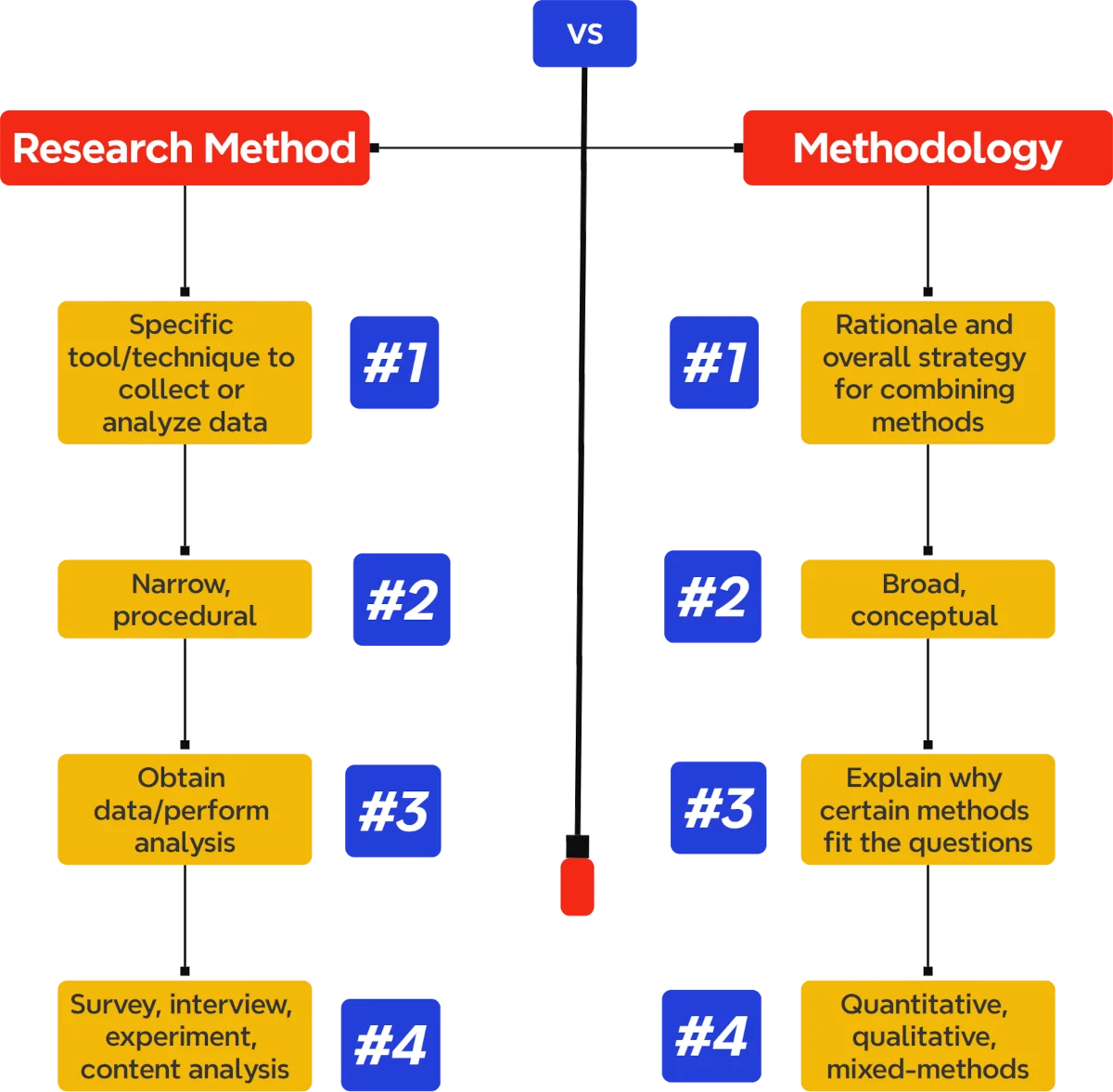
When writing the methodology chapter of a thesis or dissertation, many students confuse research method with methodology. Even some graduate students in my class have a vague understanding of these commonly encountered terms in research; familiar, yet unable to distinguish one from the other. They still use these terms interchangeably, which can cause errors in academic writing.
As a researcher and professor with over 30 years of experience teaching research methods, I often ask this question to graduate students:
“Are method and methodology the same?”
I get baffled faces, tell-tale sign of confusion. These two terms are vague in their minds and they’d rather keep silent and show bewilderment in their eyes.
The short answer is no—and understanding the difference is essential for producing a strong research paper. Read on to find out why this is so.
Table of Contents
Are Methodology and Method the Same?
Let’s define each of these terms mean so we can have a solid foundation to steer the discussion and explain the difference between method and methodology.
What is a Research Method?
A method refers to the specific tool, technique, or process used to gather and analyze data.
In the social sciences, common research methods include:
- Survey questionnaires
- Interviews
- Focus group discussions
- Participant observation
In the natural sciences, methods vary depending on the research objective:
- An ecologist might use mark and recapture techniques to estimate animal populations.
- A taxonomist could examine morphometrics (like counting fish scales) to classify species.
- A geologist might measure soil particle sizes.
- A botanist could conduct quadrat sampling to count tree species in a forest plot.
All of these activities represent research methods—practical steps for collecting data.
Example: Linking Problems to Research Methods
Here’s how research questions (problems) connect to suitable methods:
| Statement of the Problem | Appropriate Research Method |
|---|---|
| 1. What is the profile of respondents in terms of age, gender, and education? | Survey questionnaire |
| 2. What is the level of community awareness of coastal ordinances? | Focus group discussion |
| 3. What infrastructures indicate adaptation to soil erosion? | Photo documentation, video |
| 4. What is the distribution range of the monkey population? | Remote sensing |
| 5. Is there a significant difference in blood pressure before and after exercise? | Blood pressure readings with a sphygmomanometer |
Notice that each method is chosen based on the research objective.
What is Methodology?
By contrast, methodology is the study of methods appropriate to answer the research questions—it explains why certain methods are chosen and how they fit the research objectives.
The suffix -ology means “the study of.” Thus, while a method is a tool, methodology is the overall strategy or rationale behind the choice of tools.
When writing the third chapter (Methodology) of a thesis or dissertation, you are expected to:
- Justify why the chosen methods are appropriate.
- Explain the principles guiding your choices.
- Show how the methods directly address your research questions.
How to Write a Strong Methodology Section
To demonstrate a sound methodology, include the following:
- Assumptions – underlying beliefs or theories.
- Study site – where the study will be conducted and why.
- Population and sample – who is included and how many.
- Data-gathering procedures – step-by-step description.
- Statistical tests or analysis – tools for interpreting results.
- Materials used – equipment, instruments, or software.
A well-written methodology shows both the “what” (methods) and the “why” (rationale behind them).
Methodology vs Method Examples (At-a-Glance Matrix)
So, what is the difference between method and methodology after the discussion in the previous sections? I summarize them for you in the matrix given below to easily spot the difference and apply the concept in writing your thesis proposal.
| Dimension | Method | Methodology |
|---|---|---|
| Core meaning | Specific tool/technique to collect or analyze data | Rationale and overall strategy for choosing and combining methods |
| Scope | Narrow, procedural | Broad, conceptual and strategic |
| Purpose | Obtain data / perform analysis | Explain why certain methods fit the questions, context, and theory |
| Typical questions answered | “How will I collect/analyze?” | “Why these methods, for these questions, in this setting?” |
| Components | Instruments, protocols, measurements, statistics | Research design, paradigms, assumptions, validity strategy, ethics |
| Examples | Survey, interview, experiment, content analysis, t-test | Quantitative, qualitative, mixed-methods; explanatory sequential design |
| Unit of focus | Tasks and steps | Coherent plan linking questions → data → analysis → inference |
| Output | Raw data, coded data, test results | Justified design, limitations, bias controls, generalizability claims |
| Replicability | Repeat the same steps with same tools | Recreate the logic of the study design and justification |
| Where in a thesis | Subsections within Chapter 3 | Chapter 3’s framing: design, justification, alignment |
| Verbs you see | administer, measure, code, test, model | justify, align, triangulate, mitigate bias, validate |
| Risks if mishandled | Poor data quality | Weak argument for credibility/fit; misalignment with objectives |
How to read the matrix on the difference between method and methodology
Think of methods as the hands-on actions you take—administering a survey, running an interview, performing a regression—while methodology is the reasoned blueprint that explains why those actions make sense for your questions, theory, setting, and data constraints.
The left column shows what you do; the right column shows how you justify and integrate what you do into a coherent research design that produces credible findings.
How to apply it in Chapter 3 of your thesis proposal
Start from your objectives and research questions, then articulate your methodology: the paradigm (e.g., qualitative, quantitative, mixed), design choice, assumptions, validity, reliability, credibility strategy, ethics, and limitations. Justify why you identified the approaches as appropriate for the particular study you are working on.
After that justification is clear, specify the methods—instruments, sampling, procedures, and analysis steps—so another researcher could replicate your process. Replication is important to compare results with other researchers in later studies along that specific area that you cover.
If every method you list can be traced back to a methodological reason in the same chapter, your study is aligned, defensible, and easy for examiners to evaluate.
Key Points to Remember
- Method = the specific tool or technique (e.g., interview, survey, experiment).
- Methodology = the framework that explains why and how methods are chosen.
If you clearly distinguish these in your research paper, you will avoid common mistakes and strengthen the credibility of your thesis.
Now, you are armed with a good understanding of the difference between research method and methodology. You can easily answer your research adviser if he or she asks:
“What is the difference between research method and methodology?”
Answer with confidence if you have read to this point. You did your homework.
Reference
Gorman, G. E. (2012). A Student’s Guide to Methodology: Justifying Enquiry. SAGE Publications Ltd. 288 pp.
Frequently Asked Questions (FAQs)
What is the difference between method and methodology in research?
A method refers to the specific tool, technique, or procedural step used to collect and analyze data (such as a survey questionnaire, an interview, or an experiment).
Methodology is the broader strategy and rationale behind those choices—it explains why specific methods are selected, how they align with the research objectives and theoretical framework, and how risks like bias or validity issues are addressed.
What is an example of a research method vs. a research methodology?
Research Method Example: Administering a structured survey questionnaire, conducting a t-test on experimental data, or using focus group discussions.
Research Methodology Example: Adopting an explanatory sequential mixed-methods design, using a qualitative paradigm to study lived experiences, or structuring an experimental framework to test hypotheses under controlled conditions.
What is a research methodology, and why is it important?
Research methodology is the overall strategic framework that guides how a study is designed, justified, and executed. It is crucial because it proves the credibility, alignment, and defensibility of your research. Without a clear methodology, data-gathering methods lack theoretical grounding and logical justification.
How do method and methodology differ in research?
Scope: Methods are narrow and procedural; methodology is broad, conceptual, and strategic.
Core Question: Methods answer “How will I collect or analyze data?” while methodology answers “Why are these methods appropriate for these questions in this context?”
Output: Methods yield raw data, test results, or transcripts; methodology yields a defensible research design, limitations control, and a replicable framework.
What is the difference between method and methodology in teaching?
In an educational context:
Teaching Method: The specific technique or activity used to deliver a lesson (e.g., small-group discussion, direct lecture, gamified quiz, or hands-on laboratory exercise).
Teaching Methodology: The underlying pedagogical theory or philosophical framework that dictates why those teaching methods are used (e.g., Constructivism, Inquiry-Based Learning, or Student-Centered Pedagogy).
Can I get a downloadable summary or PDF of method vs. methodology?
While this article is presented directly on the webpage, you can easily save a reference PDF by using your browser’s Print menu (Ctrl+P or Cmd+P) and selecting “Save as PDF.” This allows you to print or save the At-a-Glance Matrix and quick-reference guides for thesis writing offline.
Where can I find a comparison of method and methodology in research (PDF format)?
You can create a custom PDF study guide directly from this page by exporting the article via your web browser’s print option (Save as PDF). This captures the comparison matrix detailing core meanings, typical questions answered, components, and thesis placement for easy offline reference.
What is a practical methodology example for Chapter 3 of a thesis?
A Chapter 3 methodology section starts by framing the overall research design—such as choosing a quantitative descriptive survey design—and justifying why this design fits the study’s scope. It establishes assumptions, population sampling strategies, and data validity controls. Following this overarching methodology, it details the specific methods used: distributing a 5-point Likert scale questionnaire, sampling 150 respondents, and performing linear regression analysis.
© SimplyEducate.me | P. A. Regoniel
