
Updated | November 30, 2025
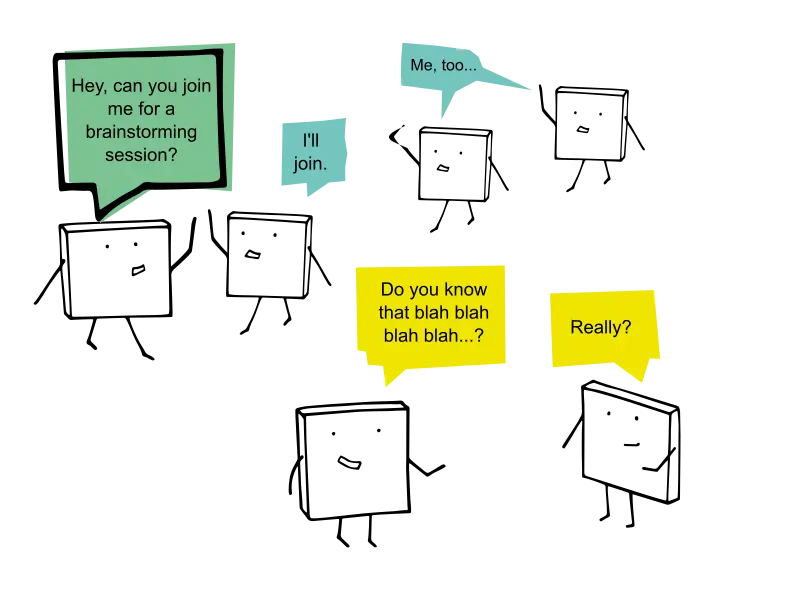
This article explores the usefulness of an organized brainstorming session-the Group Memory Approach. It applies the principles of time management and presents ideas on the conduct of time-saving meetings. Here are five tips on brainstorming that are proven to work.
Table of Contents
How do you generate ideas for research purposes? Is it challenging to come up with one?
The answer is No. It is easy to come up with ideas for research as long as you employ a systematic approach.
Beginning researchers experience difficulty in generating research ideas because they
- are unfamiliar with the topic or has few exposure about it, and
- have a preconceived notion that research is a difficult task to undertake.
I describe the Group Memory Approach to generate ideas that will narrow down your research topic speedily and meaningfully. Learn more on how this approach works.
The Group Memory Approach in Brainstorming
1. Engage Your Colleagues, Classmates, and Friends
You can quickly generate research ideas that will narrow down your investigation by brainstorming on your chosen topic. Find colleagues, classmates, or friends who share the same passion, interest, field of specialization, or discipline.
However, your group can easily get carried away and might talk about irrelevant things unrelated to your initial intention of discussing ideas for research. Say, you spoke of someone else instead of focusing on your initial plan for research. And you realized that the group is already gossiping.
Hence, a method, or strategy, that will bring your research ideas into focus comes into the picture. The Group Memory Approach as a brainstorming strategy is described next.
2. Prepare the Materials Needed for the Brainstorming Session
You will need the following materials to facilitate the brainstorming session.
- a new marker (to avoid interrupting the brainstorming session due to depleted ink) or chalk
- a small (2′ x 3′) whiteboard, blackboard, or Manila paper
- a comfortable room free from distractions
- ergonomic chairs for the participants
3. The Group Memory
To avoid the tendency to talk about something else instead of your intention to generate ideas for research, make sure that you have a small whiteboard, blackboard, a Manila paper, or anything you can write to where everybody can focus with undivided attention. Request everyone to mute or switch off their mobile phones as entertaining calls or messages during the brainstorming session can significantly interrupt the flow of the discussion. According to Shirley Turkle, smartphones can kill conversations.
Whatever content jotted down on this medium serves as the “group memory.” The whiteboard or the Manila paper in front of the group will hold everybody’s attention as you discuss the idea for research that you are initially interested in but which you find too broad to do research on.
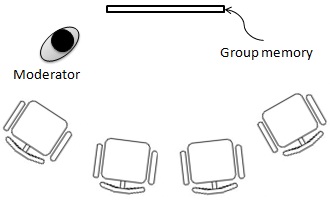
Therefore, you will serve as the moderator who will present the initial idea for research that the group will brainstorm on. A group composed of 3 to 4 four people would be best where everyone is seated in an arc in front of you to avoid unnecessary conversations.
Of course, you will need to hang the whiteboard or paste a Manila paper on a wall where everyone can see it. You may refer to the illustration below on how to arrange the seats to be more effective in engaging everyone to share their ideas.
4. Choose the best time for brainstorming sessions
It is best to do brainstorming sessions in the early part of the day as the mind is still fresh, active, and uncluttered by the day’s cares.
You can conduct brainstorming in one hour, so 8 to 9 o’clock or 9 to 10 o’clock would be ideal. Never do this at 1 or 2 o’clock as sleepiness can easily slip in, but 4 o’clock would be okay because the mind gets a second wind.
5. Undertake mind mapping
Mind mapping is an excellent way of synthesizing the ideas generated in the brainstorming sessions. Start with a central idea and attach keywords related to the main topic, connecting each word that crops up during the discussion.
For example, you may begin with a keyword such as “climate change.” Write this at the center of the whiteboard, blackboard, or Manila paper. From there, come up with a mind map.
Erasing or changing entries will not be problematic if you use a whiteboard or blackboard. Take a picture of the output once finished or when the board is filled up. Re-write the last topic discussed and make it the next central topic. Add more as you see fit or necessary.
When using Manila paper, draw a line on each of the listings you want to change. Listen to the following video on the detailed aspects of mind mapping in preparing your research proposal.
From the set of ideas in your mind map, select a clump where you can relate two or three variables (You have to read first what a variable is if you are not familiar with this concept). This set of variables now will help you find the applicable theoretical framework to back up your study. The theoretical framework will be your basis for constructing your conceptual framework.
Using modern mind mapping tools such as XMind, it is now easy to connect the keywords and arrange them neatly without physically erasing a phrase or a keyword. I find this extremely helpful in my mind mapping activity, alone or with a group of people.
At this point, you will be able to generate a lot of ideas for research and focus your attention on those key variables that matter to you or you are interested in. I have seen excellent results using these brainstorming tips.
Conclusion
Generating research ideas doesn’t have to be an overwhelming challenge. By implementing the Group Memory Approach and following these five systematic brainstorming tips—engaging collaborators, preparing proper materials, maintaining focus through visual aids, timing sessions strategically, and utilizing mind mapping—you can transform a broad, unfocused topic into a well-defined research question with clear variables and theoretical foundations.
The key to successful idea generation lies in structure and collaboration. When you create an environment that minimizes distractions, encourages focused discussion, and visually captures every contribution through your “group memory,” you’ll find that research ideas flow naturally and productively. Remember that the initial difficulty most beginning researchers face stems not from a lack of ideas, but from a lack of systematic approach to organizing and refining those ideas.
With these brainstorming strategies in your toolkit, you’re now equipped to move confidently from that initial broad concept to a focused, researchable topic backed by appropriate theoretical frameworks. The investment of one focused hour with the right people, materials, and mindset can yield research directions that might have taken weeks to develop in isolation.
FAQ: Brainstorming Tips to Generate Research Topics
Q1. Is it difficult to generate research ideas?
No, generating research ideas is easy when you employ a systematic approach like the Group Memory Approach described in this article.
Q2. Why do beginning researchers struggle with generating research ideas?
Beginning researchers typically struggle because they are unfamiliar with the topic or have limited exposure to it, and they often have a preconceived notion that research is inherently difficult.
Q3. How many people should be in a brainstorming group?
A group of 3 to 4 people is ideal for effective brainstorming sessions using the Group Memory Approach.
Q4. What materials are needed for a brainstorming session?
You’ll need a new marker or chalk, a small whiteboard/blackboard/Manila paper (2′ x 3′), a comfortable distraction-free room, and ergonomic chairs for participants.
Q5. What is the “group memory” in brainstorming?
The group memory refers to the whiteboard, blackboard, or Manila paper where all ideas are written down during the session, serving as a visual focal point that keeps everyone’s attention on the research topic.
Q6. When is the best time to conduct brainstorming sessions?
The best time is in the early part of the day (8-9 AM or 9-10 AM) when minds are fresh and active. Avoid 1-2 PM due to post-lunch sleepiness, though 4 PM can work as the mind gets a second wind.
Q7. What is mind mapping and why is it useful?
Mind mapping is a technique for synthesizing brainstorming ideas by starting with a central concept and connecting related keywords. It helps organize thoughts visually and identify key variables for your research.
Q8. Should participants keep their phones on during brainstorming?
No, all participants should mute or switch off their mobile phones to avoid interruptions that can disrupt the flow of discussion.
Q9. How do I select a research topic from the mind map?
Select a cluster of ideas from your mind map where you can relate two or three variables, which will help you identify an applicable theoretical framework for your study.
Q10. How long should a brainstorming session last?
A typical brainstorming session can be conducted effectively in one hour.
© SimplyEducate.me | P. A. Regoniel