
Watch the video above to catch a quick visual breakdown, then read the full article below to master the seven types of curriculum and discover their vital implications for the modern classroom.
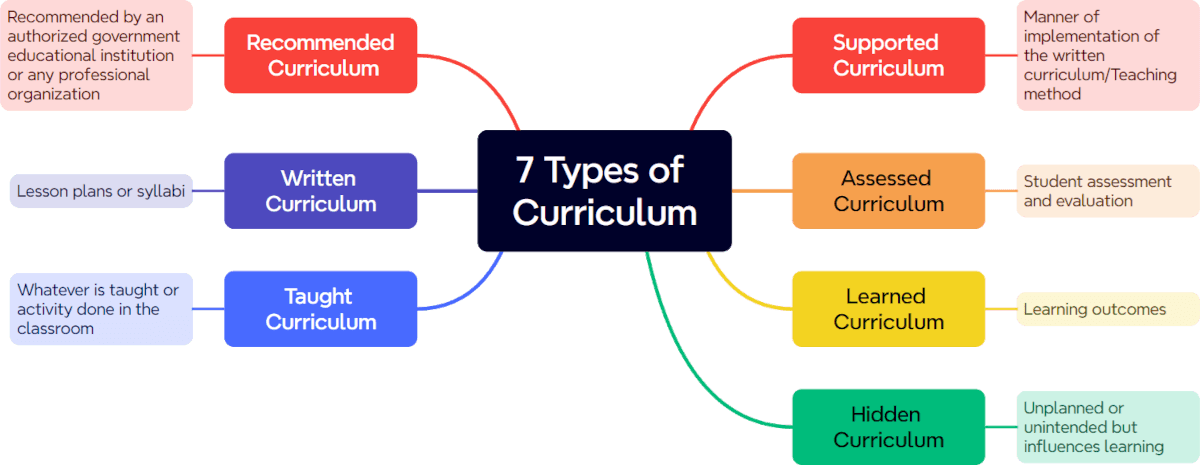
Table of Contents
Allan Grathon (2000), as cited by Bilbao et al. (2008), describes the seven types of the curriculum in the following section.
The following are the 7 types of curriculum that are being implemented in schools worldwide.
1. Recommended Curriculum
The Ministry of Education, the Commission on Higher Education, or any professional organization can recommend and implement a curriculum. This type of curriculum refers to the recommended curriculum.
In the Philippines, the curriculum implemented by the Department of Education (DepEd) or the Commission on Higher Education (CHED) is an example of a recommended curriculum.
In some cases, a lawmaking body like Congress and the Senate, or a university or school, can recommend a subject, a course, or any academic program deemed necessary for national identity and security, environmental protection, and sustainable development, among others.
Perhaps you have asked these questions:
- Why should I take all these subjects and follow the course flow religiously?
- Why is there a need to implement the K to 12?
Let me explain as simply as I can.
You should take all subjects in a curriculum and follow the course flow religiously to ensure a structured, logical, and legally valid progression toward graduation.
Academic curriculums, particularly the recommended curriculum, are designed by educational experts to maximize learning efficiency and meet institutional standards. Deviating from the set flow can disrupt a student’s academic progress in several critical ways:
1. Prerequisite Sequencing (The Foundation)
Curriculums are built like a ladder, where lower-level courses provide the foundational knowledge required for advanced topics.
- Cumulative Knowledge: For example, you cannot fully grasp Advanced Engineering Calculus without first mastering Algebra and Trigonometry.
- Enforcing Rules: Missing or skipping a prerequisite often bars you from enrolling in higher-level subjects altogether, leading to delayed graduation.
2. Cognitive Load and Developmental Pacing
Educational boards—like the Department of Education (DepEd) or the Commission on Higher Education (CHED)—pace subjects according to a student’s cognitive development.
- Subjects are distributed across semesters so that the workload and difficulty increase gradually.
- Taking courses out of order can lead to academic burnout or failing a class because the conceptual leap is too steep.
3. Graduation and Degree Requirements
To earn a degree or diploma, a student must fulfill a specific set of credit hours and mandatory courses determined by the institution and governing laws.
- Audit Blockages: During your final year, registrars perform a strict curriculum audit. If even one minor or general education subject is missing, you will not be cleared for graduation.
- Accreditation: Curriculums ensure that your degree meets national standards, which is vital for your diploma to be recognized by future employers or postgraduate universities.
4. Board Exam and Professional Eligibility
For programs that require state licensure (such as Nursing, Engineering, Accountancy, or Education), the curriculum directly aligns with the board exam syllabi.
- Component Coverage: Board exams test knowledge from the entire four- or five-year program.
- Skipping or failing to retain the information from any single curriculum subject creates a knowledge gap that can lead to failing professional licensure exams.
5. Schedule Management and Resource Optimization
Universities schedule classes based on the standard course flow.
- If you become “irregular” by dropping or skipping a subject, you will likely encounter scheduling conflicts (overlapping classes) in future semesters.
- Some specialized subjects are only offered during specific semesters (e.g., only in the First Semester). Missing it once could mean waiting an entire year for it to be offered again.
The need to implement the K to 12 Program in the Philippines arose from a critical requirement to overhaul an outdated 10-year basic education system, which was leaving Filipino graduates academically congested and globally disadvantaged.
Prior to the passage of the Enhanced Basic Education Act of 2013 (Republic Act No. 10533), the Philippines was the last country in Asia and one of only three countries worldwide (alongside Angola and Djibouti) adhering to a 10-year pre-university cycle.
Recently, current framework changes (2024–2026) were made. DepEd is currently rolling out the MATATAG Curriculum, a revision of the previous one. This curriculum was specifically designed to fix the “congested” problems of the original K to 12 system by reducing the number of learning areas from Kindergarten to Grade 10 to focus on foundational literacy and numeracy.
Meanwhile, DepEd reviews the Senior High School (Grades 11 and 12) curriculum to streamline subjects and improve job readiness.
Thus, following a recommended curriculum religiously is essential for a student’s structured academic progression, legal graduation clearance, and professional readiness, while national reforms like the K to 12 and MATATAG programs continuously adapt these structures to ensure graduates remain globally competitive and job-ready.
2. Written Curriculum
The written curriculum refers to a lesson plan or syllabus written by teachers.
Another example is the one written by curriculum experts with the help of subject teachers. This kind of written curriculum needs to be pilot tested or tried out in sample schools to determine its effectiveness.
For more details, read: Development and Examples of a Written Curriculum
3. Taught Curriculum
The taught curriculum refers to the instructional practices and learning activities that are actually implemented in the classroom by teachers. This is where the written curriculum comes to life through the various teaching methods and strategies employed by educators.
When teachers deliver lectures, facilitate group discussions, guide students through hands-on experiments, or assign project-based learning activities, they are demonstrating the taught curriculum. The goal of the taught curriculum is to address the diverse needs and interests of students by utilizing a range of teaching and learning styles.
For example, a teacher may choose to use direct instruction for introducing new content, collaborative learning for promoting critical thinking, or inquiry-based activities for developing scientific skills.
Through the taught curriculum, teachers create dynamic learning experiences for active student engagement. These activities help students master the knowledge and competencies outlined in the written curriculum.
Ultimately, the taught curriculum serves as the bridge between the prescribed learning objectives and the actual learning that takes place in the classroom.
4. Supported Curriculum
The supported curriculum is about the implementation of the written curriculum. Whatever is being taught or activity being done in the classroom is a taught curriculum.
Let’s break this down further for clarity and compare the supported curriculum to the taught curriculum discussed in the previous section.
The Supported Curriculum
The supported curriculum refers to the resources, materials, and infrastructure that enable the implementation of the written curriculum. This includes things like textbooks, technology, lab equipment, learning aids, and any other physical or digital resources that teachers use to deliver instruction. The supported curriculum ensures that teachers have the necessary tools and materials to effectively teach the content and skills outlined in the written curriculum.
The Taught Curriculum
The taught curriculum is the actual instruction and learning activities that take place in the classroom, as facilitated by the teacher. This is where the written curriculum is brought to life through the teaching methods, strategies, and learning experiences employed by the teacher.
When teachers give lectures, facilitate group work, lead lab experiments, and use various teaching styles, they are demonstrating the taught curriculum.
The taught curriculum is designed to address the diverse needs and interests of students by incorporating different teaching and learning approaches.
Key Differences
To sum it up, the supported curriculum lays the foundation, while the taught curriculum is the dynamic, student-centered application of the curriculum in the classroom setting. They are complementary components of the overall curricular process.
5. Assessed Curriculum
When students take a quiz or the mid-term and final exams, these evaluations are the so-called assessed curriculum. Teachers may use the pencil and paper tests and authentic assessments like portfolio assessment and performance-based assessments to know if the students are progressing or not.
6. Learned Curriculum
This type of curriculum indicates what the students have learned. The capability that students should demonstrate at the end of the lesson can be measured through learning outcomes.
A learning outcome can be manifested by what students can perform or do either in their cognitive, affective, or psychomotor domains. The test results can determine the learning outcome, and the students can achieve it through learning objectives.
Related Post: Learning Outcomes 101: A Comprehensive Guide
7. Hidden Curriculum
The hidden curriculum refers to the unplanned or unintended curriculum but plays a vital role in learning. It consists of norms, values, and procedures. See the two-minute video below for more details.
Classroom Implications of the Different Types of Curriculum
Now, let’s discuss some classroom implications of the different curriculum types by taking the following situation as an example.
Let’s assume that you are a college student taking up Bachelor of Secondary Education, major in English. Your course or degree program is a recommended curriculum prescribed by CHED.
The syllabi given to you by your teachers are the written curriculum. When your teachers start to teach, that is a taught curriculum. And when they ask you to use the internet and search for information about future-oriented topics like regenerative medicine as a very effective but noninvasive approach to better health, this is a supported curriculum.
Furthermore, teachers need to evaluate your performance. So, when you are given a test or exam, that is the assessed curriculum. The assessed curriculum results will determine what you have learned—and that is the so-called learned curriculum. However, the hidden curriculum can affect what will be taught and assessed by your teachers and eventually affect what you will learn.
To sum it up, the curriculum is not only about a course or a simple listing of subjects, but it is the total learning experience of students as indicated by the seven types of curriculum.
Related Post: Example of a Curriculum on Environmental Science
Recent Advances in Curriculum Development
As advances in curriculum development occur, there emerged a transformative approach to teaching and learning that has been gaining momentum in recent years—the creative curriculum. This approach paved the way for the design of a curriculum that integrates traditional academic disciplines with real-world applications, tapping into students’ inherent curiosity to foster an engaging and collaborative learning environment.
Since ChatGPT came into being in November 2022, software-based curriculum applications that use artificial intelligence emerged as the best way forward in designing an appropriate curriculum for learners of varied needs. Innovative, responsive, and up-to-date curriculum powered by the so-called curriculum engine can be designed quickly and more reliably with efficient use of digital resources.
Suggested Related Readings
- An Introduction to Curriculum Engine
- Creative Curriculum: Concepts andExamples
- Blended Website Learning Model: Excellent Solution to Forced Online Education Due to the COVID-19 Pandemic
References
Bilbao, P. P., Lucido, P. I., Iringan, T. C., and R. B. Javier (2008). Curriculum development. Quezon City: Lorimar Publishing, Inc.
Commission on Higher Education. (n.d.). Home. http://ched.gov.ph/
Department of Education. (n.d.). About the K to 12 program. Department of Education Tagbilaran City Division. depedtagbilaran.org
Department of Education. (n.d.). Official website. https://www.deped.gov.ph/
Enhanced Basic Education Act of 2013, Rep. Act No. 10533 (2013). Official Gazette of the Republic of the Philippines. officialgazette.gov.ph
Southeast Asian Ministers of Education Organization Regional Center for Educational Innovation and Technology (SEAMEO INNOTECH). (2012). K to 12 toolkit: Reference guide for teacher educators, school administrators, and teachers. https://serp-p.pids.gov.ph/publication/public/view?slug=k-to-12-toolkit-resource-guide-for-teacher-educators-school-administrators-and-teachers
FAQ: Seven School Curriculum Types
What are the seven types of curriculum?
The seven types of curriculum are recommended, written, taught, supported, assessed, learned, and hidden. Each type plays a distinct role in the educational process.
What is the recommended curriculum?
The recommended curriculum refers to curricula recommended and implemented by the Ministry of Education, the Commission on Higher Education, or any professional organization.
In the Philippines, for example, the curriculum being implemented by the Department of Education (DepEd) or the Commission on Higher Education (CHEd) is an example of a recommended curriculum.
What is the written curriculum?
The written curriculum refers to a lesson plan or syllabus written by teachers or curriculum experts with the help of subject teachers. This kind of written curriculum needs to be pilot tested or tried out in sample schools to determine its effectiveness.
What is the taught curriculum?
The taught curriculum refers to the instructional practices and learning activities that are actually implemented in the classroom by teachers. This is where the written curriculum comes to life through the various teaching methods and strategies employed by educators.
What is the supported curriculum?
The supported curriculum refers to the resources, materials, and infrastructure that enable the implementation of the written curriculum. This includes things like textbooks, technology, lab equipment, learning aids, and any other physical or digital resources that teachers use to deliver instruction.
What is the assessed curriculum?
When students take a quiz or the mid-term and final exams, these evaluations are the so-called assessed curriculum. Teachers may use pencil and paper tests and authentic assessments like portfolio assessment and performance-based assessments to know if the students are progressing or not.
What is the learned curriculum?
The learned curriculum indicates what the students have learned. The capability that students should demonstrate at the end of the lesson can be measured through learning outcomes.
What is the hidden curriculum?
The hidden curriculum refers to the unplanned or unintended curriculum but plays a vital role in learning. It consists of norms, values, and procedures.
How do these seven types of curriculum relate to each other?
All seven types of curriculum are interrelated and must be used together in the classroom. The recommended curriculum comes from educational authorities, which leads to the creation of a written curriculum through lesson plans. Teachers then implement the taught curriculum using supported curriculum resources. Students are then assessed through the assessed curriculum, which determines the learned curriculum. Throughout this process, the hidden curriculum influences what is taught, assessed, and ultimately learned.
What are the key differences between supported and taught curriculum?
The supported curriculum lays the foundation by providing resources, materials, and infrastructure, while the taught curriculum is the dynamic, student-centered application of the curriculum in the classroom setting. They are complementary components of the overall curricular process.
© SimplyEducate.me | M. G. Alvior
This is indeed credible.
Thank you so much. 🙂
what are the major types of curriculum? because i found some where that
curriculum can be categorized into two major types and these are
(a)implisity
(b)explisity
now what is your comment on this
Can You identify one by one the types of curriculum if it is prescribe curriculum or descriptive curriculum for me?
You are welcome, Wanda.
Explain the interconnectedness of the different types of curricula tht simultaneously operate in the schools
Dear Sir Paul Mukama,
Thank you for bringing that up, but I’m not familiar with the ones you mentioned (implisity and explisity as major types of curriculum). I would appreciate if you could give me the link.
Regards,
Dr. Mary
Yes, I have heard of the IMPLICIT and EXPLICIT curriculum, but what Paul brings up is new to me.
Hi, Mary! Thanks for your comments. If it is implicit or explicit curriculum, maybe it is only the terminology that makes the difference. Is implicit somewhat related to the hidden curriculum or the intended curriculum? And what about the explicit? Does it refer to the achieved or implemented curriculum? Well, I can only have a definite response if there are references or links (websites) that will further explain the implicit and explicit curriculum mentioned by Sir Paul.
I think he made an error instead of explicit he typed explisity. Nevertheless explicit is just same as formal curriculum
You are right, Halumamba.
Thank you ☺
Welcome, Chary
As students why do we need to know the different types of curricula?
Hi, Kathryn.
It is important for you to know the different types of curriculum to understand the concepts and processes involved in curriculum development. It also explains why it is important to do lesson plans, assess students’ performance and monitor and implement curricular programs, etc.
To be aware of what we will be able to know.
Hi, Isabel. I’m so sorry but I don’t understand what you mean.
hi I have found 11 types of curriculum. plz further guide me regarding these, and there are explicit and implicit curriculum also found.
Dear Sajal,
I appreciated your effort of sending me the link, but links to unsecured sites are not allowed here. I’m really happy because the purpose of this site is for professional development and academic success. This is a place where teachers and students meet to globalize higher education by sharing what we know. I agree with the ones described/defined by Dr. Leslie. There could be more kinds/types of curriculum and these are subject to interpretations. Thus, it depends on the readers what they should agree or disagree. Thank you.
Is it very imparative to apply all the type of carriclum in a school
Hi, Elias. Yes, it is important to apply the 7 types because they are the types of curriculum that exist in school. However, it depends on your country, school administrators, or school heads if they want to apply them or not. Thanks.
I had to research about the types of Curricula and the importance of knowing them. This helped me a lot. This is very understandable and clear. Thank you so much.
Hi, Kristel. You are welcome.
hello I have here a question, Why must the teacher be aware and sensitive to the hidden curriculum?
Hi, Jean.
Teacher must be sensitive to the hidden curriculum because it is a key to make students learn. A curriculum that is written may look perfect but it makes no sense when the students don’t learn. In affective filter hypothesis, if the affective filter is up, no learning will take place. Affective filters are the emotional and psychological aspects that prevent students from learning like if they are hungry, afraid or have problems in life. To know the hidden curriculum and its implications to classroom teaching, please read this link, https://dev.simplyeducate.me/2014/12/01/hidden-curriculum-its-definition/. Thanks a lot.
wat is planned and achieved curriculum
Hi, Shammy! Planned curriculum is what you want to do in the classroom. The examples of planned curriculum are lesson plans, course outlines, syllabus, etc. However, achieved curriculum is the one being learned by the students. You will know it once you already have the results of their quizzes, assignments, projects, and exams (formative and summative assessments).
Came across the question.. Explain the by product of school curriculum.. Please, how do i go about the solution? Are the by product same as the types of curriculum?
Hi, Williams! I don’t know exactly what you meant by “by product of school curriculum”, but in my opinion is when we say “by product” it means the end, results or outcomes. So, when the learning outcomes have been achieved thru assessment (formative and summative), that is considered the by product. Likewise, it may mean the quality of students or graduates that the school has produced.
hi ! I do not know what does it mean about this question on book. What are the tools used by the school to assess the curriculum? or does it mean to assess the 7 curriculum that exists in that particular school ? Can you list down
Hi, Zachary! I think it is more on assessing the curriculum, in general. It is more on ways of determining if the lesson is learned or not. For examples, the use of quizzes, projects, portfolio, assignments, etc.
hi! what is the importance of stakeholders in curriculum implementation?
Hi, Dj! Please tell me your school or university. As to your question, stakeholders are important in curriculum implementation because a curriculum can’t be implemented without them. For example, who will implement the curriculum if there are no administrators and teachers. How can the school operate without the students? How can the teachers teach if there are no students? Also, if there are no parents to send their children to school, how can there be students in school? If there are no industries to provide school for them. Curriculum is societal, so all the stakeholders must be considered in its development and implementation.
Hello, Lyn. Your question is hard to answer. The written curriculum depends on your school or to you as a teacher. In most cases, get the contents and performance standards from your Ministry of Education, Commission on Higher Education or from any accrediting bodies that govern your school.
I obviously have found this as interesting as it is educative. Bunch of thanks.
Hi, Aminu. You are welcome. Please tell me what is your school or university.
This is a very good substance. I appreciate your research. However , where does parental involvement comes in terms of support from home.
Dear James,
Hi! parental involvement comes when they support the learning environment and needs of their children. For example, they should spend money for the education of their children. They should provide their emotional needs and others. They really have to motivate their children to study and learn. May I know your school?
Why must the teacher be aware and sensitive to the hidden curriculum?
Hi, Jhien! Teachers must be sensitive and aware of the hidden curriculum because they affect the teaching and learning process. Please click the link for hidden curriculum (that is colored green) on the text. Or kindly read this article of mine, https://dev.simplyeducate.me/2014/12/01/hidden-curriculum-its-definition/ for more information.
Why do we need to change the curriculum from time to time?
Hi, Joely Ann. We need to change it in order to keep abreast with the changes/trends. We need to be updated of what is happening in the educational system. Also, we need to address the needs of the students and the industries as well, etc.
how do you perceive your role as a curricularist?
Hi, Aishnes. I already answer this question in one of the comments. Please check all the articles I wrote about curriculum. There is one who asked me the same question. To look for the articles, go to HOME, then on the left side corner you can see the list of topics, go to EDUCATION, click it, and click CURRICULUM. Then scroll down and you read the comments from each article. I have no time to look for that question since I’m a busy person. Another way, is to look for the table of contents. Thanks.
Hi, Aishnes. I found it. Just click the link and read the comments there.
https://dev.simplyeducate.me/2014/10/26/translating-the-edecolepmentalism-philosophy-into-a-universitys-vision-goals-and-program-objectives/
dr. Mary, just want to ask do you have like a list of schools that will show or act as an example of the types of curriculum they use? or is there any schools or universities that uses different type of curriculum based on the discussions you provided? your answer is highly appreciated thanks in advance.
=)
Hi, Ann. I’m so sorry but I don’t have a list of schools. However, just try to observe classrooms if they use the things I mentioned above. As far as I know, a school can use several types depending on their administrators or department chair persons. For example, in the recommended curriculum, all DEPED and SUCs (state universities & colleges) follow the curriculum recommended by CHED. You can also interview teachers as to your questions. Thanks.
Awesome. what an inspiration. keep up. Thanks…
Thank you so much, St. Cyril.
Is there any difference between the broad field and integrated curriculum?
Hi, Nana. Yes. However, once you integrate other subject matters to the existing curriculum, it will become broad, and therefore be classified under the broad field curriculum. But the question is, how many subject matters have you integrated in the existing? How broad is broad? If you only integrate less than two and the scope is not the huge, then, it could not be under the broad field curriculum. Thanks.
Thanx hey, this is very educative in as much as it is inspirational Dr Mary! Im based in Zimbabwe, teaching a local church owned school.
Thanks for reading my article. Regards to Zimbabwe. What should I address you, Pastor, Minister or Reverend?
Hi. What are the importance of these curriculum on the life of a teacher and its implication to the life of the learners?
Those types of curriculum are important to teachers because they are the ones implementing them. If there is no curriculum, the teacher nor the school can’t exist. The most important thing in an educational system is the curriculum because it is the heart. Likewise, it is also important to the life of students. Do you think students can be called students if there is no curriculum? What will they study or learn if there is no curriculum? For more details just read some of my articles about curriculum/education in this site. Thank you so much.
What is the difference between received and learned curriculum?
Hello! I’m so sorry but I am not familiar with the term received curriculum. I only know about learned. Perhaps, received is also related to learned or it could be any form of curriculum that is provided/given to the students, thus the word, received is used.
It helps me a lot. Thanks 🙂
Hi, Garlyn. You are welcome.
Thankyou so much . I’ve learned a lot from this site. Gos bless and more power.
Hello, Jovylen. I’m happy to hear from you. Please share this site to your friends.
Hi colleague, I’m happy to find such educative platform, may i some clarifications on multiple intelligence by Howard Gardner
Hello! Thanks so much for the kind words. May I know your specific question regarding multiple intelligences? Which aspect should I clarify about?
Congrats its an inspiring site ever found. I appreciate your good work but i have one qn concerning curriculum
What are the issues to consider during curriculum design and development? Your answer is highly in need..
Regards
Dear Franco,
Your question is highly appreciated. There are many issues to consider but the major issues are the legality of the program that you will design and develop. Each country or institution has its own sets of procedures and policies. Just comply with the requirements. Then the financial aspect, the manpower (like the teachers, the staff and consultants). You should also consider the industries. Just make sure that students from the program can find a job.
Hi can i asked something how do the teacher enrich the curriculum in every school where they taught?
Hi, Hanna Mae.
The teachers can enrich the curriculum if they are allowed to do so. But if they are allowed, they can give supplementary materials that are related to the topics, that can get the interests of the students, that are appropriate for their level and background.
In addition how do the teacher percieve the role as curricularist? Im just really confused of everything and i just want to know such thing about this..
Hi, again. I have already answered this question before. Please look at the previous comments and replies. Perception varies. It is a personal one. So, how do you look at it? But you could not simply state that a teacher is a curricularist because he needs expertise and thorough knowledge. A simple classroom teacher is not an expert in curriculum and cannot be addressed as curricularist. But as to the perception, and if you mean the curricularist as curriculum implementor, it is also hard on the part of the teacher. He may view his role as very important because the success of any curricular program in on the teacher. In short, you may view the role as important or not.
Thanks for the holistic work.
You are welcome, Joshua.
hello ma’am.i have a question,,ahm..what is the connection of the Recommended curriculum to Written curriculum??:)
Hi, Aida. Both are written. However, not all written curriculum can be considered as recommended. Recommended curriculum can be prescribed by other bigger institutions or organizations while the written curriculum may refer only to lesson plans or syllabus.
What a site! I m glad I come across this, short and meaningful.
You are welcome, Okon.
wow what’s a wonderful contribution
Thanks a lot, Nzere.
Curriculum operating in schools has varied types. Why is this so?
Hi, Rafei Lei. Curriculum in schools are varied due to the complexities of the learning and teaching process, and the changes that may occur in a country and society as well. In addition, there are many issues that need to be addressed by the school and the heart of any learning institution is the curriculum.
hi. Reading this helps me a lot. I just wanted to ask you about, How to implement a curriculum daily In a classroom?
Hi, Marist. If it is a daily implementation of curriculum in the classroom, it means that you have to carry out your lesson plans and syllabus in a daily basis, from the instructional objectives down to assessment in order to find out if the students have learned or not.
Thanks so much, Ayalew Molla. Please pray for me that I would be always healthy and have time to write and answer your questions. I’m getting sick due to some health problems I experienced for the past few months.
thanks for this amazing site it really help me a Lot . 🙂
You are welcome, Celine.
hi Mary hope you good. can u please help me in identifying the relationship that exist among the different types of curricular
Hi, Mulamata. I think the relationship is more on how we connect the lesson or degree program to assessment and what are the other variables that affect the teaching and learning process. The bottomline is how can we achieve the optimum learning of students in a successful manner.
This is an amazing site for we students. God bless you so much for the good works. More grease to your elbow.
Thanks so much, Tsekpo.
Can you please highlight the meaning of intended curriculum for me? Your responses are highly appreciated.Thanks
Intended curriculum is what you planned, Tsekpo.
thank you so much maam. This help me alot in making may assignment in school. Thank you so much for aloting your time sharing your wisdom to others. May the lord GOD bless you and guide you alway. 🙂
You are welcome, Ma. Leslie.
good evening maam…
why do i need to know the different types of curriculum????
Hi, Jay. I think I already answered it, please look at the thread or to my other articles.
Hello ma’am why must teacher be aware and sensitive to the hidden curriculum?
Please read this Ruel, https://dev.simplyeducate.me/2014/12/01/hidden-curriculum-its-definition/
Thanks.
hi! why the following regarded as the part of hidden curriculum
a/the choice of the subject by the pupils
b/the cleanlines of the school compound
c/the design of the school time table
Hi Sanga.
according to my view and research it’s called hidden because they are things a student learns while at the school without being aware. Also termed as unconditional learning. Attitudes, skills, habits are among hidden values copied by learners from teachers, peers or elders. It is non academic but educational significant outcome of learning.
Hi, Cellina Sanga. Koech Kipronoh Solomon is right. Please read the reply.
Hello
it gave me a problem of categorizing if it is a formal ,informal, non-formal or emerging types of curriculum.
Am not familiar with the one above.
Hello, Koech. Thanks for helping me answer the question of Cellina Sanga. As to your question about formal, informal and non-formal, please read this, https://www.coe.int/en/web/lang-migrants/formal-non-formal-and-informal-learning
Thanks.
Hi Dr.may
i am studding Master of Art in Nursing , i face to A question which is , What is the type of Curriculum used in Nursing Course CHED 2009 series 14 ? Dr.Mary i am overseas student i fined more of What i need in your page thank you so much the more you make my feel positive ,,
Have A nice day & Night Ma’am ..
Hello, Layan. How are you? I’m so sorry for a delayed reply. The curriculum issued by CHED is an example of a recommended curriculum. So, the curriculum in Nursing Course issued by CHED 2009 series 14 is a recommended curriculum.
but these types of cureiculum are confusing me coz i want the definition of prescribed,formal and imformal curriculums….and yet i couldnt see them….
Hi, Wisdom62. Please read this, https://www.coe.int/en/web/lang-migrants/formal-non-formal-and-informal-learning. For prescribed curriculum it is the formal type. Sorry for a delayed reply.
why do i need to know the different types of curricula ?
Hi, Butchoi. You have to know them in order for you to be familiar of the importance of each.
Hello po…
I just want to ask question that came in my mind and its really bothering… what does it mean___ What, Why and how to Evaluate a Curriculum?
Plsss… I need answer..
Hi, James. Your question needs a long answer and I can’t answer it here. Perhaps, I have to write an article about it if I have time. I’m so sorry.
Can there be difference in learned and assessed curriculum?
Hi, Eraj. Yes, there is. Learned curriculum is the actual lesson/knowledge learned by the students while assessed curriculum is more on the assessment process to determine if the students learned.
can you help me Dr. l have an asignment on curriculum studies.The difference between planned curriculum and actual curriculum and give possible reasons for there disparities
Dear Dr Mary
I am PGCE student and we where given an assignment on “USING PRACTICAL EXAMPLES TO DIFFERENTIATE THE TYPES OF CURRICULUM AS APPLICABLE IN THE MICRO, MESO AND MACRO LEVELS IN SA”. Please simplify this question for me or rather what examples would you consider in answering the question?
Hello, Lorraine. PGCE means a Post Graduate Certificate Education, right? And what do you mean by SA? Saudi Arabia or South Africa? I can’t give you the exact answers because the acronyms are not clear to me.
As to the definition, perhaps this can help you, https://www.maxwell.syr.edu/minnowbrook/about/analytic-frameworks-for-micro-meso-and-macro-level-public-administration/ and from there, you can provide your own examples since you are more familiar with your place.
what is the different between planned curriculum and actual curriculam.
Hi, Tafadzwa. Planned is the intended curriculum while the actual is the implemented.
can you help me Dr. l have an asignment on curriculum studies.The difference between planned curriculum and actual curriculum and give possible reasons for there disparities
Hi, again Tafadzwa. The reason for the disparity is that when you do the actual teaching, sometimes you can’t implement all the parts of your lesson plans (planned or intended curriculum) due to the influence of the hidden curriculum.
Thanks so much, Gabriel.
hi maam may you help me this QN thus ” what is actual or ongoing or implemented curriculum”
Hi, Sophie. The actual, ongoing or implemented curricula are the so-called “real”, which means that they are the ones being implemented in the classroom. The planned curriculum in a form of lesson plan is only planned and therefore can be altered depending on the students’ needs during the actual delivery of the lesson.
Good day Dr. Mary, your article enlightened me so much on the types of the curriculum. I have grey spots on understanding this on our masteral class and this page helped me in comprehending it well. I have a question though, in the Philippine setting and in the midst of various issues teachers encounter on implementing the curriculum, what are your suggestions on minimizing and or eliminating/ bridging the gap between the taught and the learned curriculum?
Thank You for taking time and best regards.
Hi, Quinn. My suggestions are the following: (1) formulate objectives that are smart or formulate learning outcomes; (2) the delivery and management of curriculum; and (3) the time spent in teaching. If the curriculum is congested or the time spent is too much for the students to absorb the lessons, then there is no meaningful learning on the part of the students. It is useless to teach more time if the students’ affective filters are high. Thus, there is a gap between the taught and the learned curriculum.
please help me.
what are the benefits of having an official curriculum prescribed to all school?
Hi, KIm. One of the benefits is that you can ensure that the standards or requirements for that course/program/subject are followed. Next, it is easier to prepare. It is like one size fits all. One main syllabus, textbook can be used and assessment tools are the same . It is also easy to manage and evaluate.
and the roles of teachers and other curriculum workers in ensuring the success of the implemented curriculum
Teachers are the implementors and they must be trained and monitored to ensure that the prescribed curriculum are followed.
sorry madam!!!!. I have a question . What are the different scholars who tried to classify the types of curriculum?
Hi, Arone. If you read the article above, I mentioned Grathon. There is a typo error. The name is Allan Glatthorn. Please click the link, http://www1.udel.edu/educ/whitson/897s05/files/Glatthorn10.pdf
Thanks a lot.
should I get the details about the following
1.what is curriculum research
2.types of curriculum research
3.process of curriculum research
4.important of curriculum research
I want to fnd out what is the developmental curriculum and where i can fiind information on it.
what do you think is an effective curriculum?
in what ways can educational objectives be attained?
thank you ma’am!
it’s very helpful and educative…
hi. this is amazing I really found it helpful long live.
You are most welcome, Marcelle.
How written curriculum,taught or implemented curriculum and received curriculum are related
Hi, Beatha. They are related because when you teach (taught curriculum), that is the process when you are implementing the curriculum. The implemented curriculum can be referred to the actual teaching and learning process.
Hi, why curriculum is important to study as a student teacher, what are the points?
Hello, Chuube. My article about the Meaning and Importance of Curriculum Development can help you answer it. Curriculum is the heart of any learning institution that’s why it is very important. In the article above, try to summarize everything and you will get the points. Remember, you can’t study or take a subject without it. The same as true as the teacher.
wow what a site ..am impressed….but i still cant give enough information on how Electronic curriculum positively influence teaching and learning
Thank you, Helalia. Your topic must be a separate one. If I have time, I will write about it or conduct a research in that field. That is the emerging topic nowadays.
What an inspiring message from you, Matthew! Thank you so much.
Hello Ma’am, Kindly explain the content of this link just briefly? The terms are different and it has more content. or maybe, what you mentioned are the types of curriculum used in the Philippines, while in the link that I’m going to paste here are in other countries? I don’t know. thanks you very much for taking the time answering. https://thesecondprinciple.com/instructional-design/types-of-curriculum/
Hi, Annabelle. If you take a look at the contents and the explanations, they are almost similar. The terms are synonymous though the author had categorized the types in different ways and added some more. Thank you.
From the types of curriculum identified, is there really the so called “best curriculum”? How these types of curriculum prepare students to become productive and purposeful individual in the society?
Hi can you give example on classroom curriculum here is the question. ..cite specific classroom curriculum situation that reveal the fallowing. .
1.realism
2.idealism
3.perennialism
4.existentialism
5.pragmatism. ..Thanks
Please I need more clarification on null curriculum
Pls help me reason out why does hidden curriculum needed in the school
Hi.reflection based on the qurstion :what do you think will happen to our curriculum if we have no trifocalized system of education?
Hi.reflection based on the question :what do you think will happen to our curriculum if we have no trifocalized system of education?
can you give example on classroom curriculum here is the question.
1.realism
2.idealism
3.perennialism
4.existentialism
5.pragmatism. .
What are the examples of overt curriculum
Hi, what are the educational implications of the various types of curriculum?
Is there a type of curricula not present in the classroom?
The hidden curriculum is not actually present but it can be felt.
What is the type of Curriculum that teacher must use in classroom ? Why?
Hi. If it is only for the classroom, all the 7 types mentioned above must be used. They are all interrelated.
Please help me to discuss the interrelatedness of curriculum operating in school and how each curriculum correlates with other..thank you
Hi, Analyn. You can see the interrelatedness by looking at the description and sequence. First is the recommended curriculum, it comes from CHED or DEPED or from the private institutes. For example, CHED recommends OBE, then you need to have written curriculum by writing lesson plans or exemplars. Next is the taught curriculum. You need to execute the lesson plan by teaching it with the use of devices, books, etc. (supported curriculum). After you teach, you assess your students’ performance. Only then you will know if they learned or not. Their performance depends now in the hidden curriculum.
When and how can use hidden curriculum?
Is there a type of curricula not present in the classroom?
Hi, Ms. Anne. The hidden curriculum might not take place in the classroom. Still, it depends as to where you want to execute it.
with relevant examples describe recommended curriculum
Thanks but how can I join you?
I have been homeschooling my children, and blogs like these have always helped me. Keep sharing such great blogs.
What is the role of hidden curriculum in all round development of the learner