
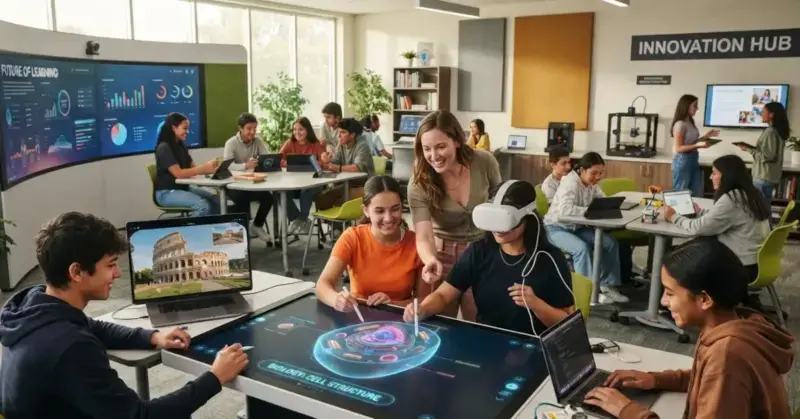
This article examines the reciprocal relationship between innovation and education, with particular attention to innovations in education and teaching as both a product of and a catalyst for societal development.
Drawing on a historical reading of human technological progress, innovations in education and teaching emerge from the accumulated knowledge transmitted through formal and informal learning, while simultaneously reshaping the conditions under which such knowledge is acquired, validated, and applied.
The article concludes by looking into the externalities of technological advancement and by reaffirming the holistic development of the individual as the proper end of educational endeavour.
Introduction
What role does innovation play in advancing education, and how does education, in turn, condition the emergence of innovation?
This question frames the present discussion, which reflects on contemporary technological development and its bearing on humanity’s acquisition of knowledge, together with the outcomes arising from the application of derived innovations. Implicit in this inquiry is a normative concern: whether the path currently pursued remains defensible.
A sustained examination of innovations in education and teaching in general therefore requires not merely descriptive analysis but critical evaluation of direction and purpose.
Let’s look how society changes through time by looking through the phases of human interactions and technological development to address human needs.
Historical Foundations of Societal Change
Contemporary society is the product of evolved responses developed by human beings across long stretches of history.
Human society, in its earliest form, consisted of small groups interacting with one another and with their environment principally to satisfy basic subsistence needs.
From the preoccupation with activities directed toward hunger relief characteristic of early hunting-and-gathering societies — in which humans led nomadic lives — humanity progressed toward self-sufficiency achieved with progressively less effort.
Agricultural production, aided by technology, matured into the complex system observable today. Crude, human-powered technologies advanced into mechanized and automated modes, thereby raising output to levels capable of supplying the growing demand generated by an expanding population.
Essential farming tasks to produce food to support sustained population growth can now be performed by robots (see video below).
The Generative Source of Innovation: Agency and Motivation
What accounts for these transformations occurring in a complex and highly organized collection of people with their respective tools to keep on advancing civilization?
On close inspection, the primary motivation for such change originates within the individuals who constitute society.
The desire to improve one’s circumstances stimulates creativity; the conception of an idea capable of resolving a problem situation may motivate individuals to undertake significant steps beyond the status quo.
These novel ideas that accomplish something are what are conventionally termed innovations. Innovations, so understood, alter the trajectory of individual lives and, cumulatively, of societies.

The Dialectic Between Knowledge and Innovation
Innovations may redirect the course a society takes. Equally important, innovations are themselves shaped by stored knowledge furnished by education or experience.
This bidirectional dependence is precisely what characterizes innovations in education: pedagogical practice supplies the cognitive resources from which new solutions are constructed, while emergent innovations reconfigure the means by which those resources are organized and transmitted.
Based on Gary Oster’s paper, emergent innovation at its simplest form is the practice of identifying, supporting, and scaling useful innovation methods and “small wins” that are already naturally happening inside an organization, rather than forcing new, foreign innovation frameworks from the outside.
The Contemporary Salience of Innovations in Education and Teaching
That education contributes substantially to societal development is well established.
In recent times this contribution has become critically important given the rapid pace of change produced by the information deluge accompanying technologies that connect thought across the globe through computational systems. Information technology has demonstrably influenced the manner in which people construct societies: the exchange of information is now feasible in nearly every region of the world, including areas previously regarded as isolated.
Schools, accordingly, cannot disregard this reality nor abstain from keeping pace with changing conditions. It must adapt.
It is foreseeable that physical presence may no longer be required for the exchange of information between mentor and student. This situation was aptly demonstrated by the application of online learning strategies despite the challenges of modular learning to cope up with the Covid-19 pandemic in 2019.
Institutions of learning no longer monopolize the dissemination of knowledge; rather, knowledge permeates every corner of a nation through internet technology. This diffusion constitutes one of the most consequential dimensions of innovations in education, as authority over information shifts from institutional custodianship toward distributed access.
Critical Concerns: Externalities of Technological Progress
It is for these reasons that serious attention must be directed by schools — as a primary agent of societal change — toward the quality of education imparted to the masses.
Yet, the developmental trajectory presently pursued raises substantive concerns. As society advances, problems multiply; new technologies carry with them externalities that may undermine the very gains they produce. There are unforeseen impacts, to learners as well as teachers or mentors.
Internet access has highlighted unequal access among learners, reduced social interaction between peers, caused lower engagement, among others.
The satisfaction of wants and the pursuit of convenience generate pollution not only in the physical dimension but also in the domain of values and morality.
Here are examples:
Physical dimension
To satisfy the want for instant convenience, we created single-use plastics, fast fashion, and disposable electronics. As a result, our oceans contain microplastics that are harmful not only to wildlife but also to us, human beings.
Although we have landfills to take care of residuals, these modern waste disposal facilities tend to overflow and cannot keep up with tons of wastes generated by a growing population. “Throwaway” culture emerged.
High carbon emissions as a result of high production also threated to worsen climate change. Significant changes in weather has been experienced in the last decade.
Values
Convenience alters what we care about. When everything is available at the click of a button, we lose our capacity for delayed gratification.
Values like patience, perseverance, and sustained effort become compromised because we begin to view any friction or hard work as an inconvenience.
When we get used to treating objects as disposable, that mindset can bleed into how we view people and relationships. We risk treating others transactionally—valuing them only as long as they are useful or convenient to us, and discarding or “canceling” them when they require effort or compromise
Morality: The Out-of-Sight, Out-of-Mind Ethics
The pursuit of convenience often requires us to turn a blind eye to moral responsibilities.
For a consumer to enjoy cheap, convenient goods, someone else usually pays the price. This often involves exploiting underpaid labor in developing nations or stripping natural resources from vulnerable communities.
Moral apathy arises. True morality requires discomfort—standing up for justice, helping those in need, and making personal sacrifices for the greater good.
When a society prioritizes convenience above all else, it becomes morally lazy. People become less willing to engage in the messy, uncomfortable work of civic duty and ethical responsibility.
In short, the statement argues that our obsession with making life easier physically is making us weaker and more selfish ethically. By constantly opting for the path of least resistance, we pollute our environments with trash and our cultures with superficiality and apathy.
Empirically, rising crime rates are frequently correlated with development and urbanization, suggesting that material progress does not automatically translate into moral or social improvement.
Any account of innovations in education that ignores these externalities remains analytically incomplete.
Conclusion
As an empowering resource for individuals, knowledge conveyed through education ought to be provided in a manner that leaves no dimension of human life unaddressed.
Attention must center on the total development of the individual and, derivatively, of society.
Innovations in education and teaching are justified insofar as they serve this end; they lose their essence when they become instruments of mere convenience instead of total human development.
The ultimate objective persists unchanged: to secure human survival and the conditions that make it meaningful.
©Simplyeducate.me | P. A. Regoniel