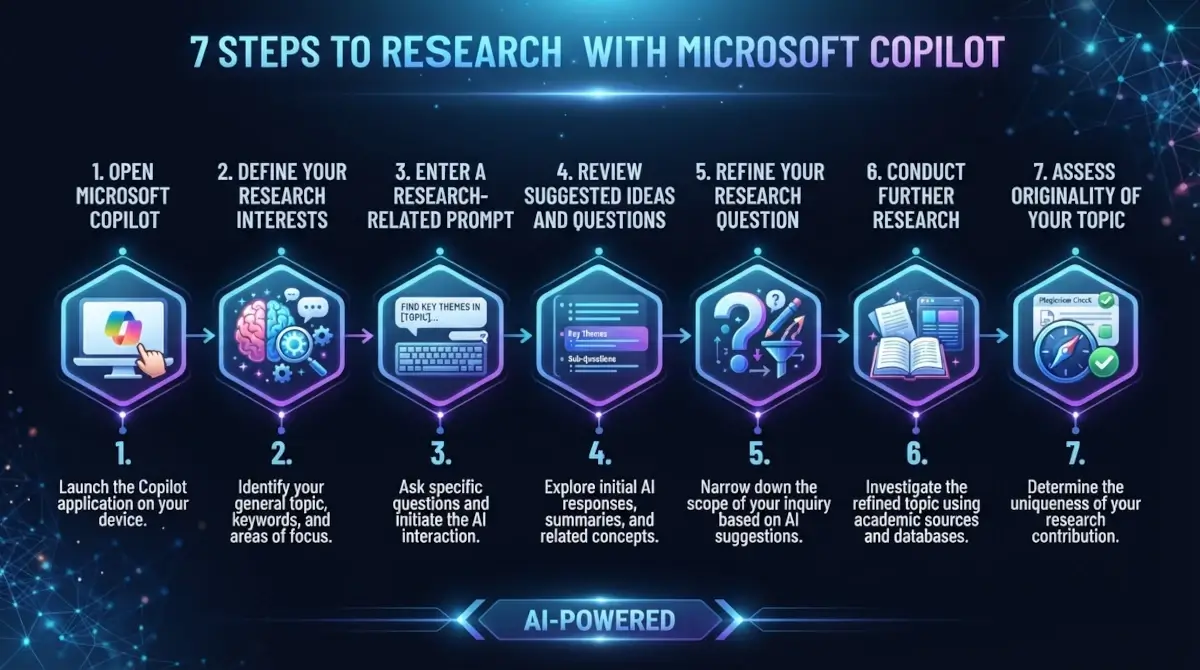
How to make a research question can be challenging, but AI can help. Learn how I used Microsoft Copilot with Bing Chat to develop research questions, narrow my focus, and save valuable research time.
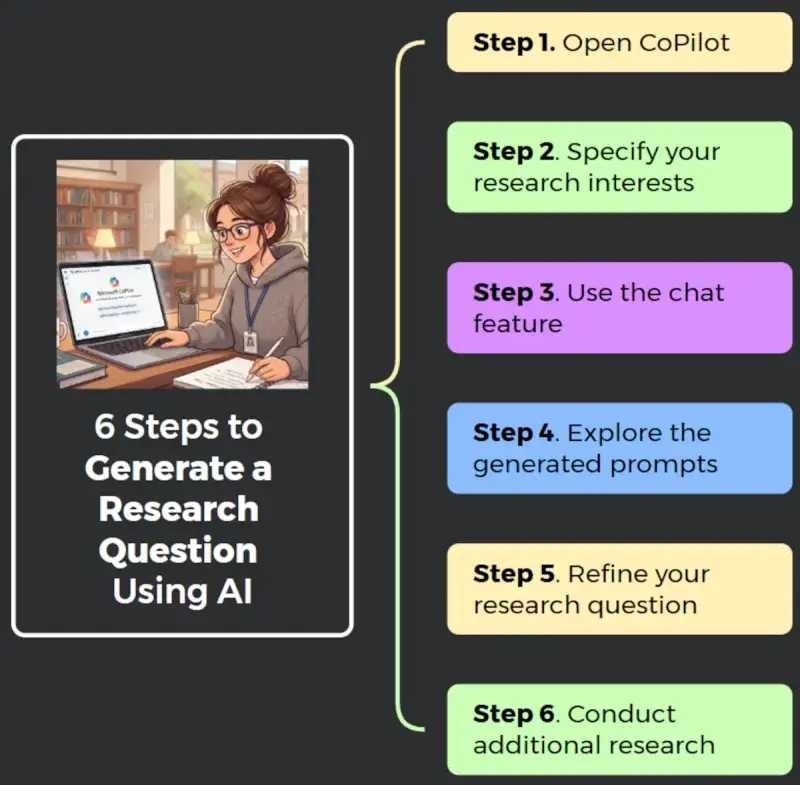
Table of Contents
Introduction
AI technology has revolutionized various aspects of our lives, including the way we conduct research. With the integration of AI in browsers like the free AI-powered chatbot Microsoft CoPilot (formerly Bing Chat), users now have access to a powerful tool that can help them generate research questions.
Both ChatGPT and Microsoft Copilot rely on the foundational GPT (Generative Pre-trained Transformer) large language models developed by OpenAI. This shared foundation enables both AI tools to process natural language effectively, generate contextually relevant responses, and support users in tasks such as writing, research, and problem-solving.

By leveraging the capabilities of AI tools available today, we can receive valuable suggestions for research study topics. AI can also help refine broad ideas into focused, researchable questions, making the topic selection process more efficient and manageable.
Need Inspiration Before Using the Tool?
Before you let AI craft your research question, spark your imagination with a list of ready-to-go subjects you can explore right from your desk. Check out our guide on Research at Home: 11 Research Topics to Get You Started.
Browse Home Research Topics →How to Generate a Research Question by Harnessing the Power of AI
The deployment of artificial intelligence in Microsoft Copilot, alongside large language models like Gemini, Grok, and Claude, allows users to tap into a vast amount of information and knowledge. These AI-powered tools can analyze data, identify patterns, and generate insights that help researchers formulate targeted research questions.
By using AI to make a research question, individuals can save time and effort in the initial stages of their research. Instead of starting from scratch, AI can provide a starting point and guide users towards relevant and interesting research topics.
While it is often beneficial to start with ideas drawn from your own experiences, particularly questions that remain unanswered in your mind, developing those ideas into a clear and researchable topic can be challenging.
Having an assistant to help clarify your thoughts and refine your initial observations can make it easier to formulate an original research question.
Why Original Research Questions?
Why is there a need to do original research?
Developing original research is important because it contributes new knowledge, addresses gaps in existing literature, and provides insights that can advance understanding within a field of study.
However, having an assistant to help clarify and refine those thoughts can be valuable during the initial stages of observation and inquiry.
On this note, I will focus my discussion on Microsoft Copilot, given the current proliferation of AI language models. While these models share a common foundation, they vary significantly in their design and capabilities.
The use of AI in Microsoft Copilot opens up new possibilities for researchers, enabling them to explore a wide range of subjects and make meaningful contributions to their respective fields.
In the following sections, I will provide a step-by-step guide on how to ask Copilot for research topic ideas. We will go through specific topics which we are interested in and would like to pursue.
Let’s discover how AI can assist us on how to develop research questions.
Step-by-Step Guide on How to Make a Research Question Using Microsoft CoPilot
How to Use Microsoft Copilot to Generate Research Topic Ideas
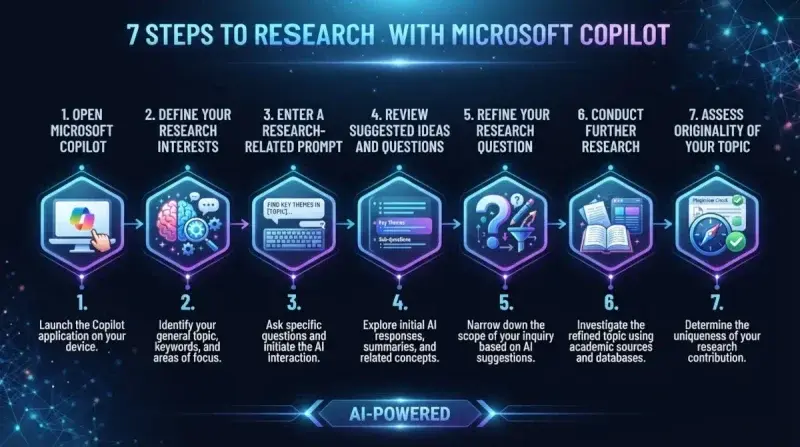
To effectively use Microsoft Copilot for generating research topic ideas and developing a research question, follow these steps:
1. Open Microsoft Copilot
Launch Microsoft Copilot on your device through a web browser, the Copilot app, or Microsoft Edge. Ensure that you have a stable internet connection for the best experience.
2. Define Your Research Interests
Clearly identify the topics or subject areas you would like to explore, such as food security, climate change, or renewable energy. Providing specific areas of interest helps Copilot generate suggestions that are more relevant to your research goals.
Provide a clear and specific prompt, and use a conversation mode that supports detailed reasoning, such as Think Deeper, if available. This can help Microsoft Copilot generate more focused research ideas and provide more thorough explanations.
3. Enter a Research-Related Prompt
Use the chat interface to ask questions about your area of interest. For example:
- What are the current trends in food security research?
- How does climate change affect energy supply?
- What research gaps exist in urban agriculture?
Well-structured prompts provide Copilot with the context needed to generate meaningful research ideas.
4. Review the Suggested Ideas and Questions
Copilot will analyze your prompt and generate potential research topics, questions, and related areas for investigation. Carefully review these suggestions and identify those that align with your academic interests and research objectives.
5. Refine Your Research Question
Evaluate the suggested topics and narrow your focus to a specific and manageable area of study. Consider the significance, originality, feasibility, and potential contribution of each idea before selecting a research question.
6. Conduct Further Research
Once you have identified a promising research question, use Copilot to gather additional background information, explore existing literature, and identify relevant sources. Copilot can help you discover scholarly articles, reports, and other resources that support the development of your study.
7. Assess the Originality of Your Topic
As you refine your research question, ask Copilot to help identify gaps, underexplored issues, or emerging trends within the field. This can increase the likelihood of developing an original research project that contributes new knowledge or perspectives to the existing literature.
By following this step-by-step guide, you can leverage the capabilities of CoPilot with Bing Chat to generate research topic ideas and streamline the initial stages of your research process. With AI as your research assistant, you can save time and effort while exploring a wide range of subjects and making meaningful contributions to your field of study.
Ready to Put Your Research Question Into Action?
You’ve got the tools and the framework—now it’s time to pick your subject. Discover practical, accessible ideas you can pursue right from your desk with our guide on Research at Home: 11 Research Topics to Get You Started.
Explore Home Research Topics →Example Research Questions on 5 Most Pressing Concerns in the World Today
Examples are essential when learning how to write research questions because they demonstrate effective question formulation. By examining examples, researchers can better understand the structure and characteristics of meaningful research inquiries.
Examples also help generate ideas, encourage critical thinking, and provide practical guidance for developing original research questions. They serve as useful reference points that can be adapted to different research topics and objectives.
So here are five of the most pressing concerns in the world today that we can focus our research on. These topics were generated by CoPilot with Bing Chat. Example research questions are given with an explanation after each question emphasizing the importance and purpose of such study.
1. Food Security
- Research Question: How does access to nutritious food impact the overall health and well-being of individuals in low-income communities?
- Importance: Food security is a critical issue that affects millions of people worldwide. This research question aims to explore the relationship between access to nutritious food and the health outcomes of individuals living in low-income communities.
- Purpose: By understanding the importance of food security, we can develop strategies and policies to address this issue and improve the overall well-being of vulnerable populations.
2. Climate Change
- Research Question: What are the long-term effects of rising sea levels on coastal communities and their infrastructure?
- Importance: Climate change poses significant threats to coastal communities, particularly through rising sea levels. This research question seeks to investigate the long-term impacts of these rising sea levels on the infrastructure and livelihoods of coastal communities.
- Purpose: By understanding the importance of this topic, we can develop adaptation and mitigation strategies to protect vulnerable areas and ensure the sustainability of coastal communities.
3. Energy Supply
- Research Question: How can renewable energy sources be effectively integrated into the existing energy grid to reduce reliance on fossil fuels?
- Importance: The transition to renewable energy sources is crucial for addressing climate change and ensuring a sustainable energy future. This research question focuses on exploring the effective integration of renewable energy sources into the existing energy grid.
- Purpose: By understanding the importance of this topic, we can develop strategies and policies to accelerate the adoption of renewable energy and reduce our dependence on fossil fuels.
4. Cost of Living
- Research Question: What are the main factors contributing to the increasing cost of housing in urban areas, and how does it impact the affordability of living?
- Importance: The rising cost of housing in urban areas is a pressing issue that affects the affordability of living for many individuals and families. This research question aims to identify the main factors contributing to this increase and understand its impact on the overall cost of living.
- Purpose: By understanding the importance of this topic, we can develop policies and interventions to address housing affordability and ensure sustainable urban development.
5. Inflation
- Research Question: How does inflation impact the purchasing power of individuals and the overall economy?
- Importance: Inflation is an economic phenomenon that affects the purchasing power of individuals and the stability of the overall economy. This research question seeks to explore the relationship between inflation and its impact on individuals’ ability to afford goods and services.
- Purpose: By understanding the importance of this topic, we can develop strategies and policies to manage inflation and ensure economic stability.
These research questions on food security, climate change, energy supply, cost of living, and inflation highlight the importance of addressing these major phenomena. By investigating these topics, we can gain valuable insights and develop solutions to improve the well-being of individuals, protect the environment, and promote sustainable development.
Conclusion
This article has provided a step-by-step guide on how to develop a research question using Microsoft Copilot. By following these instructions, researchers can effectively leverage AI to generate relevant research topic ideas and streamline the early stages of the research process.
Open Microsoft Copilot, tell it your research interests, and ask questions about your topic. Copilot will then generate relevant ideas, potential research questions, and suggestions for further exploration.
Take some time to look through Copilot’s suggestions and see which ideas stand out. Think about whether they are relevant, original, and worth exploring further. As you narrow your focus, you can refine your research question by considering its importance, feasibility, and potential contribution to the field.
Once you have a research question in mind, Copilot can also help you learn more about the topic, identify research gaps, and find useful sources to support your study.
By using Microsoft Copilot as a research assistant, you can explore different topic ideas, refine your questions, and make more informed decisions throughout the research process. It is a useful tool for generating ideas and guiding you toward meaningful and original research.
Frequently Asked Questions (FAQ)
How to make a research question example?
To make a research question, start with a broad topic and narrow it down to a specific issue that can be investigated. Microsoft Copilot can help by suggesting research ideas, trends, and gaps related to your area of interest.
Example:
Broad Topic: Climate Change
Research Question: How does climate change affect agricultural productivity among smallholder farmers in coastal communities?
You can ask Copilot:
“Suggest research questions about climate change and agriculture.”
It can generate several options that you can refine based on your objectives.
How to make a research question in research paper?
To make a research question for a research paper, first identify your topic of interest, review existing information, and determine a specific issue you want to investigate. Use Microsoft Copilot to explore trends, existing studies, and research gaps in the field.
A good research question should be:
1. Clear and specific
2. Relevant to the study
3. Researchable using available data
4. Significant to the field
For example, instead of asking:
How does social media affect students?
You could ask:
How does daily social media use influence the academic performance of senior high school students?
Copilot can help refine broad questions into more focused and manageable research questions suitable for a research paper.
How to make a research question for students?
Students can create a research question by thinking about topics that interest them, issues they observe in everyday life, or subjects they want to understand better. After selecting a topic, they can use Microsoft Copilot to brainstorm ideas and narrow their focus.
For example:
Topic: Online Learning
Instead of asking:
What is online learning?
A student could ask:
What factors influence student engagement in online learning among high school students?
To get ideas, students can enter prompts such as:
“Suggest research questions about online learning for high school students.”
Copilot can then provide possible topics, research questions, and related areas for further investigation. This makes it easier for students to develop focused, relevant, and original research questions.
Having a research question is only the beginning. To transform your ideas into a coherent study, you need a roadmap that shows how your concepts fit together.
Continue reading to learn how to develop a conceptual framework and strengthen the foundation of your research.
Ready to Build Your Complete Research Blueprint?
Don’t let your variables sit in isolation. Learn conceptual modeling and be prepared to justify your research direction to your defense panel.
Read Our Ultimate Guide to Developing a Conceptual Framework →
©SimplyEducate.me | Patrick A. Regoniel