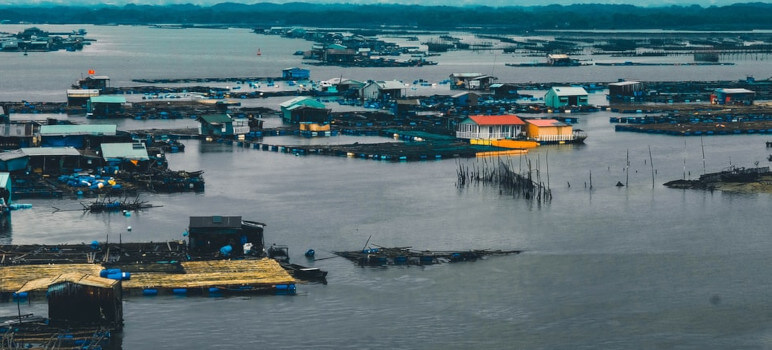
Updated | March 1, 2026
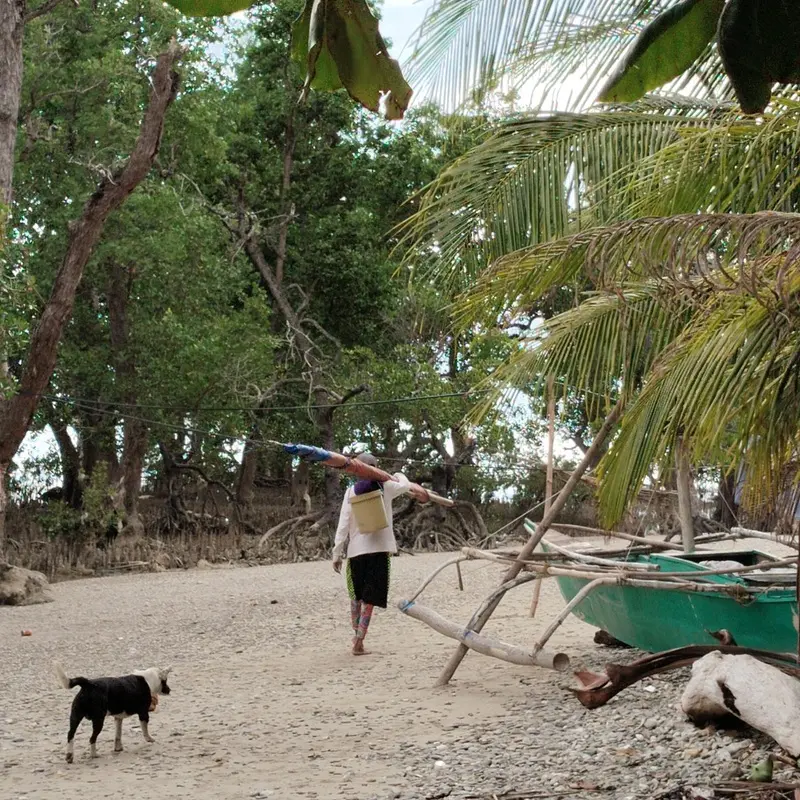
Adaptation to climate change is not just a policy goal—it’s a daily reality for marginalized communities in vulnerable coastal areas facing rising sea levels, storm surges, and erosion.
While the impacts of climate change are widespread, those with limited resources often bear the brunt of its effects.
This article explores real-world adaptation strategies at both the household and government levels, revealing how communities are turning survival into resilience. From flood-resistant homes to community-led early warning systems, discover the innovative, often overlooked solutions that are shaping the future of climate adaptation—and why they matter for everyone.
Table of Contents
One of the interesting aspects of research is discovering something new. Although a phenomenon has been there for a long time, it becomes a relevant point of interest once its occurrence is viewed more keenly and becomes a subject of discussion.
Take for instance the cross-country research our group conducted in 2013 in the coastal areas of the Philippines, Indonesia, and Vietnam to document the effects of climate change. One of those inquired in the investigation looked into the adaptation of marginalized fisherfolks to the hazards brought about by typhoon/flooding, coastal erosion, and saltwater intrusion.
What I found interesting in this climate change study are the unique ways by which marginalized people try to cope up with changes in their environment.
In this particular case that I joined, we investigated the fisherfolks’ adaptation to the erosive effects of waves in the gradually advancing seawater related to the typhoon or flooding hazard concern.
We visited three communities (locally called barangays) to find out if there are any signs of initiatives to mitigate the effects of sea level rise. There, indeed, are several interesting adaptations made by fishers in tropical regions such as the Philippines.
Household Adaptation to Sea Level Rise
Below is a picture of a household adaptation in response to rising sea levels that erode the thin strip of land a few hundred meters wide. A series of temporary and permanent houses dot this habitable portion lying between the sea and the concrete highway running along the irregular coastline.
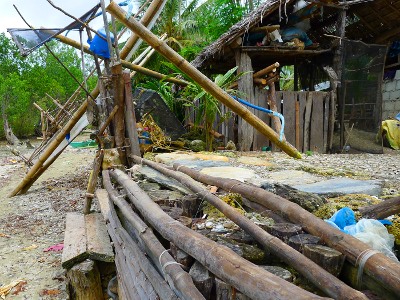
I noticed this ingenious way to keep soil from eroding in the beach of Binduyan, a coastal community lying east of Puerto Princesa on the island of Palawan in the Philippines. The residents find this simple erosion control measure effective in minimizing the effect of rising sea levels to their home. It may be a common sight to the uninitiated, but to someone who does research, this means a lot.
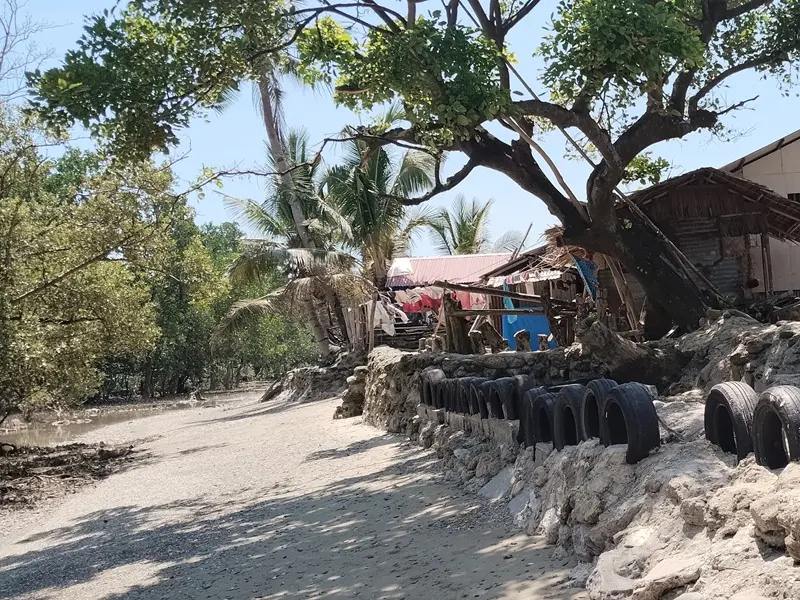
[Note: A visit in the same place on February 28, 2026 revealed that the dwellers have replaced this simple structure with concrete, vehicle tires, and coral stones. The new, much more permanent, concrete structures funded by the households themselves are shown below].
What were the costs involved?
If you consider the time, money (although these materials may have been sourced around), and effort devoted by the person who constructed this structure, you will be able to appreciate the significance of this adaptation to the life of the builder.
Since we are after economic analysis of household adaptations like this, questions like the following arise in my mind:
- How many people were involved in constructing the makeshift seawall?
- How much time did it take them to build such a structure?
- What opportunities did they lose while working on the structure (see opportunity cost to understand how important this concept is)?
- What benefits did the people gain?
- Did the benefits justify the cost of construction, or was it just a waste of time?
Why would this family go to lengths in constructing this makeshift structure made of local materials?
Unfortunately, nobody was there to ask when we passed through as we walked the beach and jot down observations. The owners were out somewhere, probably fishing.
But these questions helped us design our questionnaire as this visit was part of our scoping activity.
We measured the height of the whole structure. It is 1.2 meters high! The following questions come to mind:
- Did seawater rise that high? How many years did it take to reach that level?
- What is the distance of the water’s edge at high tide from this house since people living in the area took notice of the rising waters?
Questions Lead to Discovery and Informed Actions
Many questions arise as a result of this simple observation. If you are an avid researcher, these questions will propel you to undertake research focused on your specific concern to contribute to the body of knowledge.
That, of course, requires publishing your work for others to learn from. Research findings mean nothing if left unpublished. We did publish our findings.
Household Adaptation to Climate Change: Flooding
I could not access the internet for the past two days due to service interruption caused by the strong typhoon code-named ‘Maring,’ and southwest monsoon referred to as ‘Habagat‘ by the locals. The heavy rainfall inundated many parts of northern, central, and southern Luzon in the Philippines, affecting many residents living in those areas. The rising tide and release of impounded water in large hydroelectric dams worsened flooding in areas where the waters flow.
According to the National Disaster Risk Reduction and Management Council (NDRRMC), the calamity affected more than 1.7 million people where 17 died, 41 got injured, and 5 persons were missing[1]. Many of these people stayed in evacuation centers after the raging waters submerged their houses and damaged their belongings.
Significant changes may have been made to mitigate the effects of flooding as the death toll this week is lesser compared to that of Typhoon Ondoy or Ketsana in 2009 that caused the death of more than 300 persons[2].
The people, as well as the government, may have learned to adapt from experience and prepare for such disasters which seem to get worse.
Severe Typhoons that Cause Flooding
Climate change is believed to be the primary cause of typhoon severity in the past few years.
Despite the controversies associated with climate change, I adopt the side of those practicing the precautionary principle, i.e., it is better to adopt a policy that addresses an environmental problem than having to suffer the consequences of not taking action.
Thus, I incorporate climate change in the following subtitles on people and the government’s adaptation to large-scale flooding due to climate change.
While hundreds of people frantically moved to evacuation centers in response to early warnings from NDRRMC, still many others stuck it in their homes. They’re used to these events and undertake measures to adapt and survive. Residents even enjoyed the storms, frolicking, jumping in waist-deep waters, and laughing it out while taking certain precautions by wearing hard hats and life vests.
Of course, their behavior exposes them to yet other dangers such as the following:
1) leptospirosis (a disease caused by water contaminated by excrement of rats or other animals),
2) the possibility of raging waters once the nearby dam releases excess waters in the reservoir, and
3) alienation from nearby food sources if rains continue, exposure to toxic substances that may go with the waters, etc.

Other household adaptations to flooding include adding second floors to homes, modified vehicles, makeshift rafts, thigh-high boots, connected plastic bottles, airbeds deployed as rafts, rubber boats, among others.
Many of these household-level flood adaptations are inexpensive, largely makeshift, or temporary solutions to flooding.
I have not seen a household flooding adaptation in the long-term such as a house on logs I saw many years ago in a periodically flooded marsh of Agusan in Mindanao (video below).
Of course, having a log house in the middle of the city is absurd, but I believe households can figure out long-term solutions to their problems.
Houses built on logs by the Manobos help them cope with flooding at a certain point.
Relocation to elevated areas, after all, appears to be the best thing households can do. That means they will have to forgo their life in the urban centers and live in the hills.
Government Actions to Household Adaptation Failure: Critique and Suggested Solutions
If communities or households cannot effectively adapt to flooding, then the government must take steps to aid its citizens. Disaster relief operations always follow calamities like this. This approach, however, is at best palliative. Prevention is always a better approach than cure.
While flooding is a natural event, the government can still do something about it. It can be avoided or minimized to some extent by good environmental planning and action. Good planning and policy can prevent costly impacts of flooding.
To prevent the costly impact of typhoons, administrators and planners are looking into the contribution of the following factors:
- poor drainage,
- indiscriminate throwing of non-biodegradable wastes,
- buildings that block waterways, and
- corruption.
These problems, discussed in more detail in the next section, compromise effective flood management.
Poor drainage
Planners in government believe that making infrastructures that promote drainage can help alleviate the problem of flooding. Without incorporating ecological principles, however, this may be a hit-and-miss approach.
In reality, there is a limit to what a well-built drainage system can do because Metro Manila was historically a marshland. Flooding is a natural process in wetlands. Cities built on wetlands destroyed a crucial ecological function, i.e., flood control[3]. Nature must take its course, and repeat the same process (i.e., flooding) when loaded with lots of rainfall.
This ecologically problematic situation requires environmental planning where the role of marshlands is recognized, such as clearing the waterways, leaving existing wetlands as they are, or developing subdivisions away from the natural courses of water.
This approach entails much cost, but the benefits exceed the costs. The impact of climate change appears to worsen each year, and investments along this line can prevent future tragedies, that is, if managed properly.
Indiscriminate throwing of wastes that block waterways
Blocked waterways reduce the speed by which water flows to low-level areas. Tons of plastic or non-biodegradable wastes still clog the drains. This situation is made worse by buildings blocking the waterways. In general, many citizens still do not adopt good practices in disposing of their solid wastes, and city zoning policies are ignored.
While an appeal to the public to stop them from throwing wastes indiscriminately may work, economic incentives in the form of fines seem to be a better option. This initiative requires intensive information and dissemination campaign (IEC) that will educate the people about their action’s negative impact to the environment and themselves.
Corruption in Disaster Prevention Projects
Corruption was factored in the flooding prevention equation because a sizable part of the 10 billion pesos in Priority Development Assistance Fund or PDAF (widely know as pork barrel funds) was diverted to questionable projects of non-existent non-government organizations (NGOs). Only a handful of corrupt officials benefited from such allocations through kickbacks and commissions of up to 45%[4]. A large amount of these funds were earmarked to fund flood control projects.
Building massive flood control projects will be very costly if taken as an option. In fact, this has been a subject of recent concern in the country. Flood control projects provided an opportunity for grave corruption in taxpayers’ money with virtually no guarantee to human safety during flooding events.
Flood control projects are repeatedly used as milking cow of corrupt contractors and politicians with impunity. Fund misuse happened in 2013 then came into focus again in 2025.
The government is hot on the heels of the culprits although there are evidences that this corrupt practice among those entrusted with people’s money have been going on for decades despite rules, regulations, and policies that aimed to lower the incidence of this age-old practice.
Corruption has been culturally ingrained and became a ‘normal’ part of people’s lives since time immemorial. Ethics education and anti-corruption training is a must to minimize these practices that have been ingrained in individuals and society in general for years.
A friend and I once brainstormed to find out the underlying cause of corruption. We created a problem tree and arrived at the root cause — GREED.
Thus, the solution to this problem lies at the very foundation of one’s value system. Change must come from within the person.
Conclusion
Successful adaptation to climate change entails effective responses at household or community levels backed by a supportive government. The nature of this adaptation could be short-term or long-term. Well-informed government policies on climate change adaptation strategies appear most critical in providing long-term solutions to avert tragic consequences.
References
1. Reyes-Palanca, Z. (2013, August 23). ‘Maring’ leaves 17 dead, 41 injured. Retrieved August 23, 2013, from http://www.journal.com.ph/index.php/news/top-stories/56739-maring-leaves-17-dead-41-injured
2. Agence France-Presse. (2009, October 9). Death toll from Ondoy rises to 337. Retrieved August 23, 2013, from http://www.abs-cbnnews.com/nation/10/09/09/death-toll-ondoy-rises-337
3. Novitzki, R., Smith, R., and J. D. Fretwell. Wetland functions, values, and assessment. Retrieved August 23, 2013, from http://water.usgs.gov/nwsum/WSP2425/functions.html
4. La Viña, T. (2013, August 6). Investigating the pork barrel scandal. Retrieved August 23, 2013 from http://manilastandardtoday.com/2013/08/06/investigating-the-pork-barrel-scandal/
FAQ: Adaptation to Climate Change
1. What is climate change adaptation?
Climate change adaptation refers to the process of adjusting to actual or expected climate change impacts. It involves actions taken by individuals, communities, governments, and organizations to reduce vulnerability and enhance resilience to climate-related risks such as extreme weather events, rising sea levels, and changing precipitation patterns.
2. Why is climate change adaptation important?
Adaptation is crucial because climate change is already affecting ecosystems, economies, and human well-being. Without adaptation, the negative impacts of climate change—such as food insecurity, water scarcity, and increased health risks—will intensify. Adaptation helps protect lives, livelihoods, and infrastructure, ensuring long-term sustainability and resilience.
3. What are some examples of adaptation strategies for households?
Household adaptation strategies include installing flood barriers, using drought-resistant crops, improving home insulation, and developing emergency preparedness plans. Households can also adopt water-saving practices and invest in renewable energy sources like solar panels.
4. How can governments contribute to climate change adaptation?
Governments play a key role by implementing policies and infrastructure projects that promote resilience. This includes building climate-resilient infrastructure, developing early warning systems for extreme weather, creating land-use planning regulations, and providing financial support for vulnerable communities.
5. What are the challenges of climate change adaptation?
Challenges include limited financial resources, lack of awareness or knowledge about climate risks, and difficulties in coordinating across different levels of government and communities.
Additionally, some adaptation measures may have unintended consequences, such as displacing communities or creating environmental trade-offs.
6. How does adaptation differ from mitigation?
Adaptation focuses on adjusting to the impacts of climate change, while mitigation aims to reduce greenhouse gas emissions to slow or prevent climate change.
For example, building sea walls is adaptation, while switching to renewable energy is mitigation.
7. Can adaptation be effective in all regions?
Adaptation strategies must be tailored to local conditions, as climate impacts vary by region. While some areas may benefit from technological solutions, others may rely on traditional knowledge or community-based approaches. Effectiveness depends on local context, resources, and community engagement.
8. What role do communities play in climate change adaptation?
Communities are essential in identifying local risks and developing context-specific solutions. Their participation ensures that adaptation measures are culturally appropriate and sustainable. Community-led initiatives often lead to more effective and equitable outcomes.
9. How can individuals support climate change adaptation?
Individuals can support adaptation by adopting sustainable practices, such as reducing energy consumption, conserving water, and supporting local resilience efforts. They can also advocate for climate policies and participate in community planning processes.
10. What are the long-term benefits of climate change adaptation?
Long-term benefits include enhanced resilience to climate shocks, improved public health, increased economic stability, and the preservation of natural ecosystems. Adaptation also helps protect vulnerable populations and ensures a more equitable future for all.
© Simplyeducate.me | P. A. Regoniel