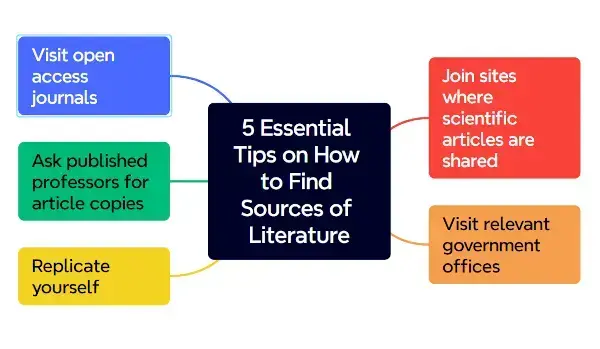
A well-written, comprehensive, and logical literature review demonstrates good scholarship. However, many students struggle with how to find sources of literature when they only have a few articles related to their research topic. How will they approach this problem? Here are five techniques to help you learn how to find sources of literature effectively.
Table of Contents
Introduction
I handled subjects that require intensive gathering of sources of literature for both syllabus preparation and lecture sessions. I was assigned two classes of third-year undergraduate students enrolled in Research 01, many of whom have not had any experience with research in their high school years.
As I introduced the subject, I noticed the confusion in my students’ eyes—many were unsure about how to find sources of literature or how to use them effectively in their work.
To help them, I recommended Simplyeducate.me, a useful site that provides guidance on how to find and use sources of literature in academic research. The students appreciated the opportunity to read content from someone they were familiar with and to ask me directly about their concerns. This helped them avoid spending excessive time searching online for useful ideas for their thesis.
I asked them to identify their research topics, which is not an easy task. It requires a lot of observation and reading to identify what specific topics they are interested in. To help them narrow down their focus, I provided them with the university’s research agenda, which includes sources of literature related to climate change for students in environmental science and alternative medicine to address common ailments for those in biology.
To get a better view of the topics the students are interested in within the research agenda, they should read related sources of literature about those topics.
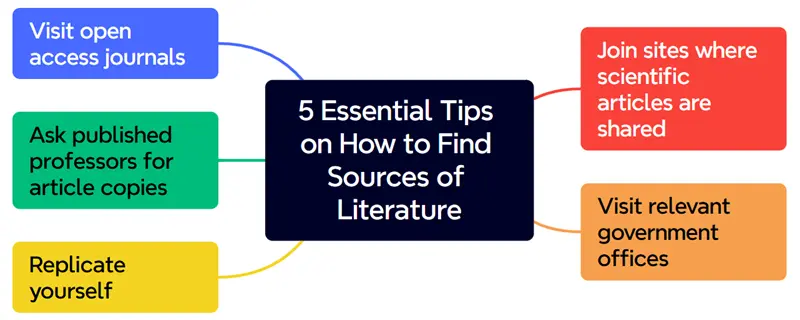
But how should they go about finding these sources of literature? Below are five tips I gave them that proved helpful.
Five Essential Tips on How to Find Sources of Literature
1. Visit open access journals
One of my favorite open access site where I can download literature on many topics in environmental science is www.doaj.org. In this site, there are full papers available for free download. You just need to be patient as you browse the site using your keyword. Elsevier also has a list of open access journals here.
There are many other open access journals if you have the time and the patience to do surfing. While these may be free, you will notice that your choices are limited. And you also need to be aware that there are open access journals which are predatory, meaning, it seeks to exploit or oppress others. Beal provides a comprehensive list of these questionable journals (see Beall’s List). It will always help if you read some reviews before spending your valuable time on those listed, especially if you intend to publish your research output.
If you have no better choice and can spend ample time to look for those articles which you believe can help you develop your research topic, open access journals are the default choice at least for a start. Verify if your library has paid subscriptions to popular scientific journals which offer more choices. This will cut down time for you to be able to understand current research and establish the state of the art.
2. Ask a professor for copies of their article collections
One MS student approached me the other day asking if I have literature on community based resource management. Indeed, her inquiry bore fruit as I subscribe to a biannual environmental science journal. I lent her six issues and she was so grateful for the help.
Don’t hesitate to approach someone who might be working on something similar to your line of interest. Almost always, there’s a pile of literature he can share with you so you can quickly browse the topics.
3. Join sites where scientific articles are shared
One of the growing websites that many scientists join is academia.edu. A colleague reminded me that is a good source of scientific articles, because some generous scientists upload and share their articles for everyone to peek into and possibly include in their list of related literature. You may also write those scientists who might be interested in your proposed investigation.
I uploaded an article in portable document format (PDF) myself and I noticed high traffic on that single article alone. At this writing, academia.edu boasts 299 million+ registered users and 55 million+ uploaded papers.
4. Visit relevant government offices
A trip to government offices who usually have mini-libraries store information on office programs, projects, and activities plus other informative materials for public use can help you enhance the quality of information in your study area’s profile. Statistics on demographics, detailed maps, and recent public service initiatives are commonly found in these offices.
Research is meant to improve the quality of human life, and the government is tasked to provide welfare to the general public. Thus, you can orient your research to address issues and problems that were already identified in such government offices.
If your study is about the environment, then the sensible choice is the environment agency of the government. You can help improve on or enhance current environmental policy using identified issues and concern on the environment as government employees interact directly with local communities. Surely, your research will be appreciated by policy makers.
5. Replicate yourself
Why do the literature by yourself when you can engage the help of others — for a fee, of course. I did this when I was conceptualizing my research topic. I learned that there was a group of graduate students who offered to do the literature review for a fixed rate. They do all the legwork, i.e., scrounging the libraries and finding relevant materials based on my set of keywords and problem statement.
That approach surely saved me a lot of time while I narrow down my research topic using my collection of related literature. The added material will strengthen my arguments and/or redefine the direction of my investigation.
If you prefer to do things online, you can use Google Scholar to find literature relevant to your needs. I provide tips on how to get free copies (in pdf) which can help you save on cost.
Conclusion
Starting research may feel intimidating, but it is also one of the most rewarding parts of your academic journey. Every article you read, every question you ask, and every topic you explore brings you closer to discovering your own voice as a researcher.
The five strategies we discussed—whether it’s diving into open access journals, reaching out to mentors, connecting with fellow scholars online, visiting government offices, or finding creative ways to gather literature—are not just tools, they are stepping stones toward confidence and independence.
Remember, research is not about finding the “perfect” topic right away; it’s about curiosity, persistence, and the courage to keep learning. Each source of literature you uncover is a spark that can inspire new ideas and help you see the bigger picture. With patience and determination, you will not only complete your thesis but also develop skills that will serve you well beyond the classroom.
So take that first step, explore boldly, and trust that the effort you invest today will shape the researcher—and the changemaker—you are becoming.
“The beautiful thing about learning is that no one can take it away from you.” – B.B. King
FAQ: 5 Essential Tips on How to Find Sources of Literature
Q1: How do I start finding sources of literature for my research topic?
Begin with open access journals and Google Scholar using specific keywords. Then refine results by reading abstracts, tracking citations, and saving relevant papers to build a focused reading list.
Q2: What are reliable open access journals I can try first?
Use directories like DOAJ to discover reputable open access journals. Cross-check journals by looking for editorial boards, indexing status, and peer-review policies on their sites.
Q3: How can I avoid predatory journals?
Verify the journal’s indexing (e.g., major databases), peer-review transparency, and publisher reputation. Look for clear editorial policies and realistic review timelines. If in doubt, ask a mentor.
Q4: I’m overwhelmed by too many articles. How do I narrow my topic?
Align your topic with your university’s research agenda and pick one specific problem, context, or population. Use a few guiding keywords and research questions to filter out off-topic papers.
Q5: Is it okay to ask professors for copies of articles?
Yes. Many professors maintain personal collections and can share papers or point you to key sources. Be specific about your topic so they can help efficiently.
Q6: Are platforms like Academia.edu useful for literature?
They can be. Many authors share preprints or postprints. Always confirm the version (preprint vs published) and cite responsibly, prioritizing peer-reviewed sources when possible.
Q7: What can I get from visiting government offices?
Access local statistics, maps, program reports, and policy documents that strengthen your study area’s profile and help identify real-world issues your research can address.
Q8: Can I outsource my literature search?
Yes, if you set clear keywords, scope, and quality standards. Treat outsourced results as a starting point—still read, synthesize, and critically evaluate the sources yourself.
Q9: How do I get full-text PDFs without paying?
Check the article page for open access versions, search Google Scholar’s “all versions,” look for institutional repositories, or email the author for a shared copy.
Q10: What’s the best way to organize what I find?
Use a reference manager (e.g., Zotero or Mendeley), tag by theme, write brief annotations, and keep a living outline that maps sources to your research questions and arguments.
© 2025 SimplyEducate.me | P. A. Regoniel